






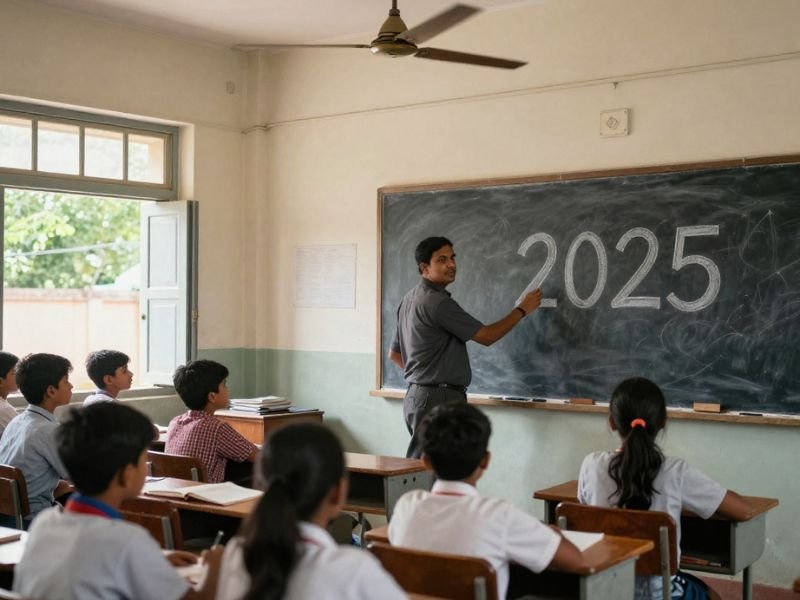
Education sector sees policy reform, AI adoption and focus on student well-being
India’s education sector saw significant policy activity over the year, shaped by legislative reform, the expansion of artificial intelligence in learning, and renewed scrutiny of student well-being.
Five years after the National Education Policy (NEP) was adopted, the Centre moved to convert key proposals into law, advanced examination reforms, and responded to persistent concerns around academic pressure and mental health.
A major development was progress on the Higher Education Commission of India Bill, cleared by the Union Cabinet and renamed the Viksit Bharat Shiksha Adhikshan Bill, 2025. The proposed law, expected to be introduced in Parliament during the winter session, seeks to replace the University Grants Commission, All India Council for Technical Education and National Council for Teacher Education with a single regulator for higher education. The government said the move would streamline regulation and reduce overlap, while critics raised concerns over centralisation and reduced state autonomy.
Examination reform remained a focus across school and higher education. Several universities piloted continuous evaluation, project-based assessment and modular testing aligned with competency-based education. The CBSE introduced twice-a-year board examinations beginning with Class 10, while entrance examinations conducted by the National Testing Agency were revised following recommendations by the Radhakrishnan Committee after alleged paper leaks.
Despite these measures, exam-related stress continued to draw attention. A parliamentary panel announced plans to review the coaching centre ecosystem, and the CBSE stepped up action against so-called dummy schools. Following a series of student suicides, including in Kota and on higher education campuses, the Supreme Court directed that FIRs be registered in suspected cases and constituted a National Task Force to address student mental health. The task force launched a portal and nationwide surveys to identify stress factors and is working towards common mental health policies and trained counsellors on campuses.
Artificial intelligence emerged as a key feature of the year. Higher education institutions adopted AI tools for tutoring, assessment, administration and curriculum design. The Ministry of Education announced a Centre of Excellence in AI for Education in the 2025–26 Union Budget to support teacher training, AI laboratories and industry collaboration. At the school level, AI literacy and computational thinking were introduced into curricula, with NCERT developing frameworks and textbooks for higher classes.
Experts, however, flagged the need to address data privacy, access and academic integrity to ensure the responsible use of AI in education.
Also Read: CBSE withdraws affiliation of Jaipur school after Class 4 student’s death









Add comment