





Karnataka: Rising demand: paltry supply
– Reshma Ravishanker (Bengaluru)
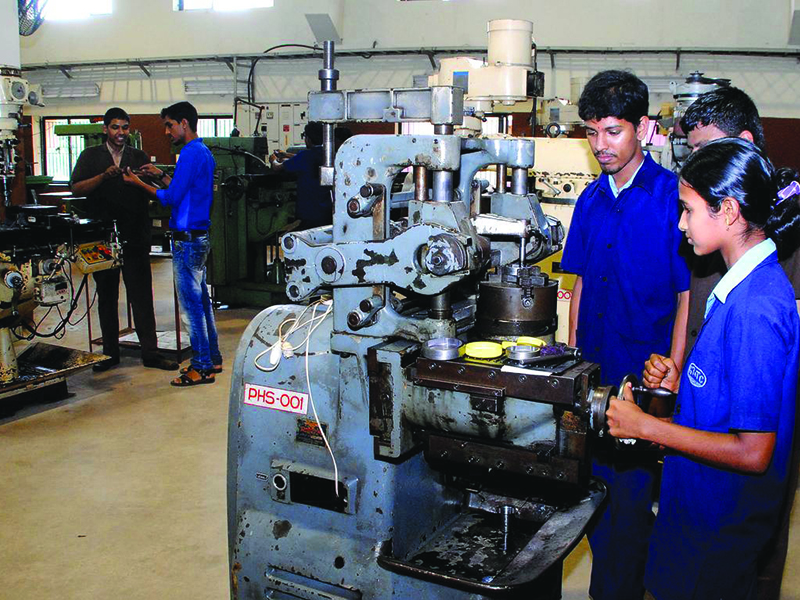
GTTC students: rising demand
With india’s political class — and perhaps dons of the academy — ignorant about the connection between education upgradation and economic development, good news is rare in the education sector. However, a recent initiative of Karnataka’s Congress party government to urgently allocate a sum of Rs.600 crore to establish 10 Government Tool and Training Centres (GTTCs) in quick response to public pressure, is good news of widening awareness of the critical importance of vocational education and training (VET).
GTTCs offer short-term (one-six months) job-oriented diploma courses in dies/tools making, precision manufacturing, mechatronics, AI and machine learning, among other vocations, to class X/XII school-leavers. Official data indicates that enrolment in seven specialised diploma courses, including tool and die making offered by GTTCs is showing steady increase. In 2023-24, total intake of GTTCs was 2,669 and in the following year increased to 5,390. In 2025-26, intake increased to 6,050, indicating steadily rising demand for vocational and technical courses. Sources within the skill development department attribute rising demand for admissions to industry insistence on hiring skilled personnel.
Although a mere 6,050 youth signing up for GTTC courses in Karnataka (pop.69 million) is a drop in the ocean, skill development department officials derive comfort from rising demand for VET. The state’s Skill Development Policy 2025-32 was launched last November to position Karnataka as a “global talent powerhouse”. With a total outlay of Rs.4,432.50 crore, the policy has set a target to train 3 million youth over seven years and mandates integration of vocational education into school curriculums.
The policy also proposes collaboration between industry and business to ensure industry-led curriculum design, trainer support and real-world projects exposure. Currently, the state’s VET sector comprises 1,466 (including 274 government) ITIs, 31 GTTCs, 800 Chief Minister’s Kaushalya Karnataka Yojane (CMKKY) centres and the Skill on Wheels — Kaushalya Ratha program.
Informed educationists welcome this VET drive as vocational education has been a glaring blindspot of successive post-independence governments at the Centre and in the states. As a result a mere 5 percent of India’s workforce has formal skills training qualifications (cf. China’s 26 percent, USA’s 50 percent and South Korea’s 96 percent). Only after dawn of the new millennium, when newly liberalised Indian industry was confronted with stiff competition from imports, that awareness of the vital importance of VET dawned upon the somnolent establishment.
In 2008, the Congress-led UPA government at the Centre promoted the National Skill Development Corporation (NSDC), a unique public-India Inc enterprise to augment the VET efforts of the country’s 14,000 ITIs (Industrial Training Institutes). Subsequently, in 2014, the BJP-led NDA government established the Union ministry of skill development & entrepreneurship and launched the Skill India Mission in 2015. This concerted push by the Centre to revitalise the country’s skills education ecosystem has resonated and found traction in the states, Karnataka included.
To augment overdue public interest in skills education, Prof. A.S. Seetharamu, former professor of education at the Institute of Social & Economic Change, Bengaluru, recommends that VET should be compulsorily introduced in all secondary schools. “The government’s skills development initiatives are encouraging. However, to make a real difference, VET courses should be mandatory for all students in classes IX-XII. Formal training in electronics, tools and dies-making and new fields like computers and AI will not only prepare students for college and university but also prepare school-leavers for gainful employment. Currently, over 15-20 percent of children drop out after classes X-XII. Without VET qualifications they are categorised as unskilled labour. Skill courses should also be offered as electives in BA and B.Sc undergrad degree programmes to make graduates more employable. A system-wide VET drive will do wonders to disseminate economic prosperity,” says Seetharamu.
While the state government’s Skill Development Policy 2025-32 and renewed push to expand capacity in VET are welcome, it has to pedal much harder to achieve scale. The past track record of the state government in skills education has been poor. The state’s 1,466 ITIs graduate a mere 1.5 lakh students annually and the 800 accredited CMKKY centres statewide have trained a mere 135,263 youth since 2017-18.
Achieving the policy’s target of skilling 3 million youth by 2032 will require VET to be provided in mission mode and, importantly, a substantial increase in the government’s budgetary allocation for skills development. While the state government had announced an outlay of Rs.4,432.50 crore over seven years for its Skill Development Policy 2025-32, i.e, Rs.633.20 crore per year, in the state Budget 2026-27 presentation, chief (and finance) minister Siddaramaiah allocated Rs.1,386 crore over five years for skill development i.e, a paltry Rs.277.20 crore per year. That’s not even half of what was promised, let alone required.










Add comment