






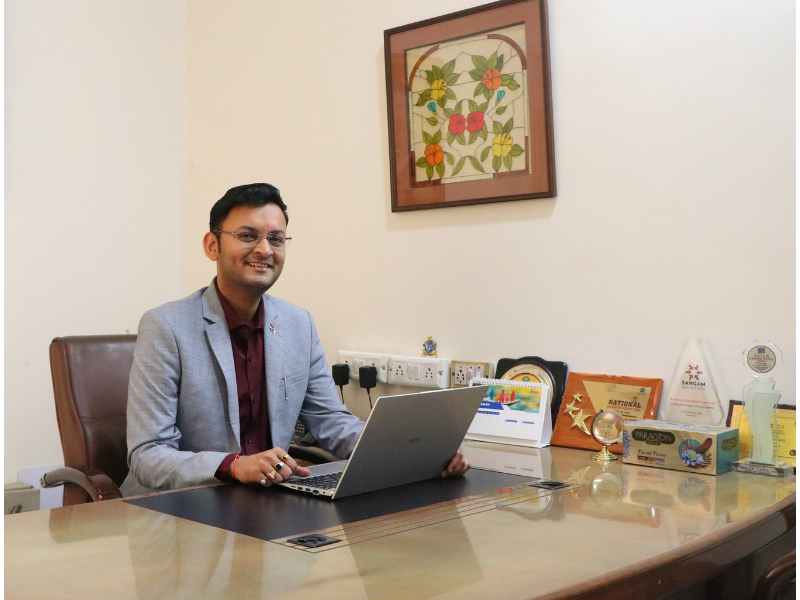
The shift toward industry-integrated and skill-driven management education
– Dr. Shrajal Gupta, Assistant Professor at JIMS
Management education has evolved significantly over time. In the past, it was primarily confined within the walls of the classroom, where aspiring managers were exposed to curated theories and neatly outlined problems. Learning progressed through a structured cycle of lectures, discussions, and assessments, which strengthened their conceptual understanding.
While this approach built a strong foundational knowledge, it often remained detached from the unpredictability and dynamism of real-world business environments. However, in the present scenario, this distance between classroom learning and practical business applications is rapidly narrowing. Students now find themselves actively engaged in live projects, participating in simulations, and interacting directly with industry professionals.
This transition is not incidental, but rather driven by the changing nature of the modern work landscape. Contemporary organizations operate in a state of constant change, necessitating swift, data-informed, and collaborative decision-making. These expectations surpass the scope of traditional teaching methods. As employers increasingly prioritize applied skills alongside theoretical understanding, business schools are compelled to rethink their approaches, with a greater emphasis on experiential learning and integration with industry from the outset.
From Curriculum Completion to Capability Building
Today’s transformation in management education is not limited to pedagogy; it is fundamentally structural. Conventional models focused primarily on content delivery and examination-based assessments, where achievement was defined by test performance. However, this approach is often disconnected from workplace expectations. According to the World Economic Forum’s Future of Jobs Report, critical skills for 2027 include analytical and creative thinking, AI, big data, leadership, and lifelong learning. These abilities require more than theoretical instruction. Consequently, management education is shifting toward application-oriented learning. Curricula are being restructured to prioritize digital fluency, critical thinking, and decision science, ensuring graduates meet emerging industry demands.
Industry Integration as the New Academic Core
Modern management education puts capability-building first by weaving industry engagement into the curriculum. Beyond the classroom, students engage in live projects, simulations, and industry-led workshops to tackle genuine business hurdles. Mentorship from seasoned practitioners adds a layer of practical wisdom that textbooks lack, helping students grasp the nuances of the field. Through this immersion, students witness firsthand how constraints and trade-offs dictate decisions in finance, marketing, and operations. By combining certifications with hands-on projects, these programs turn abstract theories into actionable, professional expertise.
Skill-Based Learning as a Differentiator
Apart from industry integration, skill-based learning is redefining the core of management education. The emphasis is shifting from knowledge retention to demonstrable capability. Management students are being trained in practical competencies. These include data interpretation, decision-making, communication and strategic thinking through simulations, case analysis, and experiential assignments. Rather than relying solely on theoretical evaluation, learning is structured around application and execution.
Moreover, soft skills have now taken centre stage. Communication, emotional intelligence, teamwork and adaptability are critical in organisations that operate across functions and geographies. These skills are woven into daily learning by means of presentations, leadership workshops, collaborative projects, and peer-led activities. Consequently, students develop confidence and practical readiness; they become capable enough to understand ambiguity, engage with stakeholders and contribute meaningfully from day one.
Technology and Data Reshaping Learning
The adoption of technology is rapidly driving this shift forward. AI, machine learning and data analytics are becoming foundational elements of management education rather than specialised domains. Further, students nowadays are being exposed to AI-enabled tools and data-driven decision-making frameworks across functions like marketing, finance and supply chain.
This makes it certain that they are not only familiar with emerging technologies but are also able to apply them in business contexts. Blended and hybrid learning models are further enhancing this shift, combining digital access with experiential, in-person engagement. This develops a more flexible and continuous learning environment while also enabling exposure to interdisciplinary domains like logistics, operations and digital business.
The Next Shift in Management Education
With India continuing as one of the fastest-growing major economies, the demand for competent managerial talent is poised to increase dramatically. The Indian management education sector itself is projected to reach USD 19.13 billion by 2033, increasing the responsibility on business schools to prepare graduates who are immediately capable of contributing to real-world business challenges. Contemporary management education is responding with a more expansive and applied approach.
Global immersion programs, international collaborations plus cross-cultural experiences increase perspectives. On the other hand, entrepreneurship initiatives supported by incubation, mentorship and startup exposure foster innovation and practical problem-solving. Ethics, sustainability, and value-driven learning prepare students to make responsible decisions, while research-led inquiry strengthens analytical and adaptive thinking. All in all, future-ready management education will be featured by immersive, industry-integrated and interdisciplinary learning. Focus on AI, digital capabilities, leadership and critical thinking ensures graduates are prepared to tackle complicated business environments. Ultimately, success will be determined not by the credentials conferred but by graduates’ capacity to adapt, perform, innovate, and lead, reshaping the purpose and promise of modern management education.
Also Read: Experiential Learning in the AI Era: Ensuring Authenticity in India’s Digital Classrooms











Add comment