






Delhi: Accountability deficit outcome
– Autar Nehru (Delhi)
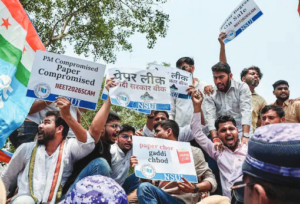
NEET-UG protest in Delhi: nationwide indignation.
Two years ago, the supreme Court cancelled the National Eligibility-cum-Entrance Test — Undergraduate (NEET-UG 2024) after it came to light that 1,563 candidates were given ‘grace marks’ for alleged loss of exam time and allegations of paper leaks in Patna and Hazaribagh were confirmed by a CBI probe. In that test, centralised in 2016 which determines admissions into 824 medical and 330 dental colleges countrywide, a record 67 candidates attained the maximum score of 720. Under the Supreme Court order, the National Testing Agency (NTA) cancelled the grace marks and offered a re-test to the 1,563 candidates.
The apex court observed that while irregularities had occurred, there was insufficient evidence of a systemic compromise affecting the entire exam and therefore allowed the results (with corrections) to stand rather than ordering a nationwide re-test. The attendant furore led to appointment of a Dr. K. Radhakrishnan Committee to assess the NTA’s NEET exam process and make reform recommendations. The Radhakrishnan Committee submitted its report making 101 recommendations in October 2024 of which 94 percent were partially implemented for NEET-UG 2025, although some allegations of malpractice, question paper ambiguities and operational glitches persisted at lower levels.
However, NEET-UG 2026, conducted on May 3 across 5,400 centres in over 550 cities for 2.27 million candidates vying for 1.3 lakh MBBS medical college seats, was cancelled by NTA on May 12 after complaints of a question paper leak were verified.
The exam cancellation triggered outrage among students and households countrywide with media graphically highlighting the psychological and academic costs of NTA’s repeated failure to protect the credibility of this high-stakes examination. Reports of at least three student suicides linked to cancellation of NEET-UG 2026 fanned the fires of national indignation and beamed a harsh spotlight on the BJP/NDA government’s penchant for centralising higher education entrance exams. CUET (Common University Entrance Test) for admission into 56 Central government universities was introduced in 2022 and NEET-UG in 2016 — both are conducted by the Central government’s NTA (estb.2017).
Shaken by these high-stakes centralised exam scandals, the BJP/NDA government has ordered an investigation by the Central Bureau of Investigation (CBI). The agency has already arrested 13 individuals in connection with the paper leak. NEET-UG 2026 re-examination has now been scheduled for June 21.
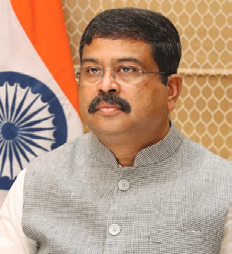
Dharmendra Pradhan
These successive NEET-UG scandals which have erupted coterminously with an OSM (On Screen Marking) mess of class XII exam papers of the Central Board of Secondary Education (CBSE), which has several of India’s top-ranked primary-secondary schools affiliated with it, have cast a harsh spotlight on Union education minister Dharmendra Pradhan, whose centralisation philosophy is in inverse proportion to his debate and communication strategy. Despite EducationWorld having emerged as India’s premier education focused news publication over the past 26 years with a transnational reputation, since his appointment in Shastri Bhavan, Delhi, in 2021, Pradhan has adamantly declined your editor’s repeated requests for access to discuss critical education policy diktats shaping the lives of 300 million children and youth in education institutions countrywide. Access/interviews are given solely to mainstream media with negligible domain knowledge.
Unsurprisingly, demands for Pradhan’s resignation are growing louder. A CVoter-India Today poll of youth between 18-25 age indicates that over 51 percent of them hold him responsible for NTA’s repeated failures to conduct fair and trusted examinations. Pressure on Pradhan to quit is particularly acute because, following the NEET-UG 2024 scandal, he had publicly assured students that corrective measures would ensure a secure and credible examination process. The recurrence of the NEET-UG scandal two years later has revived questions about his competence to manage this critical ministry, particularly since the ministry failed to transition the annual NEET-UG to a computer-based testing (CBT) format. Now, spurred by the latest controversy, the minister has announced his intention to introduce CBT for NEET-UG 2027.
The political consequences of recurring exams scandals are likely to endure well beyond the NEET-UG re-exam on June 21. The opposition’s aggressive criticism of government on this issue has resonated widely because it cuts across class, region, and political affiliation. Millions of households invest years of effort and substantial financial resources in preparing students for NEET, which makes perceived compromise of fairness highly damaging. The controversy has, therefore, transformed from an administrative failure into a broader question of accountability and public trust in institutions established by the BJP/NDA government.









Add comment