





Andhra Pradesh: Weak foundation
– Priyanka Edupugant (Hyderabad)
Andhra pradesh has taken a decisive lead in India’s AI and digital infrastructure development race with the state government approving Reliance Industries’ proposed Rs.1.08 lakh crore AI data centre project near Visakhapatnam and Bhogapuram. The project was formally cleared on May 20 by the State Investment Promotion Board (SIPB), chaired by Chief Minister N. Chandrababu Naidu, as a component of the TDP government’s larger strategy to position Visakhapatnam, aka Vizag, as a global technology and cloud infrastructure hub. The proposed facility, which will sprawl across nearly 855 acres in the Vizianagaram-Bhogapuram corridor, will be one of India’s largest AI-focused hyperscale data centre ecosystems
Since Telugu Desam Party (TDP) chief minister N. Chandrababu Naidu was returned to power two years ago, the Andhra Pradesh government has rolled out a series of investor-friendly IT, Global Capability Centre (GCC), electronics, semiconductor, and data centre policies devised to attract large-scale technology projects into the state. Government officials repeatedly stress that Visakhapatnam — rather than new admin capital Amaravati — will be Andhra Pradesh’s “digital growth engine,” and emerge as a global AI and cloud infrastructure hub on India’s east coast.
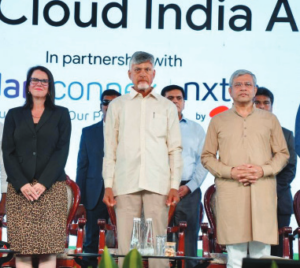
Chandrababu Naidu (centre): business-savvy
Just weeks before the Reliance announcement, Naidu, Union IT minister Ashwini Vaishnaw, and Andhra Pradesh IT minister Nara Lokesh jointly laid the foundation stone for Google’s $15 billion (Rs.1.43 lakh crore) AI data centre hub in Vizag, being developed in partnership with AdaniConneX and Airtel Nxtra. This is Google’s largest AI infrastructure investment in India and one of the largest outside the United States.
Together, these initiatives represent Naidu’s determined attempt to replicate his sterling performance as three-term chief minister of undivided Andhra Pradesh (in 2014 the state was partitioned into Andhra Pradesh (pop.53 million) and Telangana (35 million)). As chief minister of undivided AP, Naidu transformed Hyderabad into a global IT hub and positioned it into a credible alternative to Bengaluru, widely acclaimed as India’s Silicon Valley, attracting almost all of America’s top ICT (information communication technology) transnational corporations to establish large back offices. An unusually business savvy politician, Naidu has repeatedly stated that technology-led development is essential for reversing migration, generating youth employment and rebuilding Andhra Pradesh’s post-bifurcation economy.
Yet a rising number of monitors of AP’s fast-track economy (annual GSDP growth 8.2 percent) question whether AP’s education and human capital development ecosystem can keep pace with the scale of its economic development aspirations.
While the government is speaking the language of AI, cloud computing, and hyperscale digital infrastructure, too many of the state’s K-12 schools are struggling with poor learning outcomes, outdated pedagogies, and dropouts. Industry leaders now require graduates skilled in AI tools, cybersecurity, cloud technologies, systems thinking, automation, and interdisciplinary problem-solving. However, much of India’s education system — including Andhra Pradesh’s — still remains exams-driven and theory based.
According to the Annual Status of Education Report (ASER) 2024 published by the highly respected independent Pratham Education Foundation (estb.1994), only 50.8 percent of class VII children in rural AP can read class II texts and a mere 48.5 percent can solve simple division sums. These are strikingly low learning outcomes for a state that has a national reputation for producing large numbers of engineering, medical and technology graduates.
In his previous terms as CM of undivided AP, Naidu was successful because urban AP, especially Hyderabad, which has a large number of top-ranked private schools and higher education institutions, was positioned to attract ICT multinationals to set up shop in the erstwhile city of pearls. Since Hyderabad has been gifted to Telangana, this precondition may not apply to Andhra Pradesh.
Critics caution against overdependence on headline investment announcements without development of the education ecosystem. India has experienced several ambitious “next Silicon Valley” narratives over the past two decades that failed to realise their promise because of under-qualified human capital, and insufficient industry-academia collaboration.
“As Andhra Pradesh positions itself to become a leader in AI, quantum technologies, and the digital economy, it is important that school education evolves in parallel. Future-ready skills such as computational thinking, coding, artificial intelligence, and problem-solving should not be introduced after students reach higher education, but must form part of their learning journey from early age. This will ensure that the state’s hi-tech ambitions are supported by a strong talent pipeline and innovation-driven culture,” warns Dr. P. Nagabhushan, former Director of the Indian Institute of Information Technology, Allahabad and currently vice chancellor, Vignan’s Foundation for Science, Technology & Research Deemed-to-be University, Hyderabad.









Add comment