




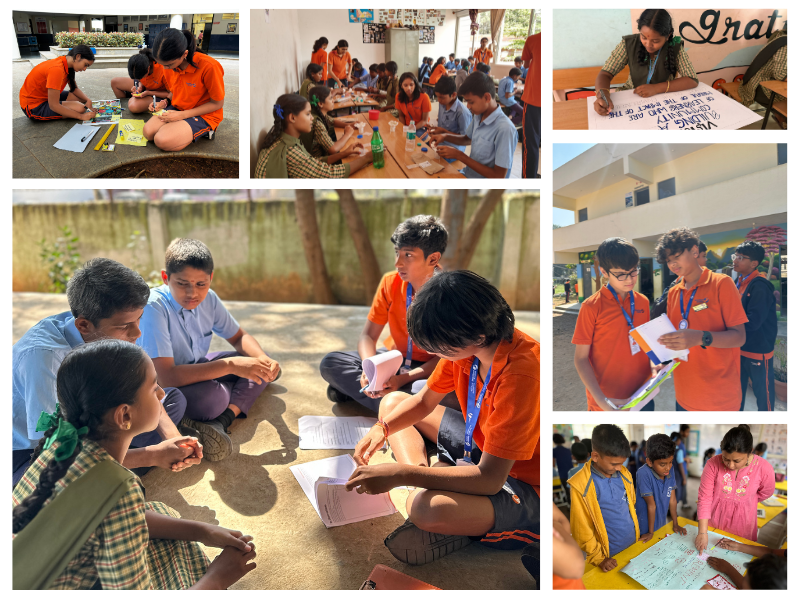
Inventure Academy: Preparing Young People to Shape the World Around Them Through Student Voice
At some point, many schools began speaking about “student voice” as though it were an innovation. In reality, children and young people have always had opinions, perspectives, anxieties, questions, and ideas about the world around them. The real question is whether schools are willing to create environments where those voices are genuinely heard, challenged, refined, and acted upon, and why should they?
For decades, schools have largely been organised around instruction. Adults decide what matters, adults design the systems, adults ask the questions, and students learn to respond correctly. That model may have worked for a more predictable world, but it didn’t serve all children well, and even then, it ran counter to what we knew about how children actually learn. The world young people are growing into today is anything but predictable.
Students are inheriting enormous and deeply interconnected opportunities: climate change, misinformation, technological disruption, social fragmentation, questions around identity and wellbeing, and widening inequality. At the same time, they are more aware, more connected, and often more socially conscious than previous generations at the same age. Yet many schools still position students primarily as recipients of learning rather than participants in shaping the world around them.
Student agency and voice
This is where the conversation around student agency and voice becomes important. Not as an educational trend or a school marketing phrase, but as a fundamental shift in how we think about young people and the kind of education they need.
When students are trusted with responsibility, invited into meaningful dialogue, encouraged to question systems, and given opportunities to engage with real-world problems, something powerful happens. They stop seeing learning as something external being done to them. They begin to see themselves as capable contributors who can influence people, communities, and ideas.
Over the years, I have increasingly come to believe that one of the greatest mistakes adults make is underestimating the depth of thought young people are capable of when we genuinely listen to them.
Some of the most thoughtful conversations I have had about safety, sustainability, education, and well-being have come from students. Not because they always have perfect answers, but because they ask relevant questions, aimed at finding solutions. Questions adults sometimes avoid because they are uncomfortable, inconvenient, or difficult to solve.
During one of our student-led mobility initiatives, a student reflected, “If we unite students, teachers, parents, newspapers, everybody together, I think we can solve this issue, whether it’s coordinating bus timings between schools or actually going and fixing the potholes ourselves as students.” What struck me was not the proposed solution itself, but the instinct to see civic problems as shared responsibilities rather than someone else’s job to solve.
The “Our Voice” projects
At Inventure Academy, this belief has shaped several long-term student-led initiatives over the years through what we call the “Our Voice” projects.
Our Lakes, Our Voice
Our Lakes, Our Voice engaged students in understanding Bengaluru’s lake ecosystems, water sustainability, and environmental citizenship through research, fieldwork, testing, and community engagement. As one student observed, “We study chemistry and biology in the lab, but we don’t always know how to apply it to the lakes around us.” The project challenged students to connect classroom learning with the environmental realities of the city they inhabit. And what began as environmental learning evolved into something much larger: students recognising that civic participation and ecological responsibility are deeply connected.
Our Safety, Our Voice
Similarly, Our Safety, Our Voice brought students into conversations around child safety, well-being, and protection, contributing perspectives that informed broader conversations around child protection policy in Karnataka.
Our Future, Our Voice
During the development of the National Education Policy, Our Future, Our Voice created spaces for students to discuss and debate questions around the future of learning itself.
Our Mobility, Our Voice
More recently, Our Mobility, Our Voice encouraged students to engage with questions around urban mobility, commuting, road safety, and access within rapidly changing cities.
Developing agency and responsibility
What has consistently stood out through these experiences is not simply the quality of student ideas, but the transformation in how students begin to see themselves.
One alumnus later reflected, “There’s so much scope for students like us to take everything for granted. But that’s no longer possible. We have a responsibility to the world we live in.” For me, that captures the deeper purpose of student voice. Not simply participation, but the development of agency, responsibility, and a belief that one’s actions matter.
When young people realise their observations can contribute to larger conversations, learning becomes more purposeful. Research becomes more rigorous because it matters. Communication becomes sharper because there is a real audience. Collaboration becomes more meaningful because the work extends beyond grades and assessments.
Agency requires guidance
Importantly, student agency is not about abandoning structure or allowing schools to become entirely student-directed spaces. Young people still need mentorship, challenge, guidance, and strong adult role models. Agency grows best when freedom is balanced with accountability, reflection, and intellectual discipline.
There is also a difference between performative leadership and authentic agency. Schools today often create student councils, leadership badges, and feedback mechanisms, but students quickly recognise when participation is symbolic rather than meaningful. Real student voice requires adults to genuinely listen, to sometimes be challenged, and occasionally to rethink their own assumptions.
Preparing students to shape the world
If education is truly about preparing children for life, then students must experience what it means to participate in shaping the world while they are still in school, not only after they leave it.
Because ultimately, student co-agency is not about making children feel important. It is about helping them understand that they already have the capacity to create a positive impact in the world around them.
Also Read: Inventure Academy shortlisted among world’s top 10 schools for community collaboration








Add comment