






Delhi: Education belatedly on Gen Z radar
– Autar Nehru (Delhi)
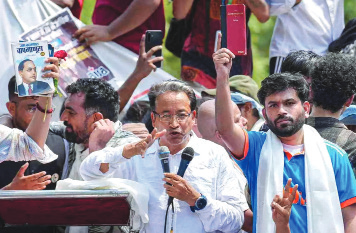
Wangchuk (left) & CJP’s Dipke: national political issue
For years, repeated allegations of question paper leaks (90 since 2000), irregularities in teacher recruitment tests, delays in examinations and chronic scarcity of capacity in professional education institutions and government jobs have steadily eroded the confidence of millions of young people and students scrambling to enter India’s too-few higher education institutions. But this year, the question paper leak of the single three-hours duration National Eligibility-cum-Entrance Test-Undergraduate (NEET-UG) — a high stakes exam that determines admission of 130,000 school-leavers into the country’s 823 medical and 330 dental colleges — written on May 3 by 2.2 million higher secondary school-leavers, proved to be a tipping point. It became a spark that lit accumulated anger into one of the largest youth-led protests in recent times, turning public examinations integrity into a national political issue that has shaken the BJP/NDA government firmly ruling at the Centre since 2014.
On July 25, Union education minister Dharmendra Pradhan resigned after a 36-day standoff with protesters, becoming the first Cabinet minister to quit under public pressure during Prime Minister Narendra Modi’s continuous premiership of 13 years.
“Never in these 13 years has Modi’s governance been so actively delegitimised. The young are searching for a new political grammar rooted in democracy and accountability. Education reform is the rallying cry. The failures of education are not entirely this government’s making, but it drove in the final nail by placing the education system in service of the Hindu nationalist project: rewriting school curricula, making political appointments, overcentralising and defunding higher education,” writes Yamini Aiyar, currently Professor of the Practice of Public Policy at America’s high-ranked Brown University’s Watson Institute for International and Public Affairs in the US-based Time magazine (July 29).
Although NEET-UG 2026 was cancelled and rewritten on June 21, cancellation of this high-stakes exam written by 2.2 million high school-leavers who had lived laborious days and nights preparing for it, caused nationwide dismay and four students committed suicide, horrified at the prospect of rewriting this arduous high-stakes exam.
Typically the BJP/NDA government’s initial response to rising student anger over the NEET exam paper leak was to turn a deaf ear to this evidently inside job and student suicides. Remarkably, this swell of students’ anger was seized upon by Abhijit Dipke, a public relations student in distant Boston, USA who appropriating an ill-advised remark by Chief Justice Surya Kant equating unemployed youth with “cockroaches and parasites”, launched the Cockroach Janata Party (CJP) as a “youth pressure group” on Instagram. Within two weeks of May, CJP attracted 24 million ‘likes’ and followers on the online platform.
On June 6, Dipke landed at Delhi airport clutching a copy of the Constitution and Dr. B.R. Ambedkar’s biography and proceeded directly to Jantar Mantar — a designated protest site in Delhi — to lead CJP’s first public protest demanding Union education minister Dharmendra Pradhan’s resignation because of the NEET-UG and CBSE’s OSM (on screen marking) exams mismanagement. CJP’s sit-in protest attracted an unusual coalition of students, parents, activists, artists, political leaders and public intellectuals, including the highly respected Leh (Ladakh)-based education reformer and climate activist Sonam Wangchuk.
On June 28, Wangchuk joined the CJP protest at Jantar Mantar and undertook a fast until Pradhan resigned. For 20 days during which Wangchuk’s weight declined by 10 kg, the government was indifferent. On July 18, he was forcibly bundled into white sheets and taken to the government-run Safdarjung Hospital and kept under observation — adamantly refusing intravenous drips.
Meanwhile on July 20 when the number of protesters at Jantar Mantar swelled to over 100,000 and an estimated 15,000 broke away to march to Parliament to register their protest, the students march was met with brutal police and paramilitary violence that shocked the nation. Student protesters and civil rights activists suffered excessive use of force, including pellet guns, tear-gas shells and lathi charges, allegedly with batons fitted with protruding nails. The images and accounts of excessive police and paramilitary violence circulating on social media generated widespread anger and significantly amplified public support for the agitation. For the first time during its 13 years in office, the Modi government appeared politically vulnerable before a youth-led movement that has extended beyond exam reforms.
The protests were called off by the CJP after Pradhan finally resigned on July 25 stating that he didn’t “want anti-national forces to take advantage of this situation.”
Insightful analysts of India’s garbled political economy say the CJP movement may well prove to be an inflection point in new millennium politics. “The resignation of Dharmendra Pradhan unleashes two dynamics. The farmers’ agitation had made the government withdraw legislation. But this is the first time that the government has acknowledged the need for taking responsibility and being held accountable. Responsibility and accountability had disappeared from our political lexicon,” writes public intellectual Pratap Bhanu Mehta in a scathing essay titled ‘Cockroaches have taught us what it means to be courageous citizens — not subjects’ in the Indian Express (July 27).
Meanwhile an uneasy peace has settled over Delhi with an argument breaking out whether an amnesty granted to protesting students — a precondition of CJP suspending the protest — also covered non-student criminals who had infiltrated the protest movement, and compensation for police personnel injured during the violence. Prime Minister Modi has made broadcasts on social media to smooth the feathers of the students’ community and “forgived” them for abusing him.
These broadcasts have been pilloried by opposition parties — demanding accountability for police violence from Union home minister Amit Shah — as hypocritical, and with sullen silence by CJP leaders. Belatedly and suddenly Gen Z has become aware that the big issue is not exam reforms, but reform of the archaic education system that has neglected to prepare the world’s largest child and youth population for the changing world and workplaces.








Add comment