






Don’t let AI do our children’s thinking for them
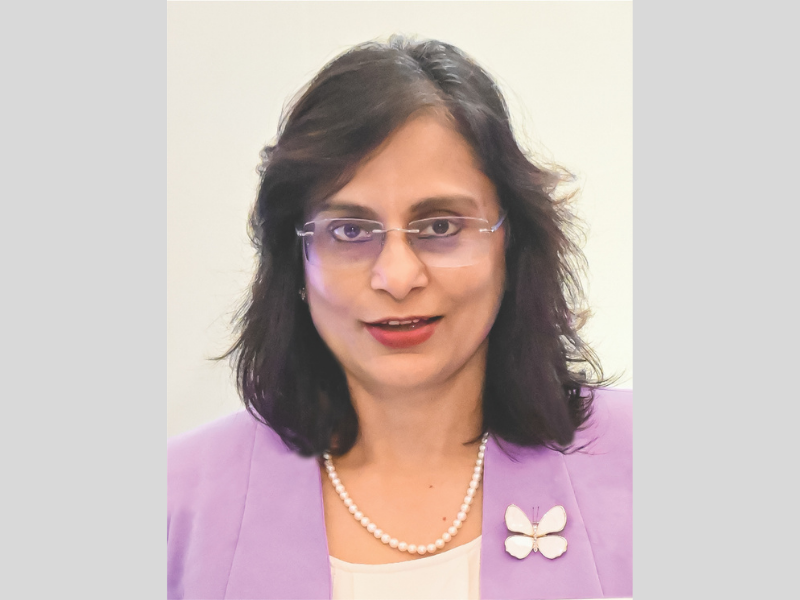
– Dr Bindu Hari, Vice-Chairperson of The International School Bangalore (TISB), National Public School (NPS) and National Academy for Learning (NAFL)
India is about to put AI tools in front of eight-year-olds. The implications deserve far greater scrutiny than they currently receive.
Starting in the 2026-27 academic year, the Central Board of Secondary Education (CBSE) and the National Council of Educational Research and Training (NCERT) plan to introduce artificial intelligence and computational thinking in classrooms from Class 3.
Eight-year-olds who are still learning to read fluently and hold a pencil steadily will be given tools that can write their sentences, solve their equations and answer their questions before they have had an opportunity to wonder about them. We should not wave this through as ‘modernisation’ without asking what it could cost a developing mind.
The distinction that matters is between atrophy and foreclosure. A working adult who delegates the writing of a memo to AI is winding down a skill developed over decades. If the tool vanished tomorrow, she could still write it — perhaps more slowly and less elegantly, but she could. An eight-year-old given the same tool has nothing to fall back on because the skill was never allowed to develop.
As researchers put it, you cannot weaken a muscle that was never built. A skill foreclosed in childhood is not the same as one weakened in adulthood. There is also no guarantee that it can be developed later in an already-formed brain.
The evidence should concern us. Researchers at the Massachusetts Institute of Technology (MIT), using electroencephalography (EEG) scans, found that students writing essays with AI showed reduced neural connectivity in networks associated with memory and creativity. They also retained less of what they had ‘written’ than students who used search engines or no technological assistance.
A 2025 study on AI dependence found that adults over the age of 46, whose reasoning skills were developed before AI existed, demonstrated stronger critical thinking and lower AI dependence. Those aged 17-25 showed the reverse: greater reliance on AI and weaker critical-thinking skills. If that is the pattern among young adults who at least had an AI-free childhood, the effect could be more pronounced among children who never do.
Even in India, school leaders involved in designing the new curriculum have warned that over-reliance on technology, particularly in early education, can limit imagination, reduce attention spans and hinder the social-emotional skills children need.
Add to this a school system already tilted towards marks over mastery and the correct answer over the reasoning behind it, and a tool that produces a flawless, examination-ready response in seconds becomes especially dangerous. We risk raising a generation that has rarely sat with a difficult question and thought it through.
Consider a straightforward school assignment titled ‘Hobbies That Define Me’. A ten-year-old writes about training her moody dog, Bruno, to sit — the commands that fell flat, the treats that did not work, the afternoon when he finally obeyed and her tears of surprise. Another writes about folding paper boats with his grandfather every monsoon and the newsprint ink that stained their fingers.
The essays ramble. The children misspell ‘necessarily’. They return to the same detail twice because it mattered twice. That is precisely the point. The details, words, memories and emotions must ring true and resonate deeply because they belong to the children.
This is not merely an assignment about hobbies. It is a child offering a teacher a window into what they notice, what makes them proud, whom they trust and which routines and relationships hold their week together.
A teacher who reads 25 of these essays learns something about 25 children that no test score can reveal: who is lonely, who is curious, who has a grandparent they adore and who needs to be asked one more question at dispersal time. That understanding is the quiet foundation that strengthens the partnership among the child, teacher and school.
Now give the same prompt to a child with a chatbot open in another tab. Ask it to write about a hobby, and it will return three tidy paragraphs containing an interest, a reason, a reflection and a concluding line that ties everything together with suspicious neatness.
It will not mention Bruno. It will not know about the newsprint ink because it was never there. What comes back is fluent and competent, yet almost entirely devoid of the child who supposedly wrote it.
The personal essay is one of the few spaces in which schools still allow children to be seen exactly as they are — in their own voices and at their own pace. If AI begins reshaping those voices, smoothing every rough, specific and truthful sentence into something more ‘polished’, we must ask a difficult question: Are we seeing the child or the algorithm wearing the child’s name?
We have watched a similar story unfold before our eyes. For more than two decades, we allowed a generation to grow up on social media platforms built by some of the world’s best-funded engineers and explicitly optimised to capture attention. We told ourselves that it was harmless and that children were ‘digital natives’.
It took years of accumulating harm — including anxiety, fractured attention and a documented youth mental health crisis — before governments acted. More than a dozen countries, including Australia, France, Denmark and the UK, are now trying to address the damage that was allowed to unfold for two decades in the name of progress and convenience.
We are running the same risk again with this experiment, but in a domain even more sensitive than attention: thinking itself. Jonathan Haidt, whose research helped shape the case against unregulated social media use among children, has been explicit. Social media damaged one generation’s attention; generative AI is positioned to damage the next generation’s capacity to think.
We do not need another decade of data. We already have the brain scans and test scores of the generation immediately ahead of our children.
This is not a case against AI or an argument for banning it once young people have developed the foundations needed to use it effectively. It is a case for protecting the primary years, from ages six to 11, as a period during which children write their own sentences, work through long division independently and sit with their own uncertainty before an AI tool enters the room.
Parents can push back against the early use of AI homework aids. Schools can make ‘unplugged learning’ meaningful. Policymakers can slow down and consider what they may be trading away for the appearance of readiness.
We owe our children the right to struggle before we owe them convenience. If we get this wrong, we may not understand the full cost for another decade. By then, we will once again be playing catch-up with a generation whose capacity to think independently has been diminished.
Having witnessed the unravelling of an ‘anxious generation’, we no longer have the excuse of not knowing better. This is a mistake worth refusing to repeat.
Also read: Is returning to India after studying abroad becoming a strategic career choice?









Add comment