





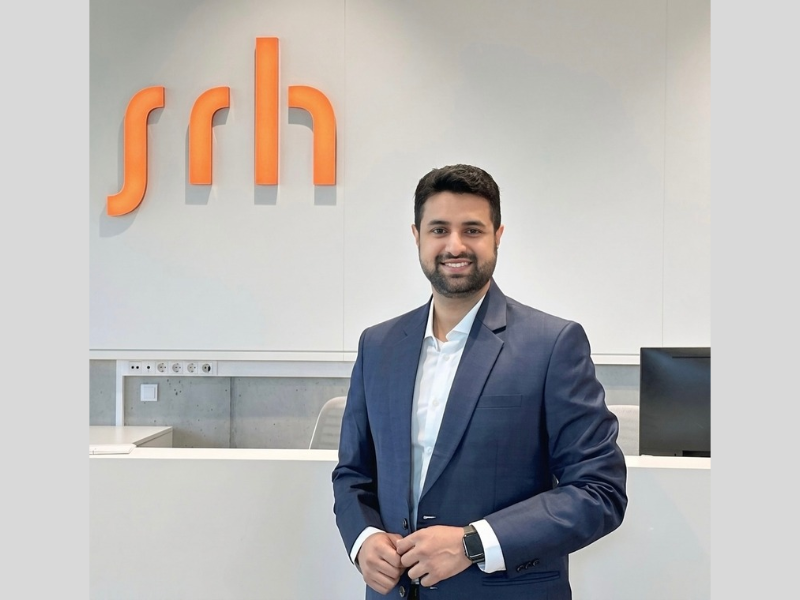
– Ajith Mohan, Director for India, SRH University
Higher education has long been judged by the credentials it confers. Yet, as artificial intelligence reshapes global labour markets, the more pressing question is no longer what degree a graduate hold, but what they can actually do with it. The debate around duration and prestige is giving way to a more fundamental question: how effectively does education translate into industry-relevant outcomes and long-term employability? AI is automating routine functions while simultaneously raising the bar for human capabilities. Employers now place a premium on critical thinking, digital fluency, problem-solving and adaptability. The World Economic Forum projects that 44 per cent of core skills will change by 2027 and that 59 per cent of workers will require reskilling by 2030. These figures are not abstract forecasts. They represent a structural shift that education systems must actively prepare for, rather than merely acknowledge.
Germany’s model offers a useful perspective. Its longstanding leadership in engineering, manufacturing and Industry 4.0 has been reinforced by a higher education and vocational ecosystem closely aligned with industry. Applied learning, technical competence and innovation are not peripheral features of German academia; they are central to how institutions define graduate readiness.
Moving beyond knowledge-based education to applied learning
Across Germany and Europe, the shift from theory-led teaching towards competence-driven, application-oriented learning is accelerating. Industry 4.0 is redefining employability: employers increasingly seek graduates who can apply knowledge across technologies, reason through complex problems and perform in real-world environments, rather than simply recall information. This transition is visible at the institutional level. A UNESCO survey found that nearly two-thirds of higher education institutions have adopted or are developing guidance on AI use. This is influencing how learning outcomes are designed, assessments are structured and skills development is sequenced. The implication is clear: education aligned with the demands of the AI era is no longer a niche aspiration but an increasingly widespread expectation.
Accelerating skills development through modular, assessment-led learning
Germany is advancing towards modular, stackable and lifelong learning models that respond to rapidly evolving skill demands. Continuous assessment and shorter learning cycles are complementing the traditional reliance on end-term examinations. Project-based tasks, regular evaluations and timely feedback allow students to develop practical capabilities and adapt to changing industry requirements. The data reinforces the urgency. The OECD finds that 72 per cent of AI-exposed roles require management skills, while 67 per cent require business process skills and more than half require digital and social capabilities. These findings point to growing demand for skills that complement technical expertise. At the same time, only 0.3 per cent of employment is directly related to AI skills, highlighting a potential mismatch between market needs and the skills supplied by existing education and training systems. Separately, 63 per cent of employers identify skills gaps as a major barrier to business transformation. Modular, continuous learning is therefore not merely a pedagogical preference; it is a response to a measurable skills challenge.
Industry collaboration as a driver of workforce readiness
Germany is moving beyond the traditional internship model towards deeper forms of industry collaboration. Co-developed curricula, live projects and structured mentorship integrate employers directly into the learning process. Students develop industry-relevant capabilities through sustained interaction with practitioners, rather than relying solely on exposure that begins after graduation. The gap between industry needs and graduate readiness is a systemic challenge. Addressing it requires institutions to embed employer engagement in their curricula rather than treat it as an optional supplement. Universities such as SRH University reflect this approach through an emphasis on project-based learning, interdisciplinary education and close industry collaboration, helping students develop skills relevant to the workplace. The OECD reports that around 20 per cent of firms are actively using AI, although wider adoption remains constrained by several barriers, including skills shortages. Embedding industry engagement in education can help institutions respond to these challenges and better prepare graduates for evolving workplace requirements.
Germany’s AI-driven labour market is reshaping talent expectations
Across Europe, AI is shifting the basis of employability from credentials alone to demonstrable capabilities. Automation is transforming routine functions while creating new roles that demand continuous learning, complex problem-solving and measurable contributions. Findings indicate that 29 per cent of schools and universities in Germany are already deploying AI for personalised learning, administrative automation and student analytics, reflecting a broader alignment between institutional practices and labour market developments. The competitive advantage in higher education is being redefined. Graduates who can apply knowledge, adapt quickly and deliver results in rapidly evolving environments are likely to be better positioned to meet employers’ expectations.
Building talent for the future of work
In an AI-driven economy, the value of a degree is increasingly defined by the skills, adaptability and employment outcomes it delivers, rather than by its duration or prestige alone. Germany’s emphasis on applied learning, modular skills development and close industry integration offers a useful model for the future of higher education. With a substantial proportion of workers expected to require reskilling within this decade, outcome-driven education is emerging not merely as an academic reform priority but as an economic imperative. Institutions that translate learning into relevant, evolving workforce capabilities will help define the next era of higher education. Those that fail to adapt risk producing graduates whose qualifications outpace their readiness for the workplace.
Also Read: Five workplace trends that will define enterprise hiring over the next five years









Add comment