
No products in the cart.






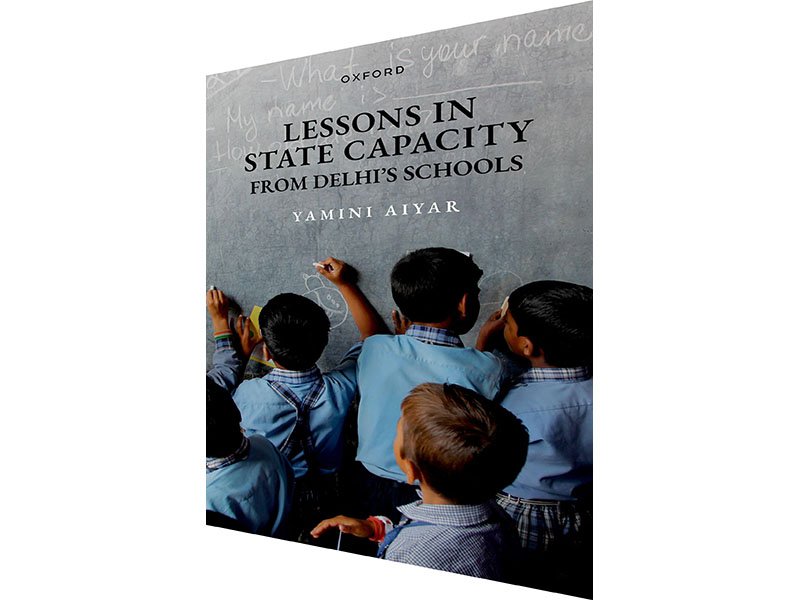
AAP schools experiment
lessons in state capacity from delhi’s schools
Yamini Aiyar
oxford university press
Rs.1,250
Pages 256
This book is not merely about Delhi’s education reforms, it is a pedagogical offering on how public systems function, adapt and stall despite best intentions
Reading Yamini Aiyar’s Lessons in State Capacity from Delhi’s Schools felt like being handed a vocabulary for questions I’ve always grappled with — about the nature of the Indian State, about reform and resistance, and about what it takes to build institutions in a democracy as complex and unequal as ours. The book is not merely about Delhi’s education reforms; it is a pedagogical offering on how public systems function, adapt, and sometimes stall despite best intentions.
The significance of Aiyar’s scholarship is that she critiques the dominant ‘plumbing’ view in public policy, where problems are seen as technical bottlenecks to be fixed by better design. Instead, she centres upon the lived reality of institutions, showing that systems are shaped as much by relationships and histories as by rules.
Through vivid ethnographic detail and sharp institutional analysis, she unveils what happens behind the scenes of a policy success story — the celebrated reforms in Delhi’s public schools under the Aam Aadmi Party government. The book moves beyond metrics to explore the daily lives of teachers, mid-level bureaucrats, and policymakers, each entangled in the dual pressures of political ambition and administrative logic.
The ethnographic accounts reveal a deeper structural paradox: systems that relentlessly demand accountability from the bottom often undermine the very autonomy that enables frontline actors to respond with purpose. By tying every action to compliance with hierarchies, reforms risk hollowing out the discretionary space teachers and bureaucrats need to innovate and adapt to local conditions.
One of the early chapters draws a powerful distinction between capacity and capability. Individuals may have skills and commitment, but unless organisations are structured to harness those skills, capability cannot emerge. This distinction resonated with me deeply, especially in education, where teachers often operate in environments that neither empower nor support them. Political will, charismatic leadership, or even increased budgets are not enough. Real reform depends on long-term investment in bureaucratic trust, routine systems, and institutional memory.
Here, Aiyar charts how Delhi’s education reforms managed to partially transcend their ‘mission mode’ origins by embedding certain practices and reworking relationships between political and administrative actors. But this was not automatic; it was built slowly, often against resistance, and remains fragile.
The book’s portrayal of mid-level bureaucrats is particularly compelling. These are not villains in the story, nor are they passive implementers. Instead, they are often emotionally and professionally stretched, tasked with ‘delivering’ reforms while navigating unclear procedures, frequent political changes, and limited autonomy. The author’s reading of their role dismantles the usual binary between reformers and resistors. It also challenges the casual use of phrases like ‘systemic change’ that permeate policy discourse.
It shows us, in granular and processual terms, what change actually looks like: messy, incremental, shaped by contestation and compromise. It reminds us that the State is not a black box, but a living institution shaped by the people within it, which always needs careful study. Her research involved being present with the State, capturing real-time activities, talking to multiple stakeholders. “State capacity is, after all, a voyage of discovery in which all actors have to be taken along,” writes Iyer.
A particularly insightful section examines the contradictory role of government school teachers expected to be professional educators, but burdened with non-teaching tasks ranging from surveys to election duty. This has shaped a dominant narrative of victimhood among teachers which I frequently encountered while surveying schools in rural Odisha for my thesis work. Nearly every teacher I spoke to expressed frustration at being pulled away from the classroom. Yet, as Aiyar rightly argues, this narrative can also deflect accountability.
Lessons in State Capacity is not just a case study of Delhi or education. It is a book about the Indian State — its rhythms, its frictions, and its capacity to both inspire and disappoint. It cautions against over-reliance on performance metrics and quick fixes and urges long-term commitment to building institutions that can reflect, learn, and adapt. The involvement of political leaders turned into reformers restoring the dignity of government teachers and schools, engaging in a new language of participation and deliberation while navigating the tussle between bureaucracy and reformers, reveals what ‘systemic change’ actually entails.
Aiyar’s work is not just an exploration of Delhi’s education reforms, but a methodological guide on how to study the State itself. Her insistence on immersive, ground-level engagement, speaking with teachers, sitting in classrooms, navigating cramped district offices, pushes back against the tendency in policy research to rely solely on aggregated data or neat theoretical models. It provides an understanding that meaningful scholarship requires patience, humility, and the willingness to embrace messiness.
In this sense, this book is both a compelling narrative and a quiet manifesto for the craft of public policy research in India. It reminds us that state capacity is not just a matter of design, but of politics, relationships, and trust. And most importantly, it is important for policy scholars to be present in lived realities of the State, to understand how and why the process of change is slow, and why it requires societal participation as an everyday task.
Samridhi Agarwal (The Book Review)







Add comment