
No products in the cart.






Delhi: Endless debate
– Kaveree Bamzai (Delhi)
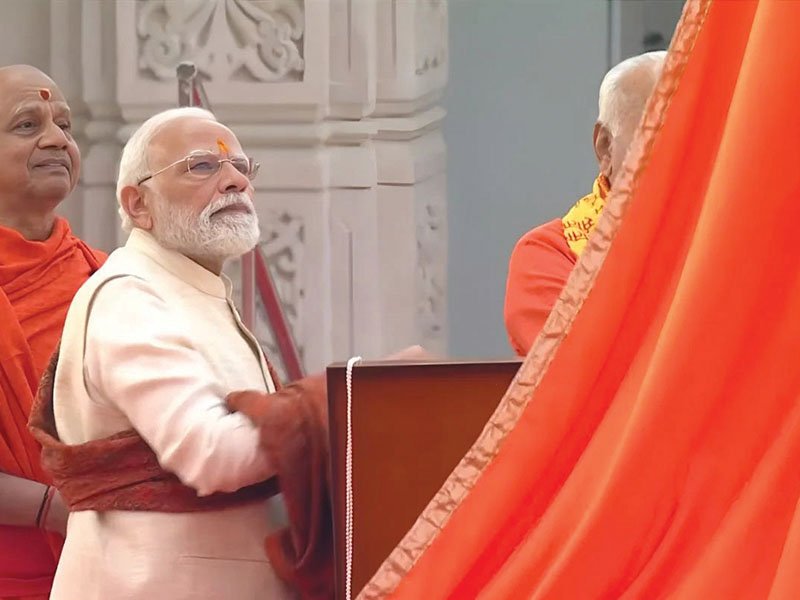 Addressing a massive public rally on November 25 in the temple town of Ayodhya, where a spanking new Ram Janmabhoomi temple complex spread over 70 acres was constructed in record time on the ruins of the Babri Masjid (estb.1528) vandalised by Hindu extremists in 1992, Prime Minister Narendra Modi called upon the citizenry to shed their “colonial mentality” and learn in their mother tongues. He contended that almost eight decades after independence from exploitative British rule of almost two centuries, India has been slow to shed the belief “that everything foreign is superior, while our own legacy is inferior”, and discard “the mentality of slavery” that treats foreign/Western ideas and languages as superior.
Although Modi’s revivalist speech enthused his audience and made headlines countrywide, it has dismayed the country’s large and growing middle class whose number is estimated at 430 million. Within this class, an estimated 100 million is comfortable and fluent in English/Inglish while the remainder aspires to become fluent in this language of national communication and international trade and commerce. But even within the middle class, Modi’s anti-English rhetoric has support.
According to M. Jagadesh Kumar, former professor of engineering at IIT-Delhi, former Vice Chancellor of the top-ranked Jawaharlal Nehru University and former chairman of the apex level University Grants Commission, scientific research has consistently demonstrated that children think and absorb knowledge best in their native language. “When schools use a foreign language, the worlds of home and classroom drift apart. Mahatma Gandhi warned that English education made Indians ‘foreigners in their own land’. There is a strong need to remove this colonial mindset and regain pride in one’s roots,” says Jagadesh Kumar.
However, heavyweight public intellectuals who value the country’s English language heritage built up over a century, are pushing back. In a brilliantly argued riposte in the online news magazine The Print, Dr. Ashutosh Varshney, professor of international studies at the high-ranked Brown University, USA, rebuts Modi’s contention that knowledge of English compels adoption of a “slave mentality”.
“Knowledge of English provided plural possibilities. For instance, three of the biggest influences on Mahatma Gandhi’s idea of civil disobedience came from English texts: Henry David Thoreau’s Civil Disobedience (1848), John Ruskin’s Unto This Last (1860) and Leo Tolstoy’s The Kingdom of God is Within You (1894),” he writes, describing Gandhi’s views on English as “cosmopolitan rootedness,” worthy of emulation.
Evidently while making these remarks about the history of English in India, the Prime Minister has forgotten that the status of English and the initiative to install Hindi as the national language in the 1960s had ignited fierce resistance in the states of peninsular India. Almost all the southern states opposed this initiative even though it had constitutional legitimacy. Violent anti-Hindi riots broke out in the southern states and there was a possibility of Tamil Nadu seceding from the Indian Union.
Within the educated middle class there is general agreement that the Prime Minister’s populist remarks rubbishing English were shorn of nuance and out of date. The plain truth is that English is necessary for national unity as the common language of a country with over 22 major languages. Moreover with English having established itself as the major language of international business and technology, it would be foolish to throw away our historical familiarity with this language. It’s also important to note that Hindi language chauvinists have done little to modernise the language and translate complex STEM textbooks and manuals into Hindi and local languages. This requires a large number of highly qualified translators fluent in Hindi and English, who are simply not available.
“This type of rabble-rousing might enthuse sangh parivar foot-soldiers, but is not good for national unity. Unfortunately the dead three-languages learning prescription has been revived by the National Education Policy (NEP) 2020. In the south, this is being interpreted as another attempt to impose Hindi. Already Tamil Nadu and Karnataka have rejected NEP 2020 and have written their own State Education Policies, prescribing learning of only two languages, especially English. The economic gap between the south and BIMARU Hindi belt states is certain to widen,” predicts a professor of education in a prominent Delhi-based private university who requested anonymity “for obvious reasons”.
Unfortunately for the citizenry and children of India, such vital issues are never resolved. They are resurrected and debated endlessly.










Add comment