
No products in the cart.






History from below
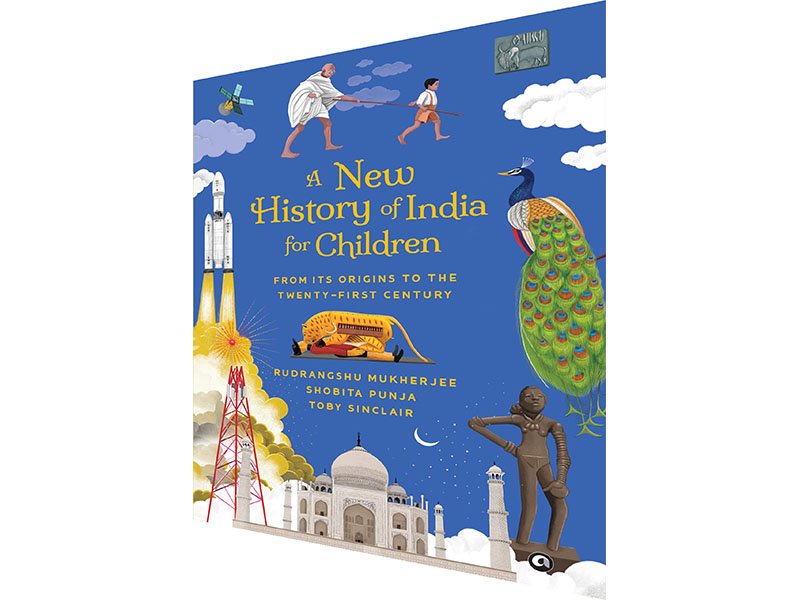
 A new history of india for children: from its origins to the 21st century
Rudrangshu Mukherjee, Shobita Punja and Toby Sinclair
Aleph book company
Rs.499
Pages 295
A vivid narration of India’s history from pre-historic times to the 21st century for school students that examines the lives of non-elite sections of society
The well-known historian of ancient India, Ram Sharan Sharma, once quipped that while it is not so difficult to teach history to college and university students, given that they already have some grounding in the subject, it is a herculean task to teach the same subject in an engaging and exciting manner, to school students. Besides making the subject ‘attractive’, it is important for those trained in the historian’s craft to make school students familiar with historical knowledge which is accurate and, at the same time, non-sectarian.
Several historians and history enthusiasts have, in recent years, made sincere efforts to make the subject more accessible to school students. Works of Jonathan Mark Kenoyer, Devika Rangachari, Subhadra Sen Gupta, Roshen Dalal, Devika Cariappa, and Archana Garodia Gupta, to name a few, are commendable inasmuch as they allow school students to understand complex facets and debates of Indian and world histories in simple terms, and in a language bereft of jargon. Moreover, these books often contain colourful illustrations which add richness to the narrative.
To this list we may also add classic NCERT history school textbooks —written by some of the leading historians of India, including Romila Thapar, RS Sharma, Satish Chandra and Bipan Chandra — as well as Audrey Truschke’s recent magnum opus, India: 5,000 Years of History on the Subcontinent (2025). Engaging with richly textured narratives, these books attempt to make young minds aware that they cannot understand contemporary India without appreciating its deeply contested past, which continues to shape current events and socio-political controversies.
Written by Rudrangshu Mukherjee, together with cultural historian Shobita Punja and photographer-archivist Toby Sinclair, A New History of India for Children vividly narrates India’s history from prehistoric times to the 21st century. Based on thorough research, each chapter dissects multi-layered and, at the same time, complex, Indian society. Importantly, rather than focusing primarily on political and dynastic history, the study examines at length socio-economic issues concerning the lives of non-elite sections of society. Mukherjee, in this respect adopts a ‘history from below’ approach, instead of ‘top-down’ methodology.
Given that in the majority of writings on Indian history, the Northeast region has been marginalised, Mukherjee’s study is essential. In the portion pertaining to the Northeastern region of the country, the author outlines the broad historical trajectories of the Northeast.
While examining the political history of the area, the section highlights the distinctiveness of various tribal formations, including the Ahoms, Chutiyas, Kacharis, and Koch. Far from being homogenous, each tribal group, we are told, was disparate and unique. And socio-cultural facets like dance, diet, clothing, religious rituals and beliefs were tribe specific. However, tribal villages were, as the author argues, ‘by no means self-sufficient’. That the tribal population of the region was actively taking part in local as well as trans-local trade shows that interaction and exchange of commodities was essential to the very survival of villages.
The establishment of Mughal rule in the territories of Koch and Ahom tribes, towards the end of the 16th century, witnessed increased use of money, given that the Mughal state collected revenue in cash. Apart from revenue, cash was now, following this development, increasingly used in commercial activities of the people of the region.
However, penetration of the British colonial state in the Northeast had adverse effects on the social and economic orders of the various tribal kingdoms. That the emergence and development of a tea plantation economy — unique to these parts of the country — led to an increased level of economic exploitation and suppression of the local peasantry, is stressed by the author. Thus, as the author rightly notes, the creation of ‘planter raj’, a term coined by Amalendu Guha, “lorded over and tyrannized the entire population of the region”.
At a time when the present dispensation is blatantly tinkering with India’s glorious past, and is leaving no stone unturned in promoting a version of history which is biased and sectarian, A New History of India for Children is an important scholarly intervention. Interspersed with a canvas of exquisite miniature paintings, archaeological remains, archival photographs and maps, the volume provides a detailed and unbiased picture of India’s history. That India has had a rich tradition of intellectual pluralism and public debates — a theme explored at length by Amartya Sen in The Argumentative Indian (2005) — is brought to life by the authors. Again, thorough discussions on the Bhakti Movement, Sufism, Brahmanical and non-Brahmanical sects and emergence of Sikhism, enable young readers to understand the diverse religious traditions of our country.
However, in dealing with India’s freedom struggle, the historical significance of the revolutionary phase is conspicuously absent. Given that revolutionaries Ramprasad Bismil, Ashfaqulla Khan, Bhagat Singh, Chandra Shekhar Azad, Sukhdev, Rajguru, Batukeshwar Dutt, and Jatindra Nath Das, among others, posed a formidable challenge to the colonial state through their acts of resistance, one would have appreciated a discussion on these freedom fighters and their times. Moreover, it would have helped young readers to understand that there were multiple strands of the freedom struggle.
Nevertheless, this richly textured history will be of interest to not just school students, but also teachers of the subject as well as history enthusiasts.
Amol Saghar (The Book Review)










Add comment