
No products in the cart.






Hong Kong: Free speech limits
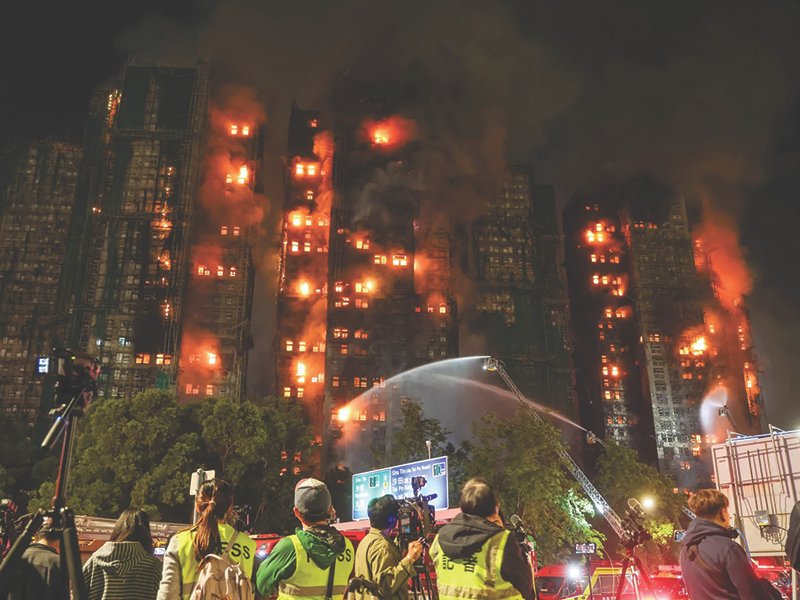
Wang Fuk Court housing complex fire. Inset: Xinyan Huang
An academic who spoke out about public safety in the wake of Hong Kong’s worst fire in more than 70 years has been forced to apologise for “inaccurate” information, while students calling for an independent inquiry into the tragedy have faced arrest.
The territory’s universities have been pulled into the crisis after the blaze killed at least 151 people at the Wang Fuk Court housing complex on November 26. Seven of the estate’s eight tower blocks, which were undergoing extensive renovation at the time, caught fire after protective netting was found not to meet flame-retardant standards.
The fire spread rapidly and took over 40 hours and more than 2,000 firefighters to extinguish. Hong Kong’s buildings department has since suspended work on 30 private projects, while at least 13 people, including directors of a construction company, have been arrested for suspected manslaughter.
Xinyan Huang, associate professor in the department of building environment and energy engineering at Hong Kong Polytechnic University, was forced to issue a detailed clarification after media interviews he gave about the incident drew controversy. Speaking to Al Jazeera, he had raised concerns about the use of bamboo for scaffolding during major building works, saying it is “structurally weaker and less stable than steel” and should be phased out.
But Huang later said that he had not intended to imply that bamboo scaffolding was the major factor in the fire’s spread. He said he had misspoken on several issues, including observing that the fire appeared to climb “in one or two minutes” to 30 floors and wrongly stating that fire engines from mainland China had been deployed. “This interview has underscored the need for rigour and prudence in public commentary,” he says adding “as an academic, I recognise that my statements carry responsibilities to factual accuracy and professional integrity. “Moving forward, I will uphold our academic mission’s core principles: verifying information thoroughly, basing remarks on evidence and expertise, and exercising greater caution. This experience reinforces my commitment to responsible engagement on public safety and community issues.”
Students have also been thrown into the spotlight in the aftermath of the blaze, drawing comparisons with the 2019 pro-democracy protests. A 24-year-old student from the Chinese University of Hong Kong was arrested for alleged sedition after distributing flyers calling for an independent inquiry into the incident.
The online petition he promoted drew more than 10,000 signatures before it was wiped. It listed “four demands”, including the establishment of an investigative committee.
John Lee, Hong Kong’s chief executive, says he will launch a judicial inquiry, marking the first such investigation since the introduction of the National Security Law in 2020. He says the committee will “review why the fire broke out and spread so fast, and to prevent similar tragedies from happening again”. The Office for Safeguarding National Security warned that those who sought to “disrupt Hong Kong through disaster” would be “strictly punished”.
(Excerpted and adapted from The Economist and Times Higher Education)







Add comment