
No products in the cart.






Karnataka: Freebies opportunity cost
– Reshma Ravishanker (Bengaluru)
Siddaramaiah (centre): social sector axe
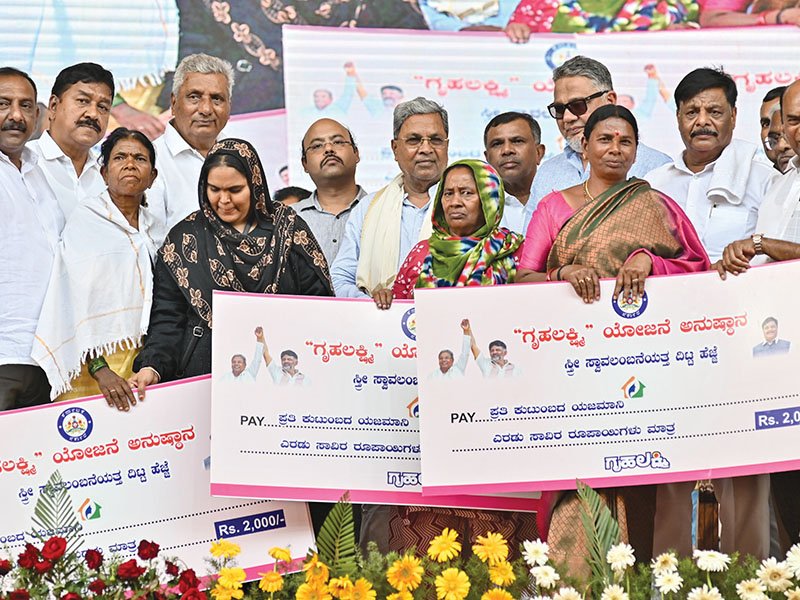
Two and a half years after the Congress party, which was voted to power in the 2023 legislative election, has been faithfully implementing its poll promise of ‘five guarantees’ — 200 units of free power for every applicant household, 10 kg rice per person in below poverty line (BPL) households, free-of-charge travel for women in government buses, Rs.2,000 per month for women heads of family and Rs.3,000 for unemployed graduates — the disastrous fallout of these handouts, aka freebies, on the state’s finances have become glaringly evident. The state’s revenue deficit has ballooned from Rs.4,000 crore in 2023-24 to Rs.27,000 crore in 2024-25. On September 8, Chief Minister Siddaramaiah confirmed that Rs.97,813 crore has been spent on its five guarantee schemes in the 30 months past.
With no effort being made to reduce runaway establishment expenditure, the axe has fallen on the social sector, especially education. In the winter legislative session held last month in Belagavi, chief minister Siddaramaiah acknowledged that 14,677 faculty positions are vacant in Karnataka’s 37 public universities. The University of Agricultural Sciences, Bengaluru, tops the list with 2,817 unfilled faculty vacancies, followed by Karnatak University, Dharwad, with 1,263. Likewise, the public primary-secondary school system is plagued by huge teacher shortages. An estimated 45,500 teachers’ posts are vacant in 41,088 government primary schools.
To tide over these teacher shortages, the state government has resorted to appointing ‘guest’ faculty in state government colleges/universities and para teachers in public schools at significantly lower remuneration.
For instance, a guest lecturer in a state government university is paid Rs.24,000-36,000 per month cf. Rs.57,000-68,000 for tenured permanent faculty. Moreover, most guest lecturers don’t meet eligibility criteria stipulated by the University Grants Commission (UGC) such as clearance of KSET/NET exams and Ph D qualifications. This huge pay disparity between tenured and guest faculty — some of the latter teaching for over a decade — has prompted guest lecturers to regularly call strikes for equal pay and regularisation of terms of service. Currently, there are around 10,000 guest lecturers employed in the state’s public colleges and universities.
Unsurprisingly, deploying under-qualified guest faculty to teach in higher education institutions (HEIs) and para teachers (usually class X-XII school-leavers) in schools has resulted in poor learning outcomes in the public education system. For several decades the Annual Status of Education Report (ASER) published by the independent Pratham Education Foundation, has been reporting that class V children in rural — especially government — primaries can’t read class II textbooks. And several studies report that 75-85 percent of HEI graduates are unemployable. Karnataka is not an exception.
Comments Chetan Singai, Professor and Dean at the School of Law, Governance & Public Policy at the privately promoted Chanakya University, Bengaluru: “When universities run on ad-hoc staffing, students lose continuity, first-generation learners lose support, and research is given rock-bottom priority. Such issues deepen inequalities between state government universities in particular, and better-resourced private HEIs and is a major cause of India’s poor research and innovation record. Filling faculty positions is quality reform, not a routine administrative act. It is foundational to outcomes, trust, and the future of the government higher education system.”
Prof. A.S. Seetharamu, former professor of education, Institute of Social & Economic Change, Bengaluru, attributes the huge faculty shortages in the state’s 37 public universities to an “unwise decision” made in 2022 by the previous BJP government to promote one public university in all of the state’s 31 districts. “This led to the establishment of eight new universities in March 2023. Karnataka’s strained finances have made it impossible for all 31 public universities to be equipped with functional multidisciplinary departments, quality infrastructure and faculty. One public varsity for every three districts would have been a better decision. Now the incumbent state government needs to make the tough decision of consolidating the number of state universities and invite private sector CSR funding to finance infrastructure upgradation. Simultaneously, hiring of permanent faculty as per UGC norms should not be delayed further.”
While the academic and public backlash against the huge number of vacancies in government-run HEIs has prompted higher education minister M.C. Sudhakar to announce grand plans to fill the vacant posts, this is likely to prove an empty promise. In Budget 2025-26, Rs.53,674 crore was allocated to the government’s five major freebie guarantee schemes cf. Rs.45,286 crore to education. That’s a clear indication of government priorities.










Add comment