
No products in the cart.







Letter from the Editor

There’s considerable substance in the witticism that if you are below 30 years of age and not a communist/leftie you don’t have a heart; but if you are above 30 and a communist/leftist you don’t have a head. Therefore, it’s unsurprising that most students in the country’s higher education institutions (HEIs) are attracted to egalitarian working-class ideologies propagating distribution of societal goods according to people’s need, rather than greed.
But as one ages, awareness dawns that before you can distribute goods (and services) at scale, one has to produce them. This necessitates efficient management of the factors of production — land, labour, capital — for which enterprise, the fourth factor is of critical importance. Most youngsters and left ideologues don’t accord any weightage to this fourth factor.
Indeed it’s because of lack of awareness of the fourth factor that post-independence India’s national development effort went wrong. Like most patricians, the Harrow College and Cambridge-educated Jawaharlal Nehru was dismissive of businessmen. Naively, he believed that provided land, labour and capital, government bureaucrats/babus could do as good a job as entrepreneurs. Although he professed to be a historian who authored Discovery of India (1946), he overlooked the glaring fact that for centuries, if not millennia, the Indian subcontinent had become the wealthiest region worldwide because of its strong entrepreneurial traditions. Traders and businessmen were given free rein by emperors and princes, content to collect taxes and levies from them. And despite newly independent India being gifted with native talent in business and commerce — Tata, Birla, Shri Ram, Murugappa among numerous others — Nehru took India down the socialist path.
With disastrous results. Procedure driven bureaucrats deputed to manage giant public sector enterprises quickly ran them into the ground, even as private entrepreneurs were bound hand and foot by reams of red tape to prevent expansion and growth. Nehru’s daughter Indira Gandhi who followed as prime minister in 1965, took the Indian economy further down the socialist road by nationalising major banks and insurance companies. Meanwhile in the neighbouring People’s Republic of China which was also struggling on the socialist road, Secretary Deng Xiaoping saw the light and set PRC on the capitalist path. Currently, China’s GDP is $20 trillion cf. India’s $4 trillion.
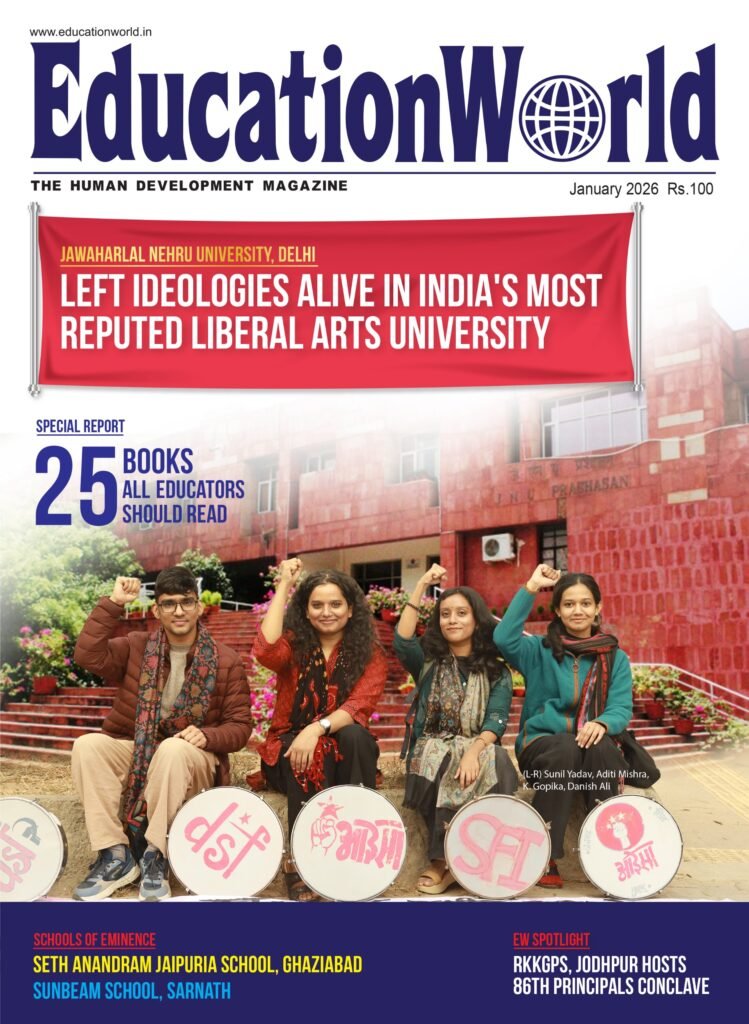
Against this backdrop in the first issue of the new year, we have beamed a spotlight on the showcase Jawaharlal Nehru University, Delhi (JNU, estb.1969) where despite the power of the BJP/NDA government at the Centre ranged against it, a Left coalition of communist/socialist parties won the students union election staged last November. Clearly, Left ideologies and dogma are alive in the top-ranked and highly influential JNU. This may be good for Indian democracy, but not for economic development. However bearing in mind that the newly-elected JNU Students Union leaders are presumably below 30 years of age, there’s hope that wisdom will dawn after they mature.









Add comment