
No products in the cart.






Telangana: Great education race
– Priyanka Edupuganti (Hyderabad)
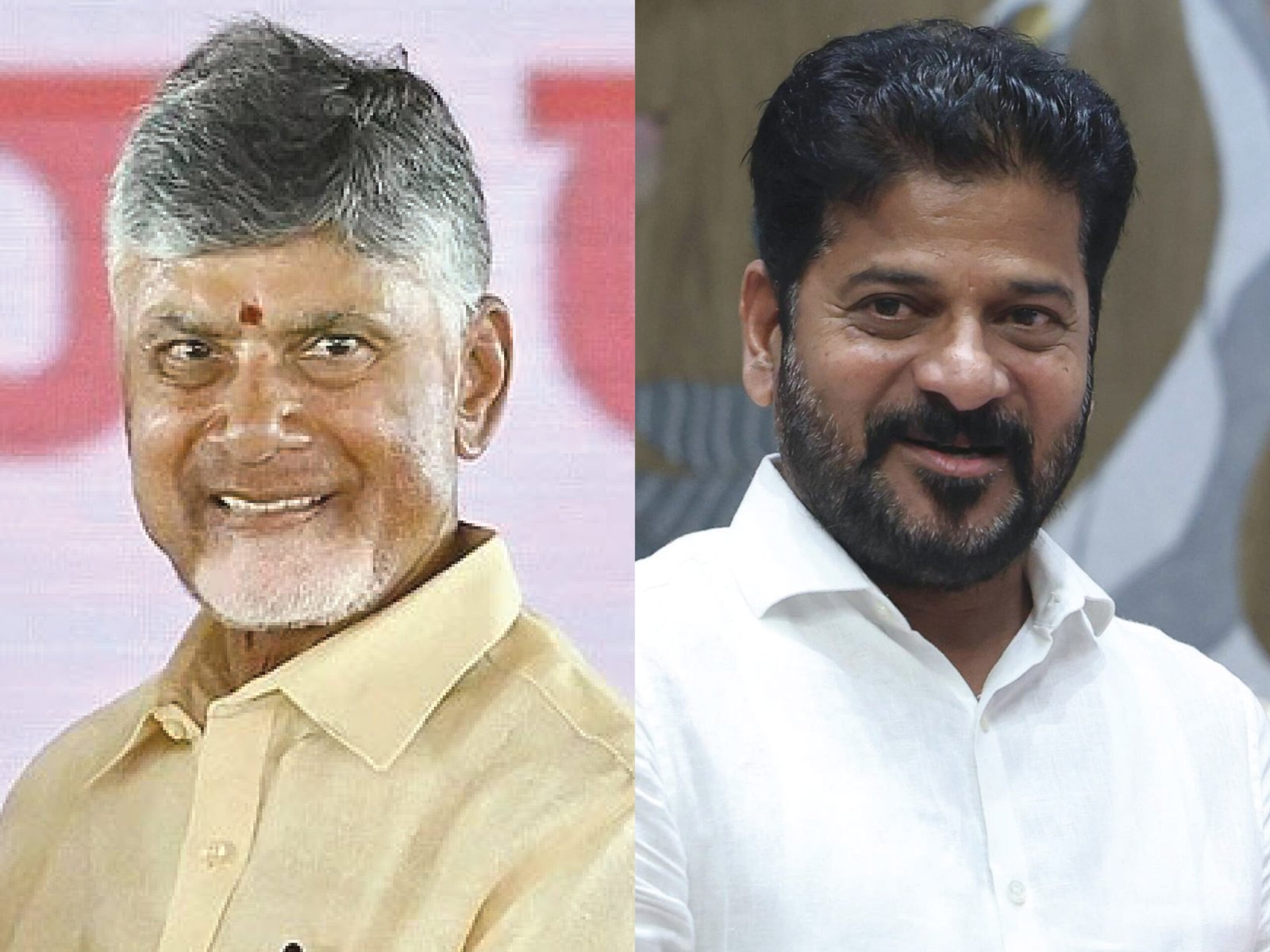
Naidu (left) & Reddy: compulsory English medium education
After independent india’s first linguistic agitation in 1952 and a dramatic 58-day fast-unto-death of politician Potti Sriramulu, Andhra State was carved out of the erstwhile Madras Presidency. Three years later it was named Andhra Pradesh under the States Reorganization Act, 1956.
Almost half a century later, following another prolonged agitation, in 2014 Andhra Pradesh was bifurcated into the two states of Andhra Pradesh (pop. 49.6 million) and Telangana (35.2 million), with Hyderabad the prosperous shared capital of consolidated Andhra Pradesh, accruing to Telangana in 2024.
Since then, the two fraternal states whose people share Telugu as a common language, have been engaged in an intense race to emerge as India’s most socio-economically developed and prosperous states. In 2024 Chandrababu Naidu who during his three terms as chief minister of consolidated AP was the prime driver in developing Hyderabad (pop. 10 million), a city renowned for its pearls industry and little else, into a glitzy IT (information technology) hub in which almost all US-based majors including Microsoft, Google and Dell among others have established large service centers and back offices to rival Bangalore, was returned to power in AP after five years in the wilderness.
Almost simultaneously the Indian National Congress, led by A. Revanth Reddy was unexpectedly returned to power in Telangana. Since then, the two fraternal states have been engaged in an intense race to transform their states into India’s most developed, with special focus on education.
With the advantage of having Hyderabad which is a thriving ICT hub rivalling Bengaluru, and several top-ranked universities including the blue-chip Indian School of Business flourishing in the city, Revanth Reddy is in pole position in the two states’ education development race. However, Naidu — whose Telugu Desam Party (TDP) is an alliance partner with the ruling BJP/NDA government now in its third consecutive term at the Centre — has the advantage of the Centre’s financial support. Moreover Andhra Pradesh/Naidu also has the advantage of Nara Lokesh, an alum of Carnegie Mellon and the Stanford School of Business — and Naidu’s son and heir — as education minister. During the past 17 months in office, Lokesh has rolled out several imaginative and high-potential initiatives to implement root and branch reforms in K-12 education
Last October Lokesh launched an ambitious LEAP (Learning Excellence in Andhra Pradesh) programme to revolutionize K-12 education statewide through technology, innovation, and inclusion. Under the LEAP framework, the state government intends to overhaul and re-build AP’s school education system on five pillars — curriculum reform, teacher training, infrastructure improvement, digital learning, and assessments. According to Lokesh, LEAP is closely aligned with the National Education Policy (NEP) 2020 and introduces AI-driven evaluation tools, play-based learning in early years, and digital content modules designed to nurture children’s creativity, communication, and problem-solving skills.
A few months earlier in July, Lokesh synchronised a mega Parent-Teacher Meeting (PTM) 2.0 in which 22 million parents, students, teachers and public representatives participated to discuss and debate ways and means to strengthen parent-school partnerships; promote transparency and accountability; facilitate holistic student development; raise child well-being awareness and promote life skills through co-curricular education. According to Lokesh the event convened simultaneously in 13 cities and towns statewide, was the largest PTM in Indian history. Moreover, in the state’s 2025-26 budget, the allocation for education was raised by 6.34 percent to Rs.34,000 crore of which Rs.29,909 crore was allocated for K-12 education.
On the other side of AP’s border, on September 19, Reddy announced a Bharat Future City (BFC) in Ranga Reddy district, 35 km from Hyderabad. Spread across 30,000 acres, BFC is envisaged as India’s first pollution-free education-centric smart city, integrating education, research, innovation and entrepreneurship. The project, to be developed over the next decade, will comprise dedicated zones for higher education, health sciences, artificial intelligence, climate innovation, and digital manufacturing. With a projected investment of Rs.1.8 lakh crore under the public-private partnership model, BFC is scheduled to be completed by 2028.
Under the BFC blueprint, a Global Education and Research District will host international university campuses, national universities, skill academies, and think tanks, all focused on next-generation learning. The proposed zone will also include residential schools, teacher training centers, and incubation labs connected by a unified digital grid. According to the Telangana Department of Education and Skill Development, discussions have been initiated with top ranked universities in Finland, Singapore, and the UK, as also with IIIT-Hyderabad, ISB, and NALSAR to establish satellite campuses within the city.
It’s also pertinent to note that despite TDP’s alliance at the Centre with the BJP which has an aversion to English, Naidu has not reversed his predecessor government’s policy of English/Inglish as the compulsory medium of education statewide. Ditto Telangana’s Congress government.
With enlightened governments whose leaders comprehend the importance of education in the global language of business, law and diplomacy as the cornerstone of socio-economic development engaged in intense competition, the future looks bright for these twin states separated by politics, but not ambition.








Add comment