






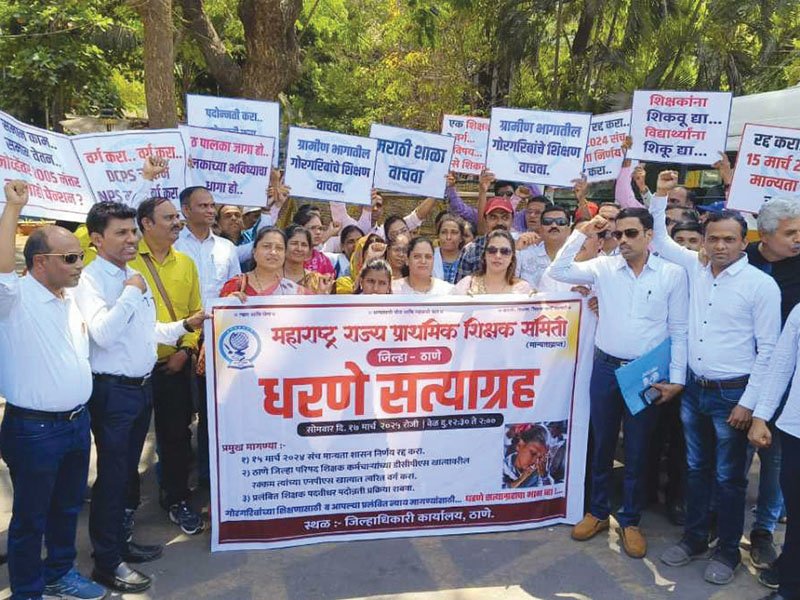
Maharashtra: Irate teachers unions
– Dipta Joshi (Mumbai)
Powerful teachers unions statewide are preparing to launch mega protest rallies against the state’s BJP/NCP/Shiv Sena coalition government’s Sanch Manyata policy which could lead to closure of 18,000 government and aided schools and render 20,000 teachers jobless. To demonstrate their clout, 15 teachers associations called a one-day statewide strike on December 5.
Teachers ire has been aroused by a government resolution (GR) to introduce its Sanch Manyata (‘section approval’) policy which mandates that government and aided schools with less than 20 students won’t be allotted any teachers and support staff.
It’s pertinent to note that the Sanch Manyata GR was first issued in 2024. However through prolonged protests and negotiations, teachers’ associations have managed to delay implementation of the policy and have persuaded state education ministry officials to evaluate data for the academic year 2025-26 instead of 2024-25.
But now with schools lesser than the prescribed enrolment in several districts earmarked for closure, teachers believe it is only a matter of time when the policy will start being implemented. For instance, 39 schools in the Sindhudurg district of Maharashtra’s Konkan region will be closed this year under the Sanch Manyata policy directive. Under the policy directive, several zilla parishad (government rural schools) will have to make do with one teacher for several grades who will be obliged to teach several unrelated subjects.
Spokespersons of teachers federations contend that the state government is “missing the wood for the trees,” with government officials focused on the technicalities of the policy while overlooking its long-term impact of depriving children in the state’s remote areas of critically important primary education. Their demand is for revocation of the Sanch Manyata GR altogether.
“Sindhudurg is one of the state’s backward districts that experiences high migration with people moving to Mumbai. However, it has consistently registered high literacy (80.30 percent) thus far because of 1,600 government and aided schools in the area. But now many schools there are likely to be closed down. This policy not only deprives children from EWS (economically weaker sections) of vitally important primary education, it will also hurt teachers and staff who will become surplus and rendered unemployed,” says Uday Shinde of the Maharashtra Rajya Prathamik Shishak Samittee (MRPSS).
The Right of Children to Free & Compulsory Education (RTE) Act, 2009 states children should not have to travel more than 3 km to attend school. But following closure of free-of-charge government schools in remote areas of the state, children will have to commute longer distances to larger government schools. “Poor quality roads and deficiency of affordable public transport which is normative in rural areas, will force a large number of children to drop out of primary-secondary education,” warns Shinde.
“On one hand, the government talks about improving the quality of education for children, but on the other, it enacts policies that deprive them of teachers and/or encourage multi-grade teaching. How can we ensure quality education when a Hindi language teacher has to also teach maths in school,” questions Vijay Kombey, State President, Maharashtra Rajya Prathamik Shishak Samittee.
Disappointed by the state government’s hard stand on this issue, despite several rounds of deliberations with teachers’ representatives, government school teachers associations intend to continue with statewide protest rallies. And if they don’t force the government to relent, they are drawing up plans to go to court to revoke this “anti-social policy”.









Add comment