





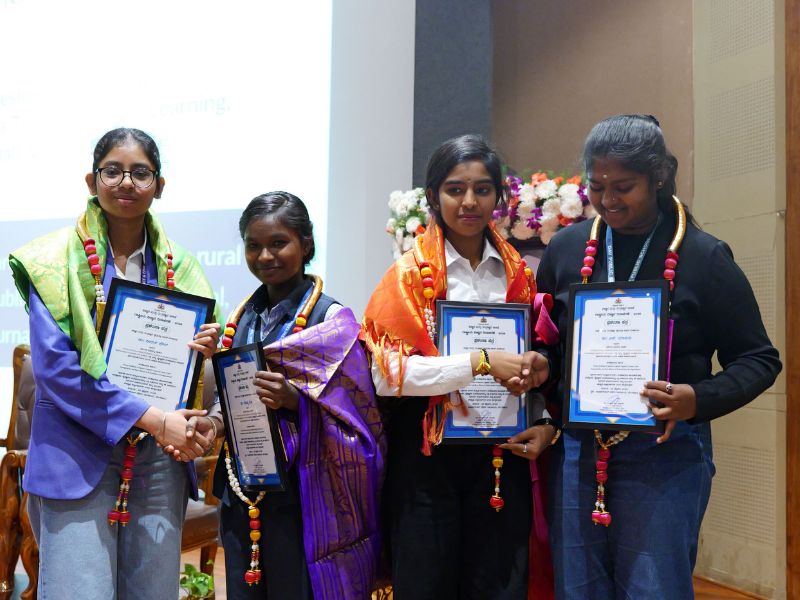
Four Rural Karnataka Schoolgirls get recognition for Green Chemistry Research
The Department of Science and Technology, Government of Karnataka, on the occasion of National Science Day 2026, themed “Women in Science Catalysing Viksit Bharat,” felicitated four high school girls from rural and tribal communities for their breakthrough contribution to green chemistry research. The recognition marks a first-of-its-kind achievement in India, where high school students from under-resourced backgrounds have participated in and contributed to internationally recognised scientific research.
The four young achievers — Reshma J. V., Class 11, Hosahalli (H. D. Kote); Lakshmi G., Class 10, Kaggalipura Village; Kirat Kaur, Class 11, Bidar; and S. Yamini, Class 11, Hosadoddi Village — earned distinction for their contribution to internationally recognised research in sustainable chemistry. Coming from families of housekeepers, daily-wage labourers, salespersons and homemakers, and often being first-generation learners, the students overcame significant social and economic barriers to pursue advanced scientific research.
Their study, recently published in Sustainable Chemistry One World, a peer-reviewed, Scopus-indexed international journal published by Elsevier, was conducted between March and August 2024 under Anveshana, the fully funded science research programme of Prayoga Institute of Education Research.
The research, titled “Green synthesis of saponin-capped copper (II) oxide (CuO) nanoparticles and their efficacy in photocatalytic dye degradation,” explored an environmentally safe method of synthesising copper oxide nanoparticles using plant-based saponin extracts.
Reflecting on the experience, Reshma J. V., a first-generation learner from the Viveka Tribal Centre for Learning in the Nagarahole Forest Region, said entering a laboratory environment initially felt intimidating due to unfamiliar instruments and scientific terminology. However, with mentorship and persistence, she gained confidence in conducting research. Reshma, who hails from a tribal community, scored 485 out of 600 in her SSLC examinations last year.
Dr. K. S. Nagabhushana, Director – Research at Prayoga, said the students progressed from learning the fundamentals of nanoscience to independently synthesising and analysing nanoparticles, interpreting data and defending their thesis before senior scientists. He described their journey as proof that scientific excellence is shaped by perseverance and opportunity rather than geography or background.






Add comment