






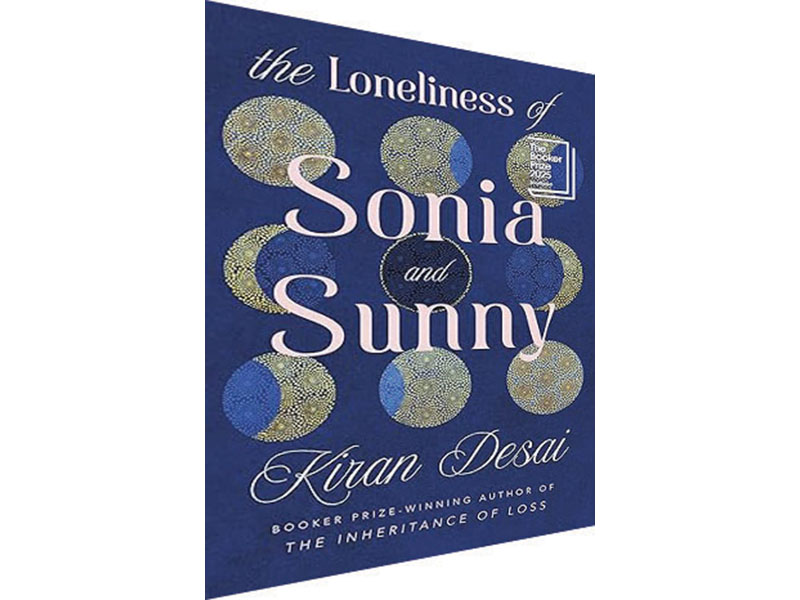
Tour de force loneliness exploration
 the loneliness of sonia and sunny
Kiran Desai
Penguin Random House
Rs.589
Pages 670
Set in the late 1990s to early years of the new millennium, this saga of two Allahabad and Delhi families traverses continents, exotic places and generational timelines
Booker Prize winner 2006, Kiran Desai has made a come-back almost two decades on with a tour de force novel short-listed for the Booker last year. Spanning the late 1990s to early years of the new millennium, this saga of the Shah and Bhatia families of Allahabad and Delhi traverses continents, curious locations and exotic places as well as generational time-lines. It cursorily refers to milestone events such as the Partition of India, and the terrorist assault on the twin towers (2001) of New York, weaving its way through a potpourri of trivial incidents and inevitable accidents. This is the vivid and stirring story of two khandani Indian families of the titular protagonists Sonia and Sunny.
The sizeable cast of characters in Desai’s big canvas is fairly typical of a late 20th century desi milieu in which conventions and social hypocrisies camouflage deep-rooted insecurities involving financial instability, marital discord and class prejudice. Refreshingly, Desai shapes the complexities, often mere mundane realities, with wit, humour and home-grown philosophy. Reflected in the distinct personalities of the older generation of Ba, Dadaji and Mina Foi residing in an ancient Allahabad bungalow, and Sonia’s Mummy and Daddy in their Delhi home, is the gulf between modern and long-held, old-world values. In Sunny’s family residing in Panchsheel Park, Delhi, there’s domestic politics around bank-balances and property, and souring relationships.
Around the turn of the new century, it was fashionable for the younger generation from upper middle-class backgrounds to drift to the USA to study and shape their future. However within a diaspora, there were problems of adjustment, discrimination, low self-esteem and anxiety that were hard to handle. The paradoxical modern day malaise of being ‘lonely’ even in crowded cities seems to have affected the young, but people back home misunderstood this loneliness and regarded it ridiculous.
So the protagonists Sonia and Sunny battle with their loneliness, each with incompatible love partners whose existence was hidden from folks back home. The intricate plot unfolds as an attempt at match making by the families that goes awry. Journeys back home, chance meetings, snatched escapades in Goa and Venice followed by significant cooling off that culminate in what turns out to be a surprising romance narrative. Juxtaposed in the novel is the traditional Indian arranged marriage that Satya, Sunny’s doctor friend seeks, set against his own misguided amorous inclinations.
Sprawled over 21 sections and 75 chapters, the novel meanders into intimate spaces and diverse geographic locations, individual destinies playing out in multicultural destinations. Almost epic in scope, the textured narrative moves into contemporary themes of immigration, cultural identity and nationhood, even environmental despoilation. Yet primary concerns repeatedly return to various aspects of loneliness.
Sonia’s mother Seher escapes from her stereotypical marriage and Delhi pollution to live in the rambling dilapidated family home — Cloud Cottage, nestled in the mountains of Mussoorie, a legacy that she has inherited from her German grandfather. Sunny takes a break from his journalism career and New York City to discover Mexico in a serendipitous way. Sonia seeks liberation from hounding traumas, real and imagined, amidst the seascapes of Goa to which she comes back to write a novel. Babita buys a dilapidated Portuguese mansion in Goa, Casa das Conchas settling into isolation rather than peace of mind. Desai has a penchant for placing real life domestic drama in juxtaposition with haunting and magical stories.
Sonia carries her German maternal grandfather’s faceless talisman, ‘Badal Baba’ as a mystical protective icon during her student days in USA. When her romantic relationship with a self-obsessed elderly artist Ilan de Toorjen Foss ends with Sonia fleeing from a fearsome and abusive relationship, Badal Baba remains in the artist’s possession. The actual origins of this mysterious spiritual object and its final retrieval reads like an adventure tale. This plot gives an amorphous epic narrative a definite structural mooring leading to a surprising novelistic denouement. One wonders how old fashioned chivalry finds a role in a millennial love story.
When a writer has spent almost 20 years working on a book with such a varied range of characters and evocations of places, histories and perspectives, it is inevitable that she acquires rich insights that reflect artistic practice, cultural expressions and individual visions. The book is in some sense also about the author’s own emotional loneliness — traversing ‘others’ minds, moods, lives while sifting through an equally expansive range of experiences, cultures, literary influences and readings.
Why Desai’s novel makes the cut is the multiple levels on which it operates. Sonia and Sunny, initially try to fulfil family expectations and chase the elusive American dream, a postcolonial phenomenon. Their homecoming is almost like a let-down for the older generation. Yet the youngsters eventually ‘find’ themselves, driven by diverse global forces that defy rule-book logic and fixed identities. Freedom becomes a leitmotif to be pursued — and ambivalent as it may sound, brings together disparate individuals, divided communities, intense reflections on the future of the world. It prophetically summarises a post-postmodern world that still gives out positive vibes.
Jayati Gupta










Add comment