






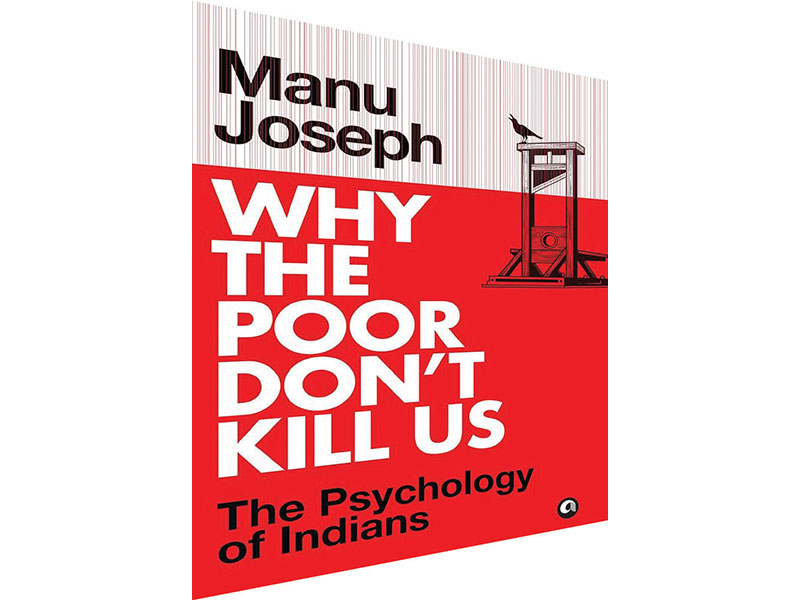
Psychology of the poor
 why the poor don’t kill us: the psychology of indians
Manu Joseph
aleph book company
Rs.599
Pages 280
The author explains the conspicuous absence of revolutionary violence in a nation characterised by stark economic disparity and democractic freedoms
The plight of the poor in India has been a central and enduring theme in Indian literature, serving as a powerful engine of social realism and moral critique since the early 20th century. Authors like Mulk Raj Anand consistently brought the marginalised to the forefront in novels such as Untouchable and Coolie, unflinchingly detailing the degradation and exploitation experienced by the lowest castes and urban proletariat; Premchand’s stories highlight the plight and pathos of the economically and socially marginalised.
The central thesis of Why the Poor Don’t Kill Us addresses the conspicuous absence of low class-based revolutionary violence in a nation characterised by stark economic disparity and democratic freedoms. Joseph posits that the maintenance of this equilibrium is not due to state coercion or strong economic safety nets, but rather due to deep-seated psychological and cultural mechanisms operative within the impoverished population.
Who after all, should be considered poor? This is perhaps the most enduring and contentious area of research. Academics and policy-makers have constantly grappled with defining who is poor and how many fall within this category. Since the 1960s (starting with the Working Group of 1962), the Union government has constituted expert committees to define the poverty line based on minimum calorie requirements and/or minimum per capita consumption expenditure. Economists have extensively analysed data and devised a Multidimensional Poverty Index. Moving beyond simple income and consumption, latter-day studies measure health, education, and living standard deprivations.
Joseph evidently approves. Early in the book he writes: “Most Indians are poor by the standards of the modern world”. Therefore, poverty is relative — and all of us, when we compare ourselves to people richer than us, run the risk of experiencing poverty. Is poverty about possession of material wealth and satisfaction that the possessions provide? Elsewhere, the author cites a definition of the poor as “anyone who does not feel economically comfortable in a particular situation.”
This statement makes poverty even more all-encompassing — almost making the reader wonder if there are any rich people at all! It’s perhaps the human condition of being dissatisfied with our status. Throughout the book the author grapples with this tough question. Joseph’s definition of poverty is not about material wealth, but about the psychological submission, cognitive burden, and exposure to hardship that enables the comfortable life of the wealthy, without violent challenge.
Joseph views Indian society as a ruthlessly pragmatic ecosystem in which the privileged benefit from the low self-worth and fragmentation of the marginalised, ensuring their own “fragile safety” through psychological manipulation and systemic apathy. Stability is thus framed as a psycho-social phenomenon rather than as structural or institutional shifting of analytical focus from material conditions to the psychology of aspiration and endurance.
This book is written on a foundation of deliberate provocation. The title itself sets the tone. The author is not interested in comforting the reader but in challenging the most fundamental assumptions of social peace and privilege. Why the Poor don’t Kill Us clearly assumes the reader isn’t poor and warns that just because she is still alive and safe, it is not an assumption one must take for granted. The book’s title has a byline The Psychology of Indians. This is a revealing sweeping statement — the psychology of Indians is too large an umbrella for the subject that the book covers. Provocative statements written as facts compel the reader to verify the claims and search for more. The book makes many other sweeping statements without context or reference, attacking the rich, the poor, Left activists, politicians, public institutions and governance systems.
What the book doesn’t do is provide the reader with any sense of direction to resolve the imbalance in this very skewed, unjust society. A work that could have been a compelling commentary ends up reading like an op-ed.
Our of psychological curiosity, I would have appreciated an enquiry into what draws the rich to literature on poverty. Many books written, much research conducted. Yet after reading this book, I understand why authors want to write about the poor. They want to recite lived experience, as does Joseph. They need to douse their anger, share experiences and ensure the travails of the marginalised don’t remain in the margins. After provoking disgust and anger at our ‘comfort’ with the current state of affairs — many dinner table conversations, moral judgements and perhaps even some self-loathing — the author provokes a desire for more answers and also poses the question whether the well-off reading such books do so as an act of charity. Many wealthy people are drawn to reading about the struggles of the poor because their stories open a window into lives far removed from their own sparking empathy, curiosity, perhaps even a sense of moral responsibility.
Such accounts challenge middle and elite classes assumptions about success, opportunity, and merit and reveal the structural inequalities that shape society. For some, reading about poverty provides emotional distance — a way to vicariously learn about hardship without experiencing it while for others, it could be a means of understanding the world more fully. In either case, the plight of the poor is a mirror through which the rich examine their own privilege and place in society. But most of these books aren’t being read by the people on whom they are based — then why do they intrigue us? Don’t we need to do more than just uncover the ‘psychology’ behind it all?
Surabhika Maheshwari (The Book Review)








Add comment