






EW-BSAI Education Leadership Retreat 2026
– Summiya Yasmeen, Managing Editor, EducationWorld
Connecting thoughtful leaders to purposeful schooling Against the background of rising competition in private schools to enroll best students, and increasingly, best teachers, the 3rd EW-BSAI Education Leadership Retreat convened in Wayanad, Kerala in early February, attracted 111 go-getting, well-informed school leaders from 25 cities countrywide
Even if for the country’s 1.10 million government schools, it’s business as usual, within the top-ranked 4,000 among 450,000 private schools which host 48 percent of the country’s 240 million in-school children — the world’s largest cohort of school-age students — winds of reform and regeneration are blowing strong. Within top-ranked private schools promoted by go-getting, well-informed edupreneurs aware of global trends and new pedagogies in K-12 education, there’s rising competition to sign up best students and increasingly, best teachers.
This perhaps explains why the 3rd EW (EducationWorld)-BSAI (Boarding Schools Association of India) Education Leadership Retreat 2026 convened in Wayanad (Kerala) in early February (5-7) attracted 111 school leaders from 25 cities, who invested time, money and effort to attend this conclave. The inaugural EW-BSAI Education Leadership Retreat 2024 was convened at the Pinegrove School, Dharampur (Himachal Pradesh) and the second at the Sunbeam Group of Educational Institutions, Varanasi. Both evoked enthusiastic response.
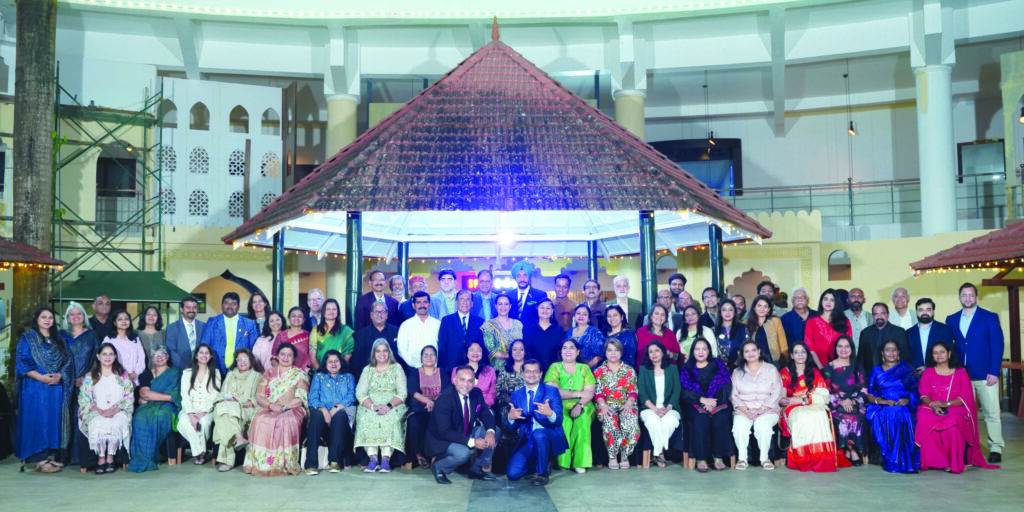 Although initially some school promoters and principals expected these Leadership Retreats to be networking jaunts, they confess to a pleasant surprise. These events are serious workshops in which the country’s best educationists and school leaders deliberate upon ways, means and strategies to prepare primary-secondary children to take on the challenges of the new millennium, in which revolutionary digital and AI technologies have transformed workplaces.
 The theme of the first Retreat at Dharampur (2024) was ‘Empowering Changemakers & Transformative Leaders’ and the Varanasi Retreat: ‘Future Proofing Education: Navigating School Safety, Student Success and Brand Resilience’. Following on, the theme of the recently concluded Wayanad Retreat hosted by the Kozhikode-based high-ranked CBSE and Cambridge-affiliated Sadhbhavana World School was ‘Connecting Thoughtful Leaders to Purposeful Schooling’.
A unique feature of these thoughtfully curated EW-BSAI Retreats is that the programme goes beyond conventional lectures and academic presentations. Under this tripartite partnership, the host school introduces delegates to the geography, landscape and cultural character of the host habitat, enriching delegates’ learning experience. Therefore, during the second retreat, Dr. Deepak Madhok and Dr. Bharti Madhok, promoter-directors of the Sunbeam Group of Educational Institutions, masterminded a ‘cultural immersion’ as an introduction to Varanasi, famously described as the world’s oldest, and most sacred hub of Hindu civilisation and culture.
This time round, Dr. K.E. Harish, promoter-CEO of the Sadhbhavana World School, orchestrated an excellent itinerary to introduce delegates to the natural charms of Wayanad, a hill station sited 2,100 ft above sea level with sweeping vistas of mist-clad hills, forested valleys, lakes and rolling tea, coffee and spice plantations. Over three days, delegates also explored the serene Pookode Lake, tea/spice plantations, embarked on guided nature walks and participated in rejuvenating yoga sessions.
February 5, Day 1. Delegates were welcomed by BSAI office bearers and EW personnel at Vythiri Village, an eco-resort spread over 20 acres of forested hills and plantations, and venue of the retreat, between 12 noon-2 pm. After lunch, they were taken on a guided tour of the forest-fringed Pookode Lake, including an hour-long boating experience.
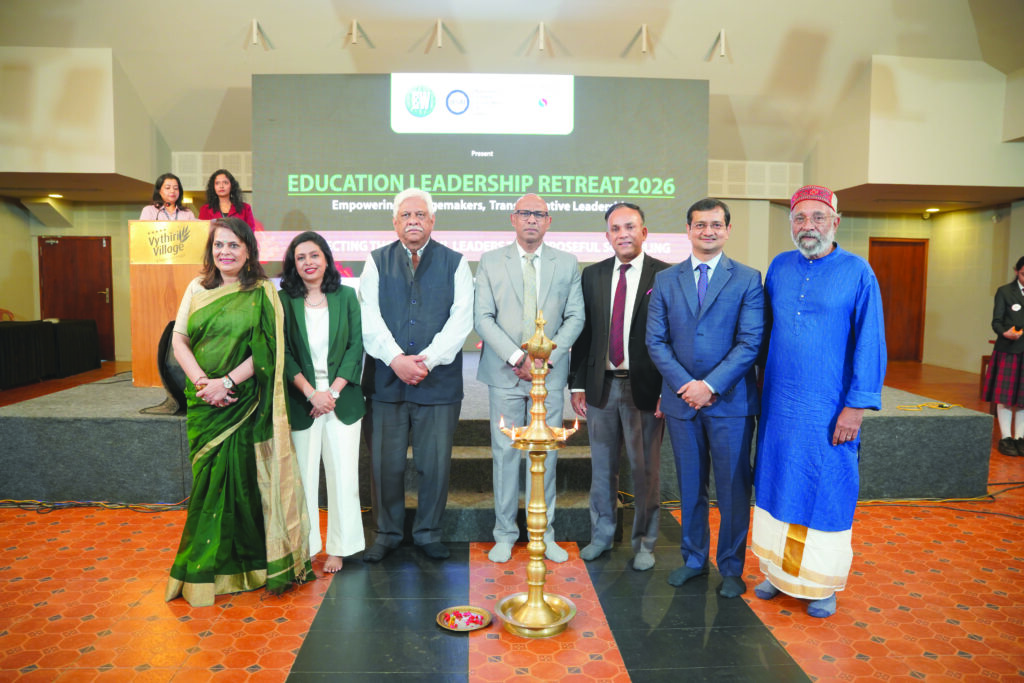
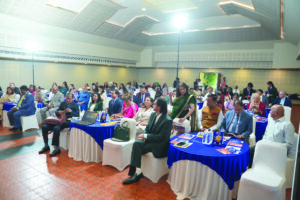
After tea and refreshment, the Education Leadership Retreat III was formally inaugurated in the resort’s poolside red-tiled Pandal auditorium with a lamp-lighting ceremony and inaugural address by Capt. A.J. Singh, President of BSAI (regstd. 2021), whose 69 member schools include the top-ranked Mayo College, Ajmer; The Doon School, Dehradun, and Scindia Kanya Vidyalaya, Gwalior, among others.
In his 30-minute inaugural address, Singh exhorted school leaders to reimagine the purpose of education beyond board examination success to prepare students to succeed in the new BANI — brittle, anxious, non-linear and incomprehensible — world. Observing that contemporary schooling remains disproportionately focused on IQ and cognitive development, he made a strong pitch for school principals and managements to also develop children’s emotional and social quotients (EQ and SQ). “Schools have concentrated for too long on developing children’s IQ; the real challenge before us is to develop children’s EQ and SQ — their capacity for empathy, ethical judgement, self-awareness and responsible decision-making. Purposeful education must enable students to distinguish right from wrong and rise above bias, ego and short-term success to nurture into ethical, compassionate and resilient citizens. Marks and degrees may help children secure livelihoods, but it is EQ and SQ that will prepare them to succeed in the BANI world,” said Singh, an alumnus of the National Defence Academy, Khadakvasla and Indian Military Academy, Dehradun, and executive director of the fully-residential co-ed Pinegrove School, Dharampur (Himachal Pradesh).
The inaugural address was followed by traditional Kerala music and dance performances by exceptionally talented local artistes, before the evening ended with an excellent poolside dinner.
February 6, Day 2. The day began early on a misty morning with some enthusiastic delegates attending a Yoga and Pranayama session conducted by Yoga Master Prashanth amidst the serene, green environs of Vythiri Village. Following a traditional Kerala breakfast, delegates convened at the resort’s spacious Pandal auditorium.
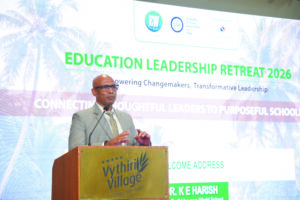 In his welcome address, Dr. K.E. Harish, CEO of the host Sadbhavana World School (SWS), thanked the 100-plus delegates for travelling long distances to participate in the Retreat. In a brief and engaging speech, he outlined that the institutional objective of SWS is to “nurture children into humane and compassionate citizens”. “The overarching purpose of education is to support human unfolding — physically, emotionally and intellectually. Schools exist to serve the child, not business or political agendas, and should nurture children’s intellectual curiosity, emotional resilience, and physical fitness. Education must go beyond academics to develop healthy bodies, balanced minds and responsible citizens who are prepared not only to earn livelihoods, but to lead life with wisdom and purpose,” said Harish.
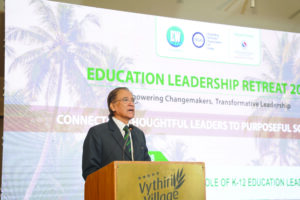 The Keynote Address titled ‘Critical Nation Building Role of K-12 Education Leaders’ was delivered by Dilip Thakore, Publisher-Editor of EducationWorld. Lamenting that adequate investment in education has been consistently neglected by the Central and state governments — evident in their failure to increase national spending on education to 6 percent of GDP as recommended by the Kothari Commission way back in 1967 — Thakore called upon school leaders to play a more proactive role in developing the nation’s human resource. “A heavy responsibility to develop India’s high-potential but neglected human resource has devolved upon private schools which mentor 48 percent of the country’s 240 million school-going children. Although it is rarely acknowledged, our 450,000 private schools have discharged a major national duty in educating and developing India’s 400 million-strong middle class which overwhelmingly prefers private school education. But now in the new age of digital learning and artificial intelligence, India’s middle class is in danger of falling behind their counterparts in Western nations and in particular China, which is racing ahead with a per capita income of $13,687 against India’s $2,878. Therefore, there is a new additional responsibility that has devolved upon trustees, principals and teachers of private schools to ensure that their schools shed outmoded rote-based learning and transform into 21st century institutions that develop digital age analytical, critical thinking and research capabilities of their students,” said Thakore.
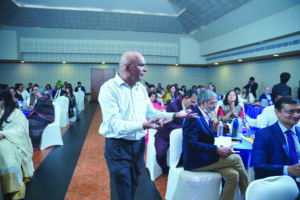 Subsequently, the first Masterclass of the day was conducted by ‘enthusiasm specialist’ and motivational speaker Suresh Srinivasan, on the subject ‘The Joy Advantage in Education: Why Happy Teachers Create High-Performing Schools’. In his interactive and highly appreciated 60-minute Masterclass, Srinivasan, adjudged the No.1 trainer in Asia-Pacific, South Africa & Australia by the Dale Carnegie Foundation, emphasised the importance of teacher wellbeing in building effective schools. Highlighting pressures confronting teachers — constant expectation, fear of judgement, comparison culture and lack of appreciation — Srinivasan lamented that too many teachers are losing their sense of purpose and joy, which inevitably affects teacher-student engagement and learning outcomes. “Schools chase exam results and rankings, but classrooms run on emotions with teachers setting the emotional temperature of the room — a calm, joyful teacher creates an engaged classroom, while a stressed teacher generates stress all around. Joy does not mean entertainment or lack of discipline; it means inner steadiness, meaning and emotional safety. Performance is an outcome — joy is the cause. If we want happy children and better learning outcomes, we must first protect the joy of those who teach them,” said Srinivasan, who has trained over 70,000 personnel in 140 corporates worldwide.
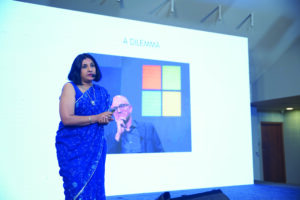 Following a brief tea break, the second Masterclass was conducted by Urvashi Malhotra, a clinical psychology graduate of Delhi University and NIMHANS, Bengaluru, leadership coach and co-founder of Reflexion, a Bengaluru-based boutique consultancy providing leadership development and organisational transformation coaching to over 50 corporates.
In her 45-minute Masterclass titled ‘Turning Vision into Impact: Making School Strategy Work on the Ground’, Malhotra guided school leaders through practical strategies to convert vision statements into visible classroom change, drawing on American management guru John Kotter’s eight-step change framework. “Change cannot be effected by vision statements framed on school walls. School leaders must ask themselves what constitutes success in classrooms. Create urgency using data, build committed teams, remove barriers that prevent action, celebrate small wins and keep momentum alive through the academic year. Real transformation happens only when change is driven by recruitment practices, evaluation and daily culture — when everyone in the school can explain what the vision means in action,” said Malhotra, urging delegates to graduate from aspiration to implementation.
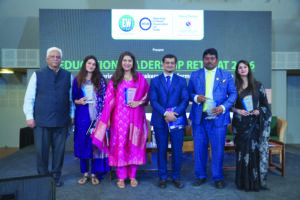 The much appreciated Masterclass presentations were followed by the first high-powered panel discussion of the Leadership Retreat which debated ‘Visibility vs Credibility – What School Leaders Must Get Right in Parent Communication’. The star panelists included Dr. Snehal Pinto, Director, Ryan International Group of Institutions, India’s largest private schools chain with 150 schools countrywide; Shraddha Bhat, Brand Director, Children’s Academy Group of Schools, Mumbai; Lt. Gen. (Retd.) Surendra Kulkarni, Former Director, Mayo College, Ajmer; Dr. Hari Krishna Maram, Founder-Chairman, Imperial College, Bengaluru; Komal Pahuja, General Manager — Projects, GEMS Education India. The panel deliberations were moderated by Bhavin Shah, CEO of EducationWorld.
“The panelists were unanimous that in an era where school communication is increasingly driven by media — especially social media — visibility, transparency and credibility must take precedence over optics. While achievements such as student success in competitive exams, international university admissions and impressive infrastructure are markers of success, panelists stressed that credibility is built by communicating the quality of everyday schooling to parents — classroom practices, teacher effectiveness and consistent learning outcomes. They emphasised that school-parent communication must move beyond promotional narratives to transparent sharing of teaching-learning practices, governance processes and student progress data to build institutional credibility,” said Shah who chaired the panel discussion, which sparked a lively debate among delegates.
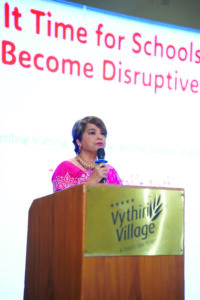 In the post-lunch session of Day 2 of the recently concluded Leadership Retreat, delegates were treated to an excellent ‘Circle of Knowledge’ presentation by Dr. Vandana Lulla, Director, Podar International School (IB/Cambridge), Mumbai on the subject ‘Is it Time for Schools to Become Disruptive? Reinventing Learning, Well-being, and the Purpose of Education — The Uncomfortable Truth.’ Dr. Lulla challenged leaders to rethink traditional schooling models in the new AI-shaped world. “If AI can outperform students on tasks, the problem is not the child — the problem is the task,” said Lulla, urging leaders to “embrace disruption as a leadership responsibility, integrate AI as a learning partner, prioritise student wellbeing as a precondition for excellence, and build cultures of trust, courage and innovation to prepare students for an unpredictable future”.
Dr. Lulla’s thought-provoking address was followed by an informative presentation by Prateek Kedia, founder and managing director of Intellicraft, a cutting-edge AI-driven ERP platform developed by the Mumbai-based IDCLE Tech LLP. During his 15-minute address, Kedia explained how Intellicraft’s ERP that streamlines administrative tasks, enables education institutions to “operate more efficiently, enhance productivity, foster collaboration, and ultimately improve students’ learning outcomes”.
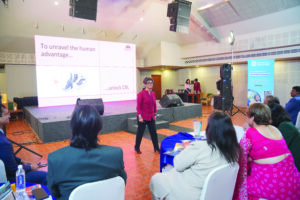 The third Masterclass of the day was conducted by Sangita Chima, former principal of The Lawrence School, Lovedale and Amity International School, Dubai and Lead Learner at Ehdzaan Pedagogy LLP, a curriculum design and learning organisation based in the Nilgiris.
In her 30-minute Masterclass on the subject ‘Competency-based Education — Unlocked Live’, Chima urged school leaders to shift focus from syllabus coverage towards competency development, stressing that education must focus on building students’ capability to apply knowledge, think critically and relate learning to real-life contexts. “Schools need to move beyond rote learning and memory-driven assessment toward developing students’ reasoning, conceptual understanding and problem-solving skills. The real measure of learning is not how much content has been covered, but whether students can use what they have learned in unfamiliar situations,” she said.
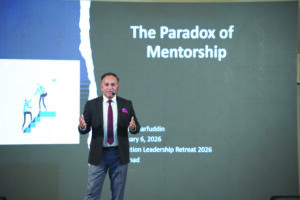 After a tea break, the over 100 delegates reassembled for the second ‘Circle of Knowledge’ presentation by Rashid Sharfuddin, Vice President of the Boarding Schools Association of India and former headmaster of the top-ranked Selaqui International School, Dehradun, on the subject ‘The paradox of mentorship’. In his brief 15-minute presentation, Sharfuddin reflected on the rising importance of mentoring, describing it as “the process of guiding students to think better, decide wiser, and act more confidently — so that, over time, they no longer need guidance.” Explaining the difference between guidance and dependency; experience and relevance, and protection and risk, he urged school leaders to ensure mentorship builds autonomy rather than imitation.
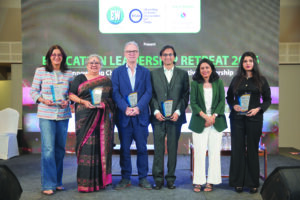 The second panel discussion of the Retreat was titled ‘Many Futures, One School – Enabling Diverse Student Choices’. It featured a set of highly experienced K-12 education leaders — Nooraine Fazal, Co-founder, CEO & Managing Trustee, Inventure Academy, Bengaluru; Dr. Nafeesa Ahmed, Vice Chairperson of the Bengaluru-based Presidency Group of Institutions; Himanshu Dev, career counselor, Access USA; Dr. Chris Stevens, Director, Education — Heritage Xperiential Schools, Gurugram and Debika Chatterji, Director-Principal, JBCN International School, Mumbai. This lively panel discussion of 60 minutes was moderated by Summiya Yasmeen, Managing Editor, EducationWorld.
“Unsurprisingly, the panelists were unanimous that the traditional one-size-fits-all model of schooling is obsolete and unsuitable for the new digital AI age. They all agreed that school leaders must consciously provide multiple pathways to students beyond the conventional college-to-career trajectory. They concurred that schools need to redesign curriculums, pedagogies and assessment systems to support diverse student pathways and develop students’ creative, vocational and entrepreneurial capabilities. Moreover, they stressed the importance of providing students early career exposure through industry and higher education partnerships while building strong teacher development programmes and career guidance systems to help students make informed decisions. The panel also underscored the need for transparent teacher-parent engagement to shift mindsets from ‘safe careers’ towards ‘fit and fulfilment’,” summarised Summiya Yasmeen.
The stimulating panel discussion was followed by presentation of the EducationWorld TREE (Teacher, Researcher, Edupreneur, Educationist) Awards 2026. From last December onward, advertisements on our website (www.educationworld.in) and social media invited nominations — including third-party and self-nomination — from teachers, researchers, edupreneurs and educationists countrywide for the TREE Awards 2026. Over 80 nominations with detailed CVs were received. Of them, 20 were selected and conferred specially designed awards (see p.70).
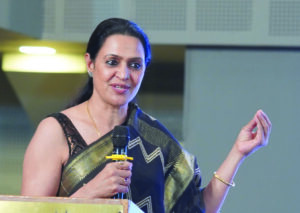 Subsequently, delegates were treated to three brief (15-minute each) ‘Circle of Knowledge’ presentations: ‘The Transformative Story – Where Dreams Rise Beyond Economic Barriers’ by Nisha Bhakar, CEO (Education) of the Hyderabad-based Vishwa Samudra Group, during which she narrated the inspiring story of the group’s Nandha Gokulam Life School, a free-of-charge, fully residential CBSE school in Nellore (Andhra Pradesh) that provides high-quality education to underprivileged male children.
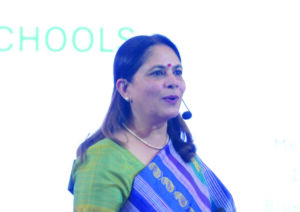
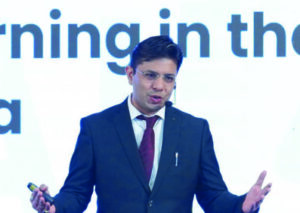 The other presentations were ‘From Classrooms to Life Outcomes: The New Role of Schools’ by Meenu Arora, Counselling Psychologist and Director of iDC BlueSpring, who urged school leaders to shift from exam-focused education to nurturing children’s life-readiness, emotional resilience and long-term adaptability; and ‘Teaching-Learning in the AI era: From Content Coverage to Cognitive Transfer’ by Dr. Akash Agarwal, assistant professor, Rajkiya Engineering College, Kannauj (UP), who highlighted the importance of competency-based learning to develop children’s critical thinking and knowledge application skills.
 For the fourth and final Masterclass of the retreat titled ‘Experiential Learning Through the Environment’, delegates strolled across to the resort’s open-air gazebo ‘Spice Boat’. Here they were presented with an interactive, experiential Masterclass conducted by Dr. Sumer Singh, Patron of BSAI and President, MU20 Opportunity School, an Indore-based organisation that “empowers high school students through leadership bootcamps, global summits, online challenges, etc”. During the one-hour session, delegates participated in a learning-cum-research exercise, to practically learn the importance of developing children’s curiosity and agency through questioning, collaborative research, and reflective discussion.
This hands-on Experiential Masterclass was followed by a Musical evening-cum-dinner hosted by the Sadhbhavana World School on the neatly manicured lawns of Vythiri Village Resort, during which several delegates were entertained with retro songs.
 February 7, Day 3. The final day of the retreat began as usual with an early morning Yoga and Pranayama session for “cognitive clarity, emotional balance, and leadership resilience” conducted by Yoga Master Prashanth. This was followed by a 20-minute guided walk through the resort’s nature trails. Over breakfast, delegates exchanged informal reflections and learnings of the retreat. This was followed by optional ‘Nature Encounters’ to Pookode Lake, Lakkidi Viewpoint and neighbouring tea estates.










Add comment