






Mailbox
Unflinching diagnosis
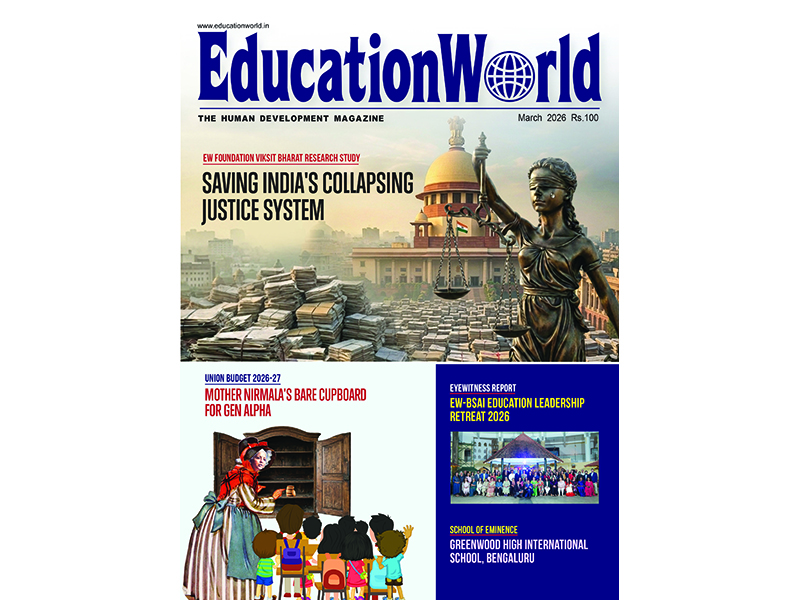
I read with interest your well-researched cover story ‘EW Foundation’s Viksit Bharat Research Study: Saving India’s Collapsing Justice System’ (EW March), highlighting the urgent need for judicial reform. Its diagnosis is unflinching: a system weighed down by a mounting 50 million cases backlog, routine delays, and procedural drag that has steadily eroded public confidence in the justice delivery system.
EducationWorld Foundation deserves rich praise for presenting a roadmap for actionable reform. Your focus on process redesign, disciplined use of AI technologies, and sustained coordination between the judiciary, executive, and the Bar provides a credible pathway forward. The real test, however, lies in execution. Without clear timelines and measurable outcomes, even well-conceived reforms risk dissipating into inertia.
Tamanna Shah
Mumbai
Inadequate depth
Your latest March cover story on judicial reform sounds more aspirational than analytical. That India’s courts are burdened with millions of pending cases rooted in procedural delays is not unknown, yet your cover story stops short of critically examining why past reforms have failed.
The tone leans towards advocacy rather than rigorous inquiry, glossing over deeper institutional challenges. Overall, the story raises concerns but lacks the depth and practical roadmap needed to drive real change.
Prathima Naidu
Gurugram
Not optional
I share your concerns in your editorial ‘Sustained Neglect of Rural Development’ (EW March). Even though rural India is the backbone of our country and 60 percent of the country’s population resides in villages, it has been systematically neglected. Limited access to quality education, inadequate infrastructure and scarce employment opportunities have widened the urban-rural divide.
Poor quality schools, colleges and universities deny rural students their rightful opportunities for economic and social advancement. Politicians and policymakers must recognize that strengthening rural India is not optional, but fundamental to building an equitable and prosperous nation.
Deepika Rajgopalan via email
Timely essay
Your Teacher-to-Teacher essay ‘Mental Healthcare is No Longer Optional’ (EW March) is a timely call for action. Author Dr. Derick H. Lindquist has rightly stressed the urgent need to prioritise students’ mental well-being within India’s education system.
The essay underscores how academic pressures, digital influences, and societal expectations are intensifying mental health problems among young people, and sensitively identifies social stigma as a major barrier to seeking help. Mental health support must be urgently prioritised in schools, colleges, and workplaces to ensure individuals — and society — can genuinely thrive.
Rajesh Koothrapalli
Hyderabad
Balanced approach call
Your Education News report (EW March) on the Karnataka government’s proposed ban on smartphones for school children across the state, though well-intentioned, is unlikely to address the issue effectively. We are living in the post-Covid era, where hybrid learning is integral to education.
While concerns regarding mental health are valid, an outright ban overlooks the plus side of digital literacy in today’s interconnected world. Smartphones serve as valuable tools for education, research, and communication. Rather than imposing a complete ban, a more balanced approach would be to encourage judicious, supervised usage by children.
Raman Desai
Mumbai
Commendable initiative
Congratulations on the EW-BSAI Education Leadership Retreat 2026 held in Wayanad, Kerala (EW March). This is a commendable initiative to bring together India’s most forward-thinking educators to encourage reflection and meaningful dialogue on upgrading India’s K-12 education system to meet the challenges of the AI age.
The retreat’s excellent theme and Masterclass topics are particularly noteworthy for inspiring school leaders to think beyond academic results and focus on holistic education, student wellbeing, and institutional growth. Such thoughtfully curated conclaves play a vital role in shaping progressive leadership and strengthening the future of education in India.
D. Chenoy
Kochi








Add comment