






Delhi: Suspect autonomy
– Nivedita Sharma (Delhi)
A comprehensive primary-secondary textbooks revision exercise led by the Delhi-based National Council of Educational Research and Training (NCERT), an “autonomous” subsidiary of the Union education ministry, has got off to a bad start.
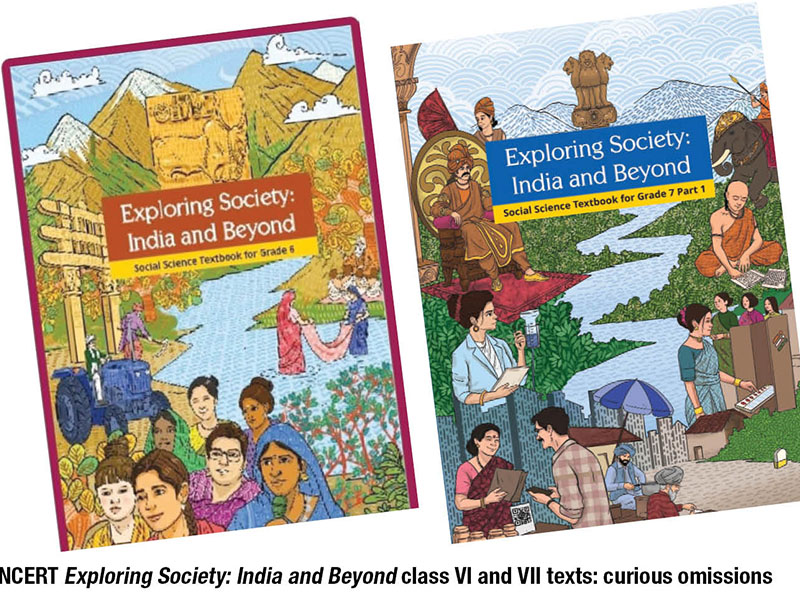
The first series of textbooks for classes I-VIII included Exploring Society: India and Beyond, a social sciences textbook for class VII students which made references to the judicial system’s huge (over 50 million) pending cases backlog and “corruption in the judiciary”. As reported last month (March), this reference aroused the wrath of the Supreme Court and Chief Justice Surya Kant who ordered the immediate withdrawal of the textbook — commissioned and printed by NCERT, India’s largest school texts publisher — and a ban on the authors from writing any more textbooks for NCERT.
The new textbooks for primary-secondary schools are being introduced in stages. Most books for classes I-VIII are already in circulation. For classes IX-X, they are likely to be introduced at the start of the academic year 2026-27, for classes XI-XII at the start of the 2027-28 academic year. Bridge programmes have been introduced to facilitate teachers and students to transition to the new syllabus without disrupting the teaching-learning process.
But hardly has the uproar over premature criticism of the judiciary abated, a new row has broken out over historical omissions in the new class VII social sciences textbook which replaces three separate books of history, geography, and social and political life, which were earlier part of the syllabus. The new textbook hasn’t included any reference to the rule over the subcontinent of the Delhi Sultanate (1206-1526) and Mughal emperors (1526-1857).
However, it has several chapters on kingdoms of ancient India such as the Gupta empire, dynasties including Shungas, Satavahanas, and Chedis and also mentions the prophecies of the Vishnu Purana about the Gupta Empire, Nalanda University, Kalidasa, Aryabhata, and Varahamihira. NCERT officials are less than forthcoming about whether Exploring Society: India and Beyond Part-2 for class VIII students scheduled for release later this year, will include these important missing chapters. The consensus is that if at all, they will receive cursory attention.
Not a few historians and academics believe that these omissions relating to six centuries of Islamic rule over India fits in beautifully with the agenda and propaganda of the ruling BJP at the Centre which prefers to belittle the contribution of Islamic rulers to national development. Therefore, questions have arisen about how autonomous is NCERT, which is formally designated an autonomous subsidiary of the Union ministry of education. Right wing historians also cite numerous examples from previous era history and other textbooks that gloss over the atrocities of Islamic invaders from Central Asia for whom India in the 12th to 18th centuries, was a frequent loot and proselytization playground.
In the circumstances, there is a groundswell of informed opinion that favours real rather than nominal autonomy for NCERT. Informed educationists are unanimous that children need to be insulated from subjective histories written and rewritten to suit the ideology of ephemeral parties ruling at the Centre and in states. They need to learn the good, bad and ugly history of the country, warts and all.
As a society registered under the Societies Act 1860 and a handmaiden of the Union education ministry for whom it is dependent for funding, appointments and policy direction, NCERT is unlikely to be able to exercise significant autonomy.
“Bodies like the University Grants Commission (UGC) and AICTE (All India Council for Technical Education) are independent regulatory bodies for higher education and established by Acts of Parliament, with clearly defined powers, governance structures, and accountability mechanisms. However, there isn’t any independent statutory regulatory body for K-12 education despite it being an important guideline set by NEP 2020 for addressing evolution of school education in India. Perhaps, it would be a good idea to start with NCERT by investing it with academic and functional independence. This will give the council greater insulation from day-to-day executive influence, while making it accountable to the public,” says Vinesh Menon, an alum of IIM-Calcutta, former banker, former CEO of Vibgyor/Ampersand, and founding CEO of the Delhi-based ARISE (Association for Reinventing Indian School Education), an association of independent private schools.
Adds Dinesh Gupta, Founder-CEO of the Delhi-based Viklap Online School: “A truly independent NCERT is an urgent necessity. It would result in academic freedom, research-driven curriculum design, and overdue high-quality education standards in K-12 education.”
P.S. As we go to press on March 30, NCERT has been awarded the status of a deemed university with degree granting powers. At this time, the status of its K-12 curriculum design and school textbooks writing and printing is not clear.








Add comment