






Why Brand Identity Is the Real Foundation of New Schools
– Rohit Mohindra, Director at Raj Mohindra Consultants & Amisha Beri, Partner at Rite Angles Consulting
A school does not begin when its gates open. It begins much earlier — quietly, and often invisibly — in the minds of families, educators, and communities who are already forming perceptions about what the institution represents.
In the absence of legacy markers such as board results, university placements, or alumni outcomes, early-stage schools are evaluated on something less tangible but equally powerful: clarity of intent. What does the school stand for? What kind of learning experience does it promise? And, more importantly, can that promise be trusted?
It is in this context that brand identity assumes strategic importance — not as a marketing layer, but as a foundational discipline.
From Vision to Articulation
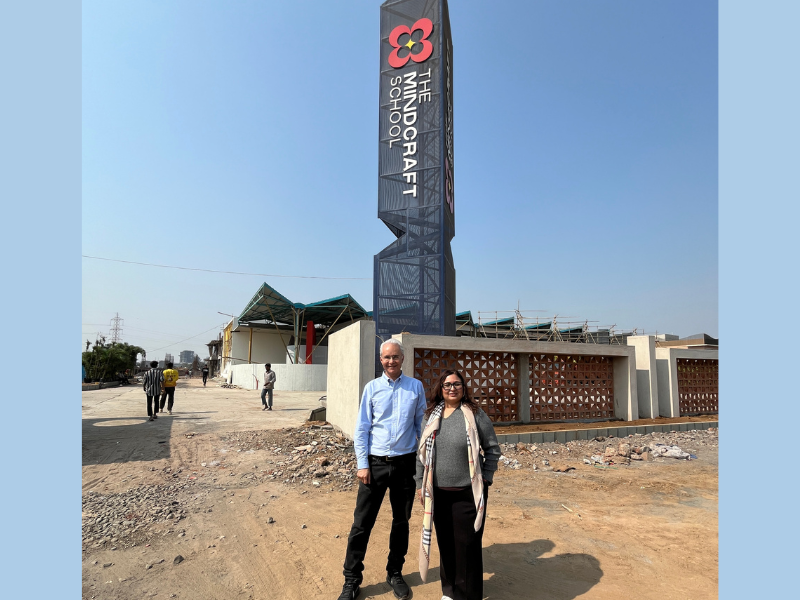
The development of Mindcraft School in Surat offers a useful case study in how early-stage educational institutions can approach identity-building with rigour.
The project was led by Rohit Mohindra and his team at Raj Mohindra Consultants (RMC), whose work has focused on conceptualising and operationalising new school ventures across India. Critically, the starting point was not infrastructure or curriculum planning, but founder alignment.
RMC partnered with Rite Angles — a strategy and brand consultancy with a focused practice in education — to ensure that institutional identity was articulated well before any external communication began. Through a series of structured engagements, the founding team was encouraged to move beyond generic aspirations of “quality education” toward more precise questions of purpose, relevance, and context. Simultaneously, detailed research was conducted into parent expectations and local education dynamics across Surat and the adjoining Kamrej region.
This collaborative model — combining project-led educational planning with research-led brand thinking — enabled the articulation of a coherent institutional identity before a single brick was laid.
Research as Strategic Input
The findings from the field pointed to a nuanced parental mindset. Families were aspirational and increasingly aware of global benchmarks, yet decision-making remained cautious and transactional. A recurring concern was the gap between what schools promise during admissions and what families actually experience thereafter. Parents across the research cohort expressed a clear appetite for stronger communication skills in students, more engaged and better-trained teachers, and learning environments that move meaningfully beyond rote frameworks.
Importantly, these insights were not treated as a checklist of features to be marketed. Instead, they informed a more fundamental question: what kind of school would be meaningfully relevant in this context?
That shift — from research as validation to research as direction — is what distinguishes a considered institutional launch from a reactive one.
Identity Before Infrastructure
One of the distinguishing aspects of the Mindcraft project was the deliberate sequencing of decisions. Rather than allowing infrastructure and facilities to define positioning — a common pattern in new school launches across India — the leadership prioritised identity definition as a precursor to design and delivery.
This led to the development of the M.I.N.D. framework, centred on Meaning, Intention, Nurture, and Direction. Not a curriculum in itself, the framework functions as a decision-making lens, informing academic design, student experience, and communication in equal measure.
Such an approach reflects a broader and welcome shift in education planning: one in which philosophy precedes execution, ensuring that subsequent investments — whether in campus, faculty, or programmes — remain coherent expressions of a single, well-considered vision.
From Philosophy to Practice
A clearly articulated identity has tangible downstream effects.
In the case of Mindcraft, learning spaces were conceptualised as active environments that encourage movement, expression, and hands-on engagement. Academic planning was aligned with inquiry and application rather than content coverage alone. The communication strategy was built around specific, demonstrable intent — deliberately avoiding the generic superlatives that crowd the education marketing landscape.
The role of strategic partners in this process is worth noting. While RMC anchored the overall school development and ensured alignment across planning stages, Rite Angles translated the emerging philosophy into a structured brand narrative, ensuring consistency across all stakeholder touchpoints. Neither role is interchangeable; both are necessary.
Implications for Families and Educators
For parents — particularly in emerging urban centres where school options are multiplying rapidly — clarity of positioning reduces uncertainty and enables more informed decision-making. Families that understand what a school genuinely stands for are far better positioned to assess whether it is the right fit for their child.
For educators, a well-defined institutional philosophy functions as a critical alignment tool. Early hires in a new school play a disproportionate role in shaping culture. A clear identity helps attract teachers who are not only competent but also philosophically aligned — a distinction that compounds significantly over time.
Brand Identity as Institutional Responsibility
There is also an ethical dimension to this discussion, and it deserves to be addressed directly.
Educational institutions operate on trust. Overstated claims or ambiguous positioning may accelerate admissions in the short term, but they risk eroding credibility over time — and the consequences, in institutions that shape children’s formative years, extend well beyond reputational damage.
This places responsibility not only on founders but also on the advisors and consulting partners involved in school development. The task is not merely to create appealing narratives; it is to ensure that what is communicated is both authentic and deliverable.
Marketing amplifies a message. Identity defines it. Without the latter, the former risks magnifying inconsistencies.
A Considered Beginning
Mindcraft School is yet to commence operations. Like many new institutions, it does not have outcomes to showcase. What distinguishes its approach, however, is the emphasis placed on getting the fundamentals right at inception — on asking the harder questions before the easier ones, and on treating brand identity as a precondition for institutional credibility, not a consequence of it.
The collaborative model explored here — bringing together education project expertise and research-led brand strategy — offers a replicable framework for new school promoters across India. As the country continues to witness significant growth in private K–12 education, particularly in Tier II and Tier III cities, such approaches are likely to become not merely relevant but necessary.
Because in education, institutional credibility is not built only over time.
It is shaped at the very beginning — before the first bell rings.
Also Read: From Smart Services to Smart Campuses: A Digital Illusion or an Academic Imperative?











Add comment