






Karnataka: Education window dressing
–Reshma Ravishanker (Bengaluru)
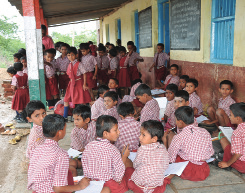
Government school students: belated guarantees
After successfully rolling out its five popular election guarantees — 200 units of free electricity per household; 10 kg of rice per person to below poverty line (BPL) households; free bus travel for women; Rs.2,000 per month for women heads of households, and Rs.3,000 for unemployed graduates — Karnataka’s Congress government has now rolled out new guarantees for government schools.
Confronted with steadily declining student enrolment in the state’s 49,300 government schools, on April 27, the state government splashed full front-page advertisements in leading newspapers announcing a package of eight “education guarantees” to upgrade the state’s public education system. Significantly, the announcement was timed a day after declaration of the class X SSLC (Secondary School Leaving Certificate) results, which recorded a 14.06 percent increase in pass percentage, up from 80.4 percent in 2025-26 to 94.1 percent this year.
The high-visibility “education guarantees” campaign is an initiative of the Congress government to restore confidence in government schools after three years of steady fall in enrolments. The number of children signing up with government schools has been steadily declining — from 4.54 million in 2022-23 to 4.29 million in 2023-24 and further to 4 million in 2024-25 — a 10 percent decline in three years with a growing number of parents preferring to admit their children in the state’s estimated 19,000 BPS (budget private schools) that offer — or claim to offer — superior English-medium education whereas government primaries provide Kannada or “mother tongue” as the medium of instruction. Official explanations for the exodus — placed on record in the state assembly — include absence of bilingual instruction (English and Kannada), deficit of pre-primary classes, teacher shortages, and non-provision of labs, laboratories and lavatories in government schools.
The state’s Congress government led by chief minister Siddaramaiah, now in its third year in office, promises to address these lacunae through its “eight education guarantees”. The guarantees include provision of one teacher per class in primary school (classes I-V) and subject-specific teachers from class VI onwards; introduction of optional English-medium stream in all government schools; free public transport for students attending clustered, better furbished Karnataka Public Schools (KPS); provision of IT education with dedicated teachers and early exposure to digital and AI learning; appointment of arts, music and physical education instructors to support holistic development; recruitment of separate non-teaching staff to reduce teachers’ administrative burden, and the introduction of skill-based education from class VI plus additional tuition for competitive examinations. The government has set a target of increasing enrolment in government schools to 5 million students within five years.
It’s a measure of the casual attitude of government ministers and officials towards public education which bottom-of-pyramid households are obliged to avail — most ministers and bureaucrats enroll their children in Karnataka’s show-piece private schools, some of which are of global standard — that these modest guarantees commonplace worldwide, are expected to win the Congress party the next assembly election due in May 2028.
The main obligation of the guarantees is recruitment of teachers — one teacher per class upto class V, separate teachers for computers, music, art, and physical education, introduction of skills education, and training teachers to teach in English. This will require recruitment of teachers on a massive scale. Currently, Karnataka faces a huge shortage of teachers — 45,590 teaching posts are vacant against the total sanctioned strength of 178,935 in the state’s 41,088 government primary schools. Filling up existing vacancies and recruiting new teachers will require a huge budgetary outlay.
Against this the state government has allocated 10.7 percent (Rs.45,286 crore) of its Budget 2026-27 towards expenditure for education — a lower percentage than of other states (averaging 14.5 percent). Against this, the budgetary allocation for freebies/handouts is Rs.51,286 crore.
According to Prof. A.S. Seetharamu, former professor of education, Institute of Social & Economic Change, Bengaluru, the Congress government’s education guarantees have a chance of succeeding only if the state government goes ahead with its KPS (Karnataka Public Schools) magnet scheme under which small government schools (often with fewer than 50 students) are clustered with KPS institutions to create composite, well-equipped K-12 schools with average enrolment of 1,200 students.
“The state government will be able to implement its education guarantees only if small under-resourced government schools are merged or clustered into 6,000 KPS schools — one in every gram panchayat of the state. Students’ learning outcomes will improve if they study in well-resourced composite campuses. But this requires the government to ensure good rural roads and free dedicated school buses to enable children to attend KPS schools conveniently and safely. This will require the state government to launch a massive teacher recruitment and training programme and substantially increase its budgetary outlay for education,” says Seetharamu.
Obviously, the government’s expensive full-page ads in mainstream newspapers are mere window-dressing. The ads now have to be followed up with adequate budgetary provision for government schools to build “the best government school system in the country”. But the messy finances and wrong spending priorities of successive governments of Karnataka indicate that this goal is a long way off.









Add comment