






Andhra Pradesh: Shining new capital
– Priyanka Edupuganti (Hyderabad)
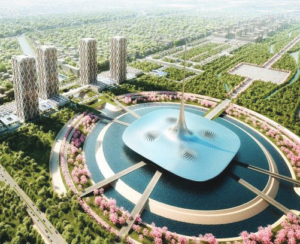
Amaravati table top model: built-in knowledge city
On april 7, 2026 president Droupadi Murmu gave assent to the Andhra Pradesh Reorganisation (Amendment) Act, 2026, formally designating Amaravati as the sole and permanent capital of Andhra Pradesh. Passed by both Houses of Parliament in Delhi, the amendment revises the original 2014 legislation and conclusively replaces the three-capitals framework of the previous YSR Congress government (2019-24), bringing to an end a decade-long policy ambiguity over the state’s administrative capital.
The back story of this historic decision is that after the bifurcation of undivided Andhra Pradesh into Telangana (pop.38-39 million) and Andhra Pradesh (50 million) in 2014 — following an uneasy interregnum of ten years when Hyderabad served as the joint capital of the two states — the latter was without a capital, as Hyderabad, the economic, administrative and cultural hub of undivided Andhra Pradesh was awarded to Telangana. Andhra’s loss was not merely geographic; it stripped the new state of its established ecosystem of universities, industries and governance infrastructure.
Over the subsequent decade, the question of a permanent capital remained unsettled, with policy oscillations between centralised and decentralised models. The recent decision of the Telugu Desam Party (TDP) government led by two-term chief minister of undivided Andhra Pradesh and since 2024 of new AP, N. Chandrababu Naidu to reaffirm Amaravati as the sole capital marks a decisive closure of prolonged uncertainty
Returned to office in 2014, Naidu was tasked with rebuilding a state without a capital or established ecosystem. However in 2019, Naidu and the TDP suffered a massive defeat in new Andhra Pradesh’s legislative assembly election with the YSR Congress Party securing a huge 151-seat majority in the assembly. The YSR Congress and Chief Minister Y.S. Jagan Mohan Reddy vetoed the Amaravati proposal introducing a three-cities capital envisioning Visakhapatnam as the executive capital, Amaravati as the legislative capital, and Kurnool as the judicial capital — a model of decentralised development. However, according to most academics and policy pundits, the three-capitals experiment proved unworkable in practice, prompting administrative delays, increased logistical costs, and diluted institutional focus.
Five years later in the state’s legislative election of 2024, TDP led by Naidu was returned to power with a massive majority of over 130 seats in the 175-strong legislative assembly, enabling a policy reset and resurrection of his plan to establish Amaravati as the sole capital, revive stalled infrastructure projects, and simultaneously push education and innovation-led initiatives.
Naidu’s renewed capital push is not merely an exercise in administrative consolidation; it is being framed as the foundation of a broader human capital development strategy. Both Naidu and his Stanford and Carnegie Mellon University-educated son and education minister, Nara Lokesh, have placed education at the centre of Andhra Pradesh’s long-term development plan with the explicit goal of transforming the state into India’s most highly educated and skill-intensive economy. In this context, Amaravati is envisioned not just as a seat of government, but as a deliberately designed knowledge capital being constructed with a substantial budget of Rs.50,000 crore.
Dr. Carol Upadhya, professor of sociology at the National Institute of Advanced Studies, Bengaluru sounds a note of warning. “In large-scale planned cities, there is often a tendency for physical infrastructure and land development to take precedence, with knowledge institutions such as universities and research ecosystems expected to follow later. However, it is advisable for education institutions to be planned and built as a foundational layer from the outset. This will prevent Amaravati from evolving primarily as an administrative and real estate project before it matures into a knowledge hub,” says Upadhya.
It’s well-accepted that 21st century India’s next growth spurt will not come from its overcrowded and unkempt metros and large cities but tier-I and tier-II habitations. After Chandigarh was designed and constructed by brilliant French architect Le Corbusier in the 1950s, no new towns or cities have sprung up on Indian soil to relieve the country’s hard pressed 374 cities with over 1 million population.
This time round, some of the world’s most respected town planners/architects including Surbana Jurong, a Singapore-based urban planning giant, which has prepared the overall city master plan (land use, zoning, transport networks, and urban structure); Norman Foster & Partners (legislative assembly, high court and secretariat) and Hafeez Contractor (local partner and collaborating architect) are designing AP’s new capital.
If Amaravati emerges as a well-planned state capital offering rare ease of living and a knowledge hub — as seems likely — Naidu won’t only quickly vault AP into India’s most developed state, but also earn a place of honour in history yet to be written.










Add comment