





West Bengal: Enduring long night
– Baishali Mukherjee (Kolkata)
The recently concluded legislative assembly election in West Bengal in which the Bharatiya Janata Party (BJP) bagged 208 of the 294 seats with Suvendu Adhikari taking oath as the state’s first BJP chief minister, marks a seismic shift in the state’s political landscape. The 2026 assembly poll is an electoral reckoning in which the state’s electorate punished the Trinamool Congress (TMC) led by three-term chief minister Mamata Banerjee for a decade of institutional collapse and relentless corruption, especially in the education sector.
As repeatedly highlighted by your correspondent, TMC’s usage of public education as a political transaction tool, permitting school infrastructure to crumble, and allowing recruitment scandals to fester, has denied millions of Bengal’s poorest children of upward mobility. This cynical betrayal ultimately transformed public outrage into a powerful ballot-box revolt, enabling the BJP to win Bengal for the first time.
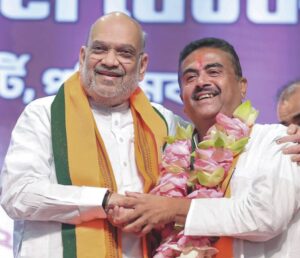
Suvendu Adhikari (right): nationalist pivot
During the three-term reign of TMC, Bengal’s school system has almost broken beneath the weight of TMC’s politicised governance and administrative decay. The multi-crore teacher recruitment scams of 2014 and 2016 were not merely corruption scandals, they provoked institutional implosion. Thousands of teacher appointments became trapped in litigation, investigations, and court interventions. Recruitment froze. Schools emptied. In stretches of rural Bengal, the number of single-teacher schools increased from 2,290 in 2023-24 to 6,482 in 2024-25 with huge numbers of children opting out. Meanwhile, 17,000 teachers are twiddling their thumbs in government schools with zero enrolment. The state’s secondary school dropout rates remain among the highest countrywide.
The extent of educational damage is exposed in the latest Annual Status of Education Report (ASER) 2024. Almost 30 percent of children in class VIII — one year before they enter high school — can’t read class II textbooks and 66 percent can’t manage simple division sums. These are not mere statistical deficiencies; they represent a foundational literacy emergency. To a great extent, the BJP’s victory was built on this collapse of rural education.
Against this backdrop, although Chief Minister Suvendu Adhikari’s NEP-2020 aligned education blueprint combines welfare restructuring with swift reforms such as capping school bags weight and abolishing early-grades homework, the new government has also quickly moved towards infusing BJP ideology into public education.
The mandatory recital of Vande Mataram in schools and madrasas marks a deliberate nationalist pivot signalling that classrooms under the new dispensation will not merely be academic spaces but also ideological arenas. With ideological and religious politicisation of education spaces in a state historically defined by pluralism and intellectual dissent, social tensions are likely to intensify.
Looming syllabus/curriculum revision battles are likely to prove unfortunate for Bengal’s children and youth in a state that has a long and hallowed intellectual tradition. Several Nobel Prize winners — Rabindranath Tagore (literature) and Amartya Sen and Abhijit Banerjee (economics) — were nurtured in this state. The intellectual decline of West Bengal began during 34 years of rule of Communist Party of India-Marxist (CPM)-led Left Front government (1977-2011) when public schools and undergrad colleges were massively infilterated by under-qualified CPM cadres and the state was de-industrialised by militant state-sponsored trade unionism.
Now there is widespread apprehension of the first-ever BJP government of the state infiltrating schools and academic institutions to spread half-baked RSS ideology and generating communal tensions inside classrooms.
The Bengal BJP’s propagation of projects like Vidyanjali reflects this shift. Under this model project, CSR funds, NGOs, and private institutions will be permitted in school maintenance, infrastructure development, and educational support. Left-aligned student organisations including the All-India Democratic Students Organisation promise fierce resistance, apprehending that corporate participation will eventually weaken state accountability, widen educational inequality, and impose indirect financial burden on poor households.
“If the “double engine” model fails to deliver transparency in teacher recruitment, industrial investment, jobs, and inflation relief within 24 months — or if the regime resorts to freezing recruitment and aggressively pushing privatisation through public-private partnerships, it will spark fierce public resistance,” warns Shatarup Ghosh, a prominent youth leader of CPM.
Clearly the long night of education institutions in West Bengal is not over.









Add comment