






More Than a Cheque: How the ARRA Scholarship is Rethinking What Students Need
For a parent, the maths of a scholarship is usually simple: Are tuition, accommodation, and books covered? For a student, it rarely feels that simple. There is the pressure of earning admission to a competitive course, the uncertainty of what comes next, the disorientation of a new city, and, often, the quiet question of whether they truly belong.
The Arunkumar & Ramniklal Mehta (ARRA) Scholarship, instituted by the Rosy Blue Foundation, was built around that second, harder problem.
Launched in 2024 in memory of Shri Arunkumar Mehta and Shri Ramniklal Mehta, founders of Rosy Blue, one of India’s leading diamond companies, the ARRA Scholarship is fully funded, covering tuition, accommodation, and living expenses for first-year undergraduate and postgraduate students admitted to top institutions in Management, Engineering, Architecture, Design, Medicine, Law, and other disciplines through highly competitive national entrance examinations. It is both merit- and means-based, open to applicants whose annual household income is below ₹35 lakh — a deliberate filter to direct support toward students who would otherwise struggle to afford these institutions, regardless of how well they have scored.
That part is familiar scholarship territory. What follows is not.
Before designing the programme, the Foundation studied scholarship and student-support models in India and abroad and identified a consistent gap: while most scholarships cover tuition, few continue supporting students once they are on campus, navigating academic pressure, adapting to a new environment, and managing the emotional challenges that accompany both. ARRA was designed to bridge that gap, treating financial assistance as the beginning of support rather than its entirety.
In practice, scholars are brought together as part of a connected community rather than recipients of individual award letters. They get access to mentors and professionals across business, technology, medicine, law, architecture, design, academia and social impact, and above all, to each other, at moments that matter: the first year away from home, a tough exam season, the start of a job search. For a student from a smaller town with a limited professional network, that access can matter as much as the fee waiver itself.
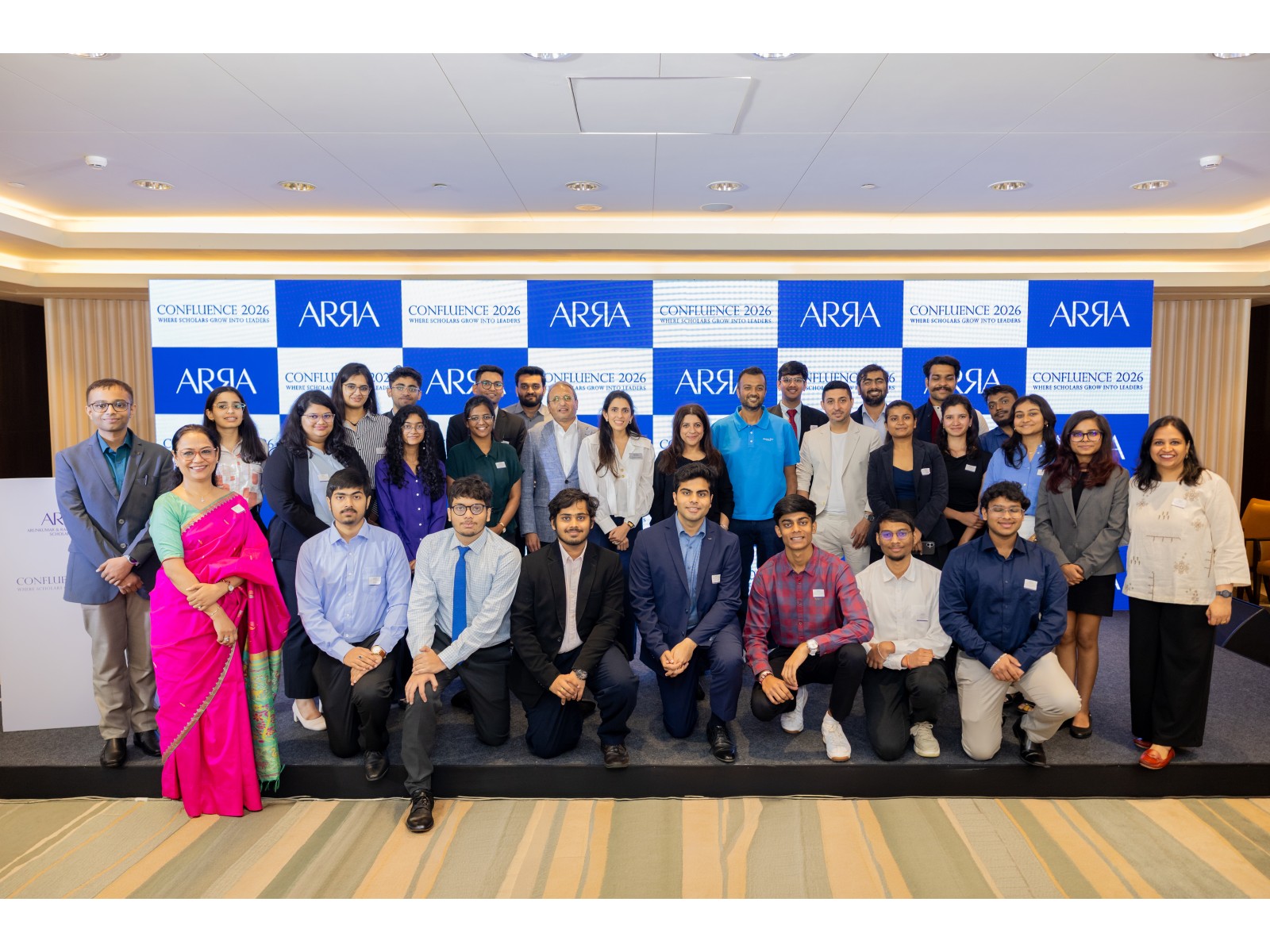
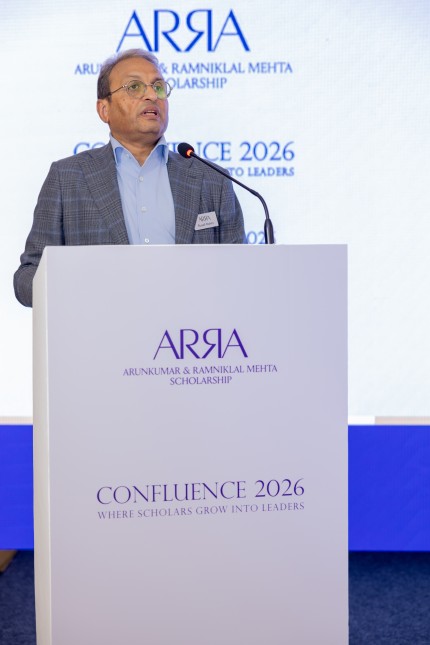
This sense of community finds its fullest expression in ARRA Confluence, the programme’s annual conclave. The inaugural edition, held in Mumbai on January 30–31, 2026, brought together the 2024 and 2025 cohorts for two days built around honest conversation rather than ceremony. Sessions such as ‘One Gift, One Ask’ encouraged scholars to contribute something to the community while also seeking support from it, reinforcing the idea that ARRA thrives on participation rather than funding alone. Speaking at the inaugural session, Russell Arunkumar Mehta, chairperson of the ARRA Scholarship and director of the Rosy Blue Foundation, said, “ARRA is not a transaction; it is a relationship… it is the community that truly changes trajectories.”
 Day 2 began with ARRA ThinkLab 2026, followed by a panel discussion titled ‘The Inner Game of Success,’ moderated by Shloka Ambani, director of the Rosy Blue Foundation. Featuring filmmaker Zoya Akhtar, architect Rooshad Shroff, and Harsh Jain of Dream Sports, the discussion explored failure, resilience, and defining success on one’s own terms—the kind of conversation students rarely encounter in even the best classrooms.
Selection works the same way. Academic excellence is the baseline, not the sole criterion: applicants are also evaluated on leadership, resilience, integrity and clarity of purpose, irrespective of caste, creed, religion, gender or socioeconomic background. In practice, the selection process includes a written statement and a personal interview alongside academic records — an attempt to understand who the candidates are, not just their academic scores. The current cohort is studying at IIT Delhi, IIT Bombay, IIM Ahmedabad, IIM Calcutta, IIM Bangalore, NID Ahmedabad, CEPT Ahmedabad, NLSIU Bengaluru, BITS Pilani, Seth GS Medical College Mumbai, and Ashoka University.
Well-being is given equal importance. Through a partnership with Sir H. N. Reliance Foundation Hospital, scholars have access to guidance and resources that support their overall well-being, making it an integral part of the programme rather than an afterthought.
What this means in practice is perhaps best captured in the scholars’ own words.
Shreya Seshadri (B.Sc., Ashoka University), one of the 27 students currently supported by ARRA, describes the scholarship as providing “a sense of quiet encouragement, the opportunity to build meaningful connections in a diverse community, endless access to resources and advice, and love and support.” Her father, Soundrarajan Seshadri, recalls the more practical side of it: “The scholarship came at a time when we were working on financial planning for my daughter’s university education. Ashoka and ARRA’s partnership supports parents like us who may not be able to afford the high fees needed to study in the best universities.”
Another ARRA alumnus, Jitesh Seth (IIM Ahmedabad graduate), shared, “Being part of ARRA’s first cohort gave me far more than financial support – it gave me mentorship, perspective, and a lifelong community. The regular interactions with the ARRA team helped me reflect on my MBA journey, while Confluence broadened my horizons. Today, I carry those learnings into my career and future entrepreneurial aspirations with deep gratitude.”
It is that combination — the financial relief a parent feels and the sense of belonging a student describes — that Russell Mehta points to when he says ARRA is “not a charity. It is a shared journey built on trust — trust that if young people are supported holistically, they will define success on their own terms and contribute to a better society.”
This philosophy also explains why the programme has stayed small by design. Rather than scaling up cohort sizes, ARRA has kept numbers limited enough for meaningful relationships to develop between scholars, mentors and the Foundation. There is no obligation attached, but scholars are encouraged, not required, to mentor the cohorts that follow them. This is the beginning of what the Foundation hopes becomes a self-sustaining alumni network, with former scholars carrying ARRA’s values forward on their own. Partnerships with top-ranked universities abroad are next, extending the model beyond India.
For a student or parent evaluating a scholarship, the distinction ARRA draws is simple: financial support may address the immediate challenge of paying fees, but what happens afterwards — the mentorship, the community, and the support during difficult moments — is the part most scholarships leave out. That is the gap ARRA was built to address.
Applications for the ARRA Scholarship Batch 2026 (Academic Year 2026–27) will open in phases between July and November 2026, in line with the admission timelines of partner institutions. Aspiring students can explore scholarship eligibility, courses covered, scholarship benefits, and the application process by visiting www.arrascholarship.org.
Also read: How a Tirupati School Is Building India’s Next Generation of Makers & Innovators








Add comment