





FORE School of Management launches new healthcare & hospitality, working professionals PGDM programmes
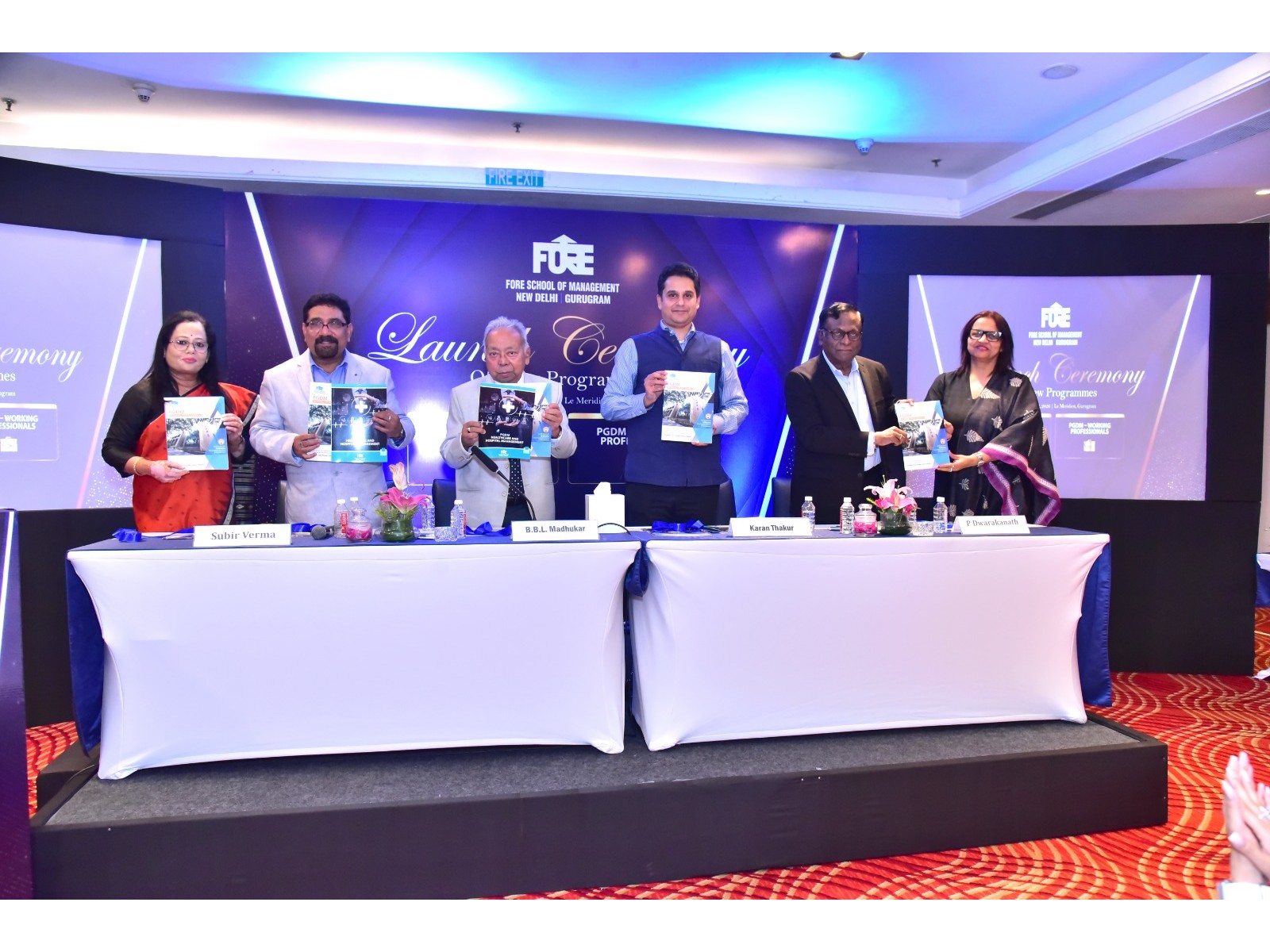
FORE School of Management (FSM) has launched two new postgraduate programmes – the PGDM (Healthcare and Hospital Management) and the PGDM (Working Professionals) – at a launch ceremony held at Le Meridien, Gurugram recently. The event brought together academic leaders, industry executives, and healthcare sector stakeholders to mark the expansion of FSM’s flagship PGDM portfolio.
The evening began with a welcome address by Dr. Subir Verma, director, FORE School of Management, followed by an insightful address from FSM president Dr. B.B.L. Madhukar.
Commenting on the launch of the new programme, Dr. B.B.L. Madhukar said, “As India progresses towards the vision of Viksit Bharat 2047, higher education institutions have a critical responsibility to create value for businesses, society, and the nation by nurturing future-ready leaders. The launch of our PGDM in Healthcare & Hospital Management and PGDM for working professionals reflects this commitment. While the healthcare programme is designed to develop leaders who can combine managerial excellence with empathy and technological understanding to strengthen India’s healthcare ecosystem, the programme for working professionals equips experienced managers with contemporary skills in AI, digital transformation, and strategic leadership. Developed in close collaboration with industry experts, both programmes embody our commitment to academic excellence, industry relevance and lifelong learning, preparing professionals to drive innovation, inclusive growth and meaningful societal impact.”
Dr. Subir Verma said, “The launch of our PGDM in Healthcare & Hospital Management and PGDM for working professionals reflects FORE School of Management’s commitment to developing future-ready leaders equipped to address the evolving needs of industry and society. The healthcare sector is undergoing a profound transformation, driven by digital technologies, artificial intelligence, connected devices, and data-driven care models. Through this programme, we aim to prepare professionals who can lead the next generation of smart healthcare systems by combining management excellence with technological innovation and patient-centric care. At the same time, our PGDM for Working Professionals builds on FSM’s long-standing legacy of executive education, offering experienced professionals the opportunity to strengthen their leadership capabilities while advancing their careers. Both programmes have been developed in close consultation with industry leaders and domain experts to ensure they remain relevant, practical, and aligned with emerging workforce needs. We look forward to working closely with our healthcare and corporate partners to continuously enrich these programmes and prepare leaders who will drive innovation, create meaningful impact, and responsive to the evolving needs of the profession.”
P. Dwarakanath, executive board member, FORE School of Management, delivered a special address highlighting the strategic significance of the new programmes.
“I congratulate FORE School of Management on launching these two highly relevant and contemporary programmes. Reviving or introducing a new programme is always a significant milestone, especially when it addresses the changing needs of industry and society. Healthcare today is very different from what it was 15 or 20 years ago. It has become corporatised and must be run with strong governance, leadership, systems and processes. Institutions that can integrate management excellence with healthcare expertise will play a vital role in preparing future-ready professionals. Likewise, in today’s rapidly changing world, learning is no longer an event it is a lifelong journey. As Satya Nadella rightly said, we must move from the mindset of ‘know it all’ to ‘learn it all’. The illiterate of the 21st century will not be those who cannot read and write, but those who cannot learn, unlearn and relearn. Technology, AI and business models will continue to evolve, but talent will always remain the constant. As the former P&G CEO famously said, ‘Take away my money, my buildings and my brands, but leave my people, and I will build the company again.’ That is why programmes like these are so important they build the talent and leadership that organisations and society will need for the future.”
Prof. Shilpi Jain, dean (Strategic Initiatives & International Accreditations), FORE School of Management, presented an overview of the two programmes, highlighting their curriculum, industry integration and career opportunities.
Speaking about the launch, she said, “With these two AICTE-approved programmes, our aim is to prepare future-ready professionals through a curriculum that is technology-enabled, industry-aligned and experiential. The PGDM in Healthcare and Hospital Management has been designed to develop leaders who understand both management and the evolving healthcare ecosystem. The curriculum incorporates inputs from international universities as well as healthcare practitioners, while modules on AI, data-driven healthcare, smart hospitals and live industry projects ensure students gain practical exposure and are equipped for the sector’s changing needs.”
The launch also featured an executive address by Dr. Karan Thakur – group vice president – corporate affairs & sustainability, Apollo Hospitals Group, who shared industry perspectives on the growing demand for trained healthcare management professionals in India. He quoted, “India’s healthcare sector has undergone a remarkable transformation over the past two decades. In 2005-06, the country did not have a single JCI-accredited hospital, and the NABH accreditation framework was yet to be introduced. Today, India has nearly 75-80 JCI-accredited hospitals and hundreds of NABH-accredited healthcare facilities, reflecting the sector’s rapid evolution. Alongside transformative initiatives such as Aadhaar, the JAM Trinity and Ayushman Bharat, healthcare has emerged as a key driver of innovation, employment and nation-building. As India prepares to add nearly a million hospital beds over the coming decades, the need for future-ready healthcare leaders has never been greater. The next generation of professionals must be equipped to lead AI-enabled and digitally integrated healthcare systems, build sustainable and resource-efficient institutions, and respond to changing disease patterns through innovative models such as telemedicine and home care. I believe programmes like this, built on strong industry-academia collaboration, will play a vital role in developing leaders who can shape not just the future of Indian healthcare, but also create scalable solutions for the Global South. We must also broaden our vision of healthcare beyond hospitals by embracing preventive care, MedTech, health financing and innovation to build a healthier and more resilient India.”
The event witnessed active participation from the audience comprising delegates from the most reputed corporates in Delhi-NCR. The engagement with the stakeholders demonstrated the unwavering commitment of FSM to the industry and its ever-evolving context. The event concluded with dinner, providing an opportunity for attendees to engage with FSM’s leadership and industry partners.
The PGDM (Healthcare and Hospital Management) has been designed to address the growing need for skilled management professionals in India’s rapidly expanding healthcare sector, equipping participants with domain expertise across hospital operations, healthcare policy, and health-tech innovation. The objective of this programme is to prepare professionals for tech-based healthcare and managing smart hospitals.
The PGDM (Working Professionals) offers a flexible, industry-aligned pathway for working executives looking to accelerate their management careers without pausing their professional journeys.
With campuses in New Delhi and Gurugram, FORE School of Management (FSM, estb. 1982) is one of India’s leading business schools, known for its rigorous academic programmes, strong industry connects, and focus on developing future-ready business leaders.
Also read: Flinders University to establish Bengaluru campus in early 2027








Add comment