






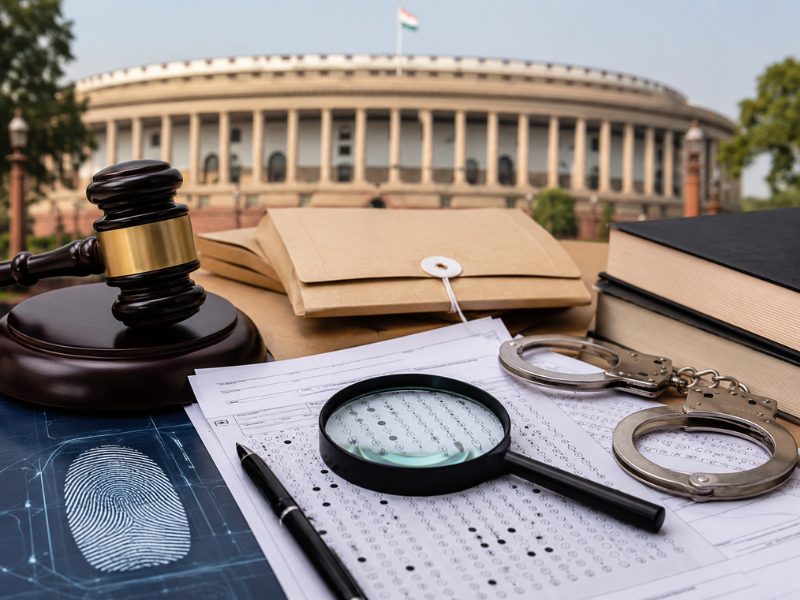
Anti-paper leak Bill introduced in Lok Sabha, proposes stricter penalties and fast-track trials
The Union government on Monday introduced the Public Examinations (Prevention of Unfair Means) Amendment Bill, 2026 in the Lok Sabha, proposing stricter punishment for paper leaks and examination malpractices, days after the NEET controversy led to the resignation of former education minister Dharmendra Pradhan.
Introduced by Minister of State for PMO Jitendra Singh, the Bill proposes imprisonment of five to 10 years and a fine of up to Rs 50 lakh for individuals involved in paper leaks or unfair means. Organised offences would attract a minimum seven-year jail term and fines of up to Rs 10 crore.
The Bill mandates that investigations into paper leak cases be completed within two months and empowers states and Union Territories to establish fast-track courts to conclude trials within three months of filing the chargesheet. It also enables the Centre to constitute a special task force to investigate paper leak cases where necessary.
The legislation was introduced amid Opposition protests over the police action during the July 20 Cockroach Janta Party (CJP)-led protest march to Parliament. Speaker Om Birla urged members to debate the Bill instead of protesting, stating that the government would consider suggestions for improving the legislation before adjourning the House till 2 pm.
The proposed amendments strengthen the Public Examinations (Prevention of Unfair Means) Act, 2024, which was enacted to curb cheating and paper leaks in examinations conducted by central agencies, including the UPSC, SSC and National Testing Agency (NTA).
The Bill also lays down provisions for examination security, including biometric registration, pre-audit of examination centres, question paper handling, candidate verification and reporting of malpractice. It identifies 15 offences, including leaking question papers, tampering with OMR sheets, creating fake websites and issuing fake admit cards.
Inputs from PTI
Also Read: Delhi Police may act against abusive social media posts linked to CJP protest










Add comment