






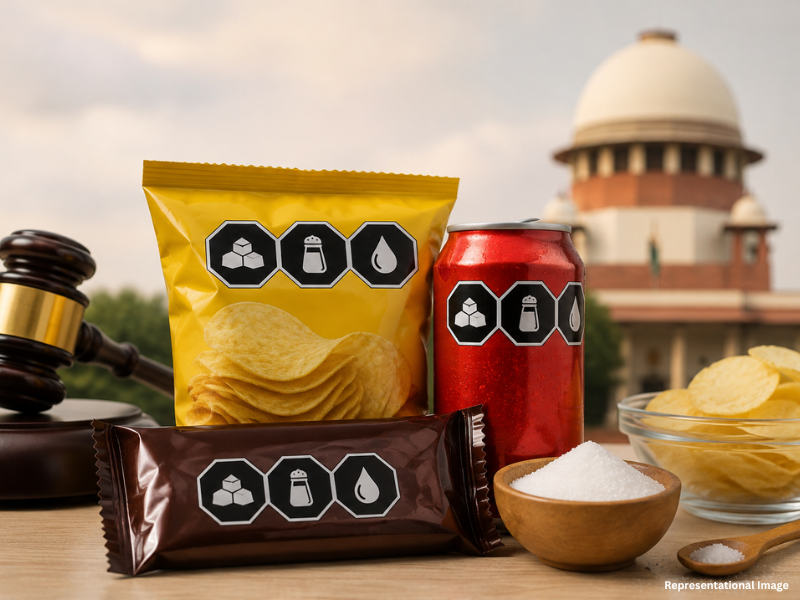
Supreme Court raps FSSAI over delay in labelling high-sugar, salt and fat foods
The Supreme Court on Thursday came down heavily on the Food Safety and Standards Authority of India (FSSAI) over its delay in introducing front-of-pack warning labels for packaged foods high in sugar, salt and saturated fat, questioning whether the regulator was yielding to pressure from the food and beverage industry.
The Supreme Court had previously directed the FSSAI to reconsider front-of-pack labelling in its February 10 order. On Thursday, the Bench made it clear that the earlier direction was not merely advisory and gave the Centre and FSSAI two more weeks to place their final decision before the Court.
A Bench of Justices JB Pardiwala and K Vinod Chandran, hearing a public interest litigation seeking mandatory warning labels to help consumers identify the nutritional risks of packaged foods at a glance, said the issue was particularly important for protecting children’s health.
The Court expressed displeasure that, instead of introducing clear interpretive warnings such as “High Sugar”, “High Sodium” or “High Saturated Fat”, the FSSAI had proposed displaying recommended daily consumption limits for these nutrients.
On Tuesday, the FSSAI had listed the permissible levels per 100 grams of food and beverages for salt, sugar and fat, based on the 2024 dietary guidelines of the Indian Council of Medical Research–National Institute of Nutrition.
The petitioner opposed the proposal, arguing that numerical information would require consumers to read the figures, compare them with recommended limits and interpret the results. A prominent warning label, the petitioner said, would allow consumers to understand potential health risks immediately, without requiring calculations or specialised nutritional knowledge.
The FSSAI, meanwhile, cited stakeholder consultations in which several industry organisations opposed warning labels, arguing that such labels could create fear among consumers. The Centre also contended that international labelling standards could not be applied mechanically in India because dietary patterns differ.
The arguments did not convince the Bench. The Court questioned whether commercial interests were influencing the regulator’s position and stressed that manufacturers’ concerns could not take precedence over consumers’ right to clear information. Justice Pardiwala also questioned the availability of healthier food choices for children and contrasted the affordability of dry fruits with popular packaged snacks.
The Court indicated that if the authorities failed to act, it could consider issuing further directions on the issue.
Also Read: FSSAI proposes salt, sugar and fat limits for children










Add comment