






When AI knows more: How GD Goenka Public School helps children know better
– Anuradha Handa, Founder Principal, GD Goenka School, Sector 48, Gurugram
Imagine a child standing at the edge of a swimming pool, listening to the voice in the head that says, “You might fall.” The heart says, “Go on, try.” And somewhere in between, a quieter voice says, “I think I can do this.”
That quiet voice is what we often call the gut.
For years, we have spoken about education as a preparation of the head and, increasingly, as a nurturing of the heart. We celebrate children who can think brilliantly and those who can feel deeply. But there is another dimension that deserves greater attention: the inner sense that tells a child when something feels right, when to pause, when to persist, when to question and when to be brave.
At GD Goenka Public School, Sector 48, Gurugram, we think of this as nurturing the gut.
Science has taught us that the relationship between the gut and the brain is considerably more fascinating than we once imagined. Research shows that signals arising in the gut can influence mood, motivation and aspects of cognition, while the brain, in turn, constantly influences the functioning of the gut. Nature Reviews Neuroscience: Gut feelings: the emerging biology of gut–brain communication
This may help explain something human beings have known instinctively for centuries: the body can sometimes seem to know something before the conscious mind has found the words for it. We call it a gut feeling.
But gut instinct is not magic. Much of what we experience as intuition is shaped by what we have seen, felt, learnt and internalised over time. Experience, memory, emotion and observation can come together to influence a decision before we have consciously reasoned it through.
This has profound implications for education.
When we tell a child, “Trust your gut,” we must first ask whether we have given the gut something worthwhile to draw upon.
A child does not arrive at school as a head waiting to be filled with knowledge. A child arrives with curiosity, instinct, emotion, imagination, fears, relationships and a growing sense of self. Education, therefore, cannot be simply about making the head more knowledgeable. Nor can it be about making the heart more sensitive. It must help the two learn to work together—and help the child develop the inner clarity to know what to do when they do not agree.
What we repeatedly experience becomes part of us. Experiences, memories, emotions, observations and values are continually being encoded and retrieved, often without conscious effort. The intuition we develop is, in many ways, the result of this accumulated human experience. So, if we want children to develop good judgement, we have to give them good experiences from which judgement can grow.
At our school, we try to do this deliberately.
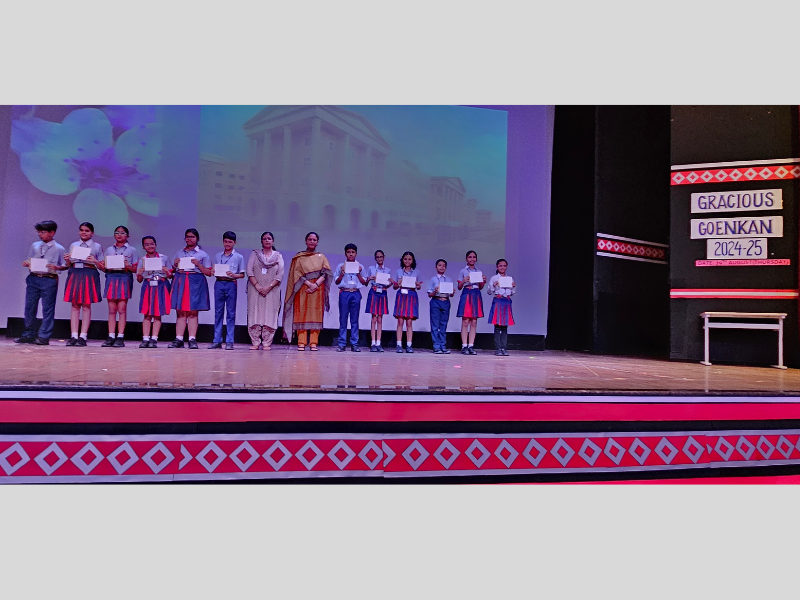
Consider our Gracious Goenkan initiative. A child is recognised not only for academic accomplishment but also for being good, kind, caring or compassionate. In that process of recognition, values cease to be abstract words and become experiences that are noticed and reinforced. Through Values and Visual Arts, children do not simply hear that values matter. They encounter them through art, discussion, questioning, introspection and expression. Values cannot simply be downloaded; they have to be experienced until they gradually become part of how a child sees the world and responds to it.
And then comes perhaps the most important part of the process: helping children discover the person behind all these experiences. Our I Discover Me journey is designed to help students understand their own strengths, interests, aspirations and possibilities. They gradually begin to distinguish between what everyone else expects them to become and what they may genuinely be suited to become.
That distinction will become increasingly important in an AI-driven world. When algorithms can recommend careers, courses, content, friends and even opinions, the danger is not that children will have too little information. The danger is that they may stop knowing themselves.
AI can process information at extraordinary speed. It can compare, predict, recommend and even create. But a human being has to decide what matters, what is meaningful, what is right and what is worth pursuing. And that requires more than information. A computer processes data. A human being needs time to feel, reflect, question, connect and make meaning.
This is why meditation has a place in our school. We do not introduce meditation simply to make children quieter or calmer. We introduce stillness because a mind constantly occupied by external noise has little opportunity to process what it has received. A child needs moments to notice a thought, sit with an emotion, reflect on an experience and listen to the quieter voices within. In that space, information can become understanding, and understanding can gradually become wisdom.
The challenge before education, therefore, is not to protect children from AI. Nor is it to surrender to it. It is to prepare them to leverage it. The future should not be a choice between human and AI. It should be human with AI.
And for that future, the education of the head and heart remains essential. But perhaps there is one more thing we must nurture: an inner repository of experience, values, self-awareness and reflection from which a child learns to decide. Let us feed it well.
And then, when the head and heart disagree, perhaps we can trust the child to listen deeply, draw upon everything that has been thoughtfully placed within, and have the gut, and the guts, to choose well.
That, I believe, is how we keep the human at the centre of an AI world.
Also read: GD Goenka Public School hosts Moolaadhar programme on life skills










Add comment