





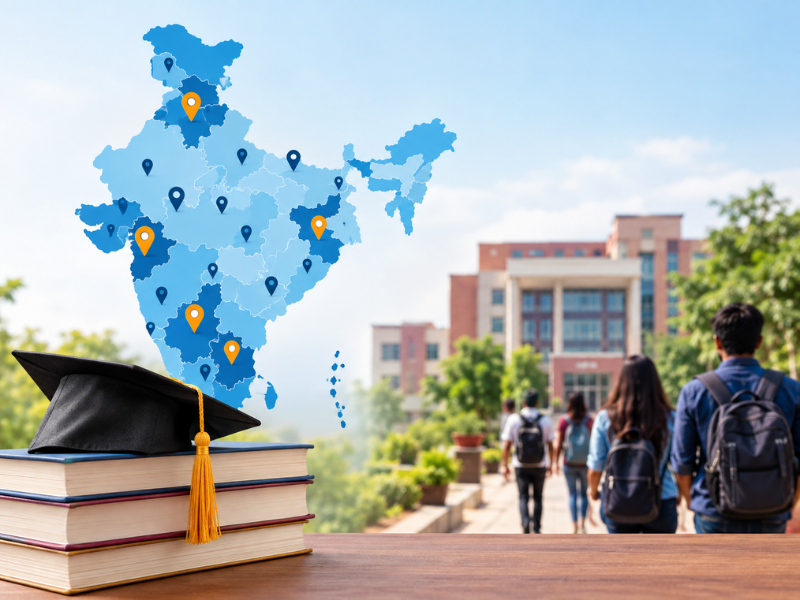
About 28 percent of India’s universities are concentrated in 20 districts, while states with some of the largest future student populations have comparatively fewer institutions, according to The Geography of Higher Education Report 2026, released by Jetri and Impactica.org.
The report maps the growth of India’s higher education institutions over the past 25 years and compares the distribution of capacity with projected student populations.
Since 2001, India has added 981 universities and 34,840 colleges. The number of colleges per lakh people aged 18 to 23 has increased from nine to 37, while the population in this age group has grown by 11 percent.
Bengaluru Urban has the highest number of colleges among districts, with 1,225, followed by Jaipur with 809. A total of 173 districts have 100 or more colleges.
Seven states — Gujarat, Karnataka, Maharashtra, Madhya Pradesh, Rajasthan, Tamil Nadu and Uttar Pradesh — account for 49 percent of India’s 1,405 universities and 66 percent of its 53,433 colleges.
At current capacity levels, one university in Bihar would correspond to a future student population of about 10.3 lakh, compared with around six lakh in Uttar Pradesh. The report identifies Bihar, Uttar Pradesh and Jharkhand as states that will require greater higher education capacity.
Four states — Assam, Bihar, Jharkhand and Nagaland — have a Gross Enrolment Ratio below 20 percent, against the national average of 30 percent. Only Puducherry, Chandigarh, Delhi and Tamil Nadu have crossed the National Education Policy (NEP) target of 50 percent.
The report also finds that 83 percent of education-related migrants remain within their home state, based on Census 2011 data, highlighting the importance of regional access to higher education.
Some higher education clusters have developed outside major cities. Sikar in Rajasthan has 374 colleges, followed by Azamgarh in Uttar Pradesh with 338 and Belagavi in Karnataka with 317.
The report notes that 22 universities each oversee more than 500 affiliated colleges, while 96 percent of affiliated colleges are linked to state public universities.
Nearly 13.4 lakh Indian students were studying abroad in 2024, almost twice the number in 2016. In 2022, around 20 Indian students went abroad for every international student studying in India.
“India has already demonstrated that it can build higher education at extraordinary scale. The next test is precision: understanding where future students will be, where capacity is weakest and where new institutions can have the greatest impact on opportunity and regional growth,” said Shreyasi Singh, Founding Managing Partner, Jetri.
Vrunda Bansode, Founder and CEO of Impactica.org, said the focus should now shift from expanding capacity to matching it with demand.
The report recommends developing ecosystems of universities, colleges and regional connectivity rather than isolated campuses, with Bihar, Uttar Pradesh and Jharkhand identified as focus states for the next phase of expansion.
Also Read: JEE Advanced 2026: Women qualification rate highest in six years











Add comment