





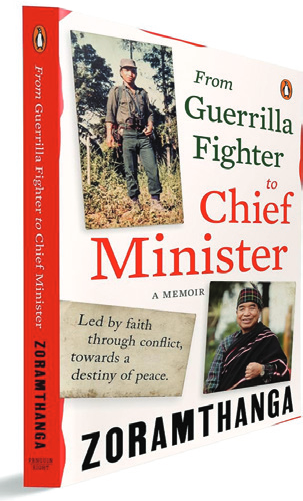
From guerilla fighter to chief minister: A memoir
Zoramthanga
penguin/ random house india
Rs.699
Pages 448
The Mizo nationalist movement was perhaps the biggest ethnic assertion in post-independence India. Former chief minister Zoramthanga offers an insider’s account…
India’s Northeast witnessed some of the biggest ethnic assertions in post-independence India. One of them was the Mizo Nationalist Movement. Beginning as a civil society movement in present-day Mizoram, then part of undivided Assam, it evolved into an insurgency whose ultimate aim was the establishment of a sovereign homeland for Mizos.
In 1986, the Indian government entered into a peace accord with the Mizo National Front (MNF) that spearheaded this movement. As part of its provisions, the Union Territory of Mizoram was granted Statehood. On its part, the MNF abjured its goal of secession, accepted the Indian Constitution and reconciled itself to working for the cause of Mizo nationalism through democratic means. The book under review chronicles this protracted movement led by MNF and in the process tells the story of the author’s long association with it.
The author, former Mizoram Chief Minister Zoramthanga’s unique position in the movement enables him to offer unparalleled insights on the book’s subject matter. This becomes evident in the elaborate descriptive accounts that he provides about critical events that don’t have comparable references in the public domain.
Starting out as a sympathizer of the MNF-led movement in his student days, Zoramthanga soon became one of its volunteers. After becoming the President’s secretary, he steadily rose through the ranks of the party and after the 1986 accord, became a Cabinet Minister and then Chief Minister for multiple terms. The narrative is based on his memories, reflections in hindsight as well as notes taken from his personal diary. Despite knowing about the risk of maintaining written records by underground operatives, he first began maintaining a diary in 1975 and has been doing so uninterruptedly since 1980.
Zoramthanga dedicates the book “to the thousands of martyrs who sacrificed their lives for Mizoram”. Divided into ten sections the volume comprises 80 brief chapters. For the most part, the book proceeds in a linear sequence that begins from the early years of the author’s life and movement and runs until the formation of the MNF-led Interim Government in 1986.
In the opening sections, the author takes readers back to the reasons that spurred the growth of the Mizo movement and compelled its secessionary turn. The argument he makes locates part of the answer in a pre-existing disconnectedness that Mizos felt regarding their political association with the Indian state. The other part of the answer is attributed to two substantial apprehensions that began to subsequently bother Mizo people. The first was cultural and it stemmed from what many Mizos saw as the growing influence of Hindustani culture.
This led Laldenga and his compatriots to constitute the Mizo Cultural Society (MCS), MNF’s first avatar. A much stronger catalyst was provided by the Assam government’s mishandling of the 1959 Mautam famine. Zoramthanga argues that the apathetic response of the authorities greatly aggravated the crisis. The resulting trail of death and impoverishment further hardened the resolve in Mizos to take matters into their own hands.
MNF is one of the most successful political parties of India. The book sketches the party’s evolution since its establishment as the MCS, through its metamorphosis first into the Mizo National Famine Front and eventually to its current form. The author shares backstories relating to the party symbol, flag, uniform as well as its early office premises. Rare details like the composition of its early executive committees, social profile of its members as well as efforts to expand the organisational base are also divulged.
Even more importantly, Zoramthanga frankly discusses the factional conflicts that surfaced within the MNF and how they hampered the wider movement. In 1962, one faction broke away to set up a rival faction called Mizo National Council. Again, in the late 1970s, the author claims that forces opposed to Laldenga contributed a lot of instability, partly with the connivance of the Indian government.
The most notable contribution of this book, however, is the comprehensive account that it provides of the MNF-led insurgency (1966-1986) from a non-state perspective.
Zoramthanga devotes five chapters to ‘Operation Jericho’, the MNF-led armed uprising which sought to liberate Mizoram from India. He sheds light on its planning and major sites of conflict, besides making a realistic assessment of its successes and failures. He also dwells on the counter-insurgency operations of the Indian army. It was to suppress this very uprising that the Indian Air Force launched an attack within its own territory, the only such instance to date. The author mentions many of the places where the Air Force struck. The army’s strategy of grouping villages into guarded enclaves is also critically discussed. While its purported objective was to shield villagers from conflict, according to him the real reason was to cut off supplies and information to the rebels. Whatever the actual reason, Zoramthanga’s estimate that it displaced nearly 80 percent of Mizoram’s rural population instantly draws attention to the predicament of people caught in conflict, a theme that recurs through the book.
The author highlights that insurgencies, despite their localised aims, often operate within a larger international context. He suggests that to a significant extent, the fate of the MNF insurgency was determined by its relations with India’s neighbours, the changing tides of the latter’s domestic politics and the broader calculations of Cold War politics.
This matrix on which the MNF operated crisscrossed through countries like Myanmar, Pakistan, Bangladesh, China, Afghanistan, Germany, Thailand and Switzerland. And moving in this shadowy landscape in true James Bond-style was the author — from illegally slipping into Kabul, holding secret discussions with Chou en Lai in Beijing to driving with a CIA operative in Islamabad to plan a dialogue with India.
Zoramthanga’s book is a gripping narrative which will appeal to the casual reader and the academic alike. The only lament is that the author hardly covers his chief ministerial stints, including the first, despite titling this book From Guerrilla Fighter to Chief Minister.
Abhinav Pankaj Borbora (The Book Review)









Add comment