





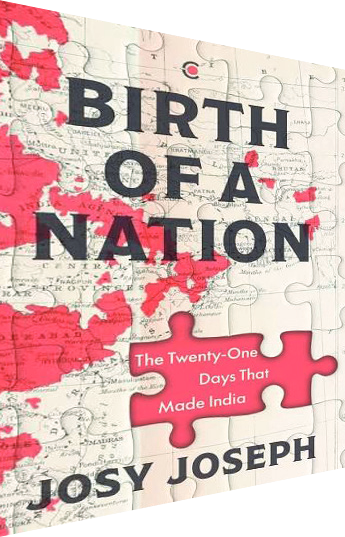
 Birth of a nation: the twenty-one days that made India
Josy Joseph
Westland Books
Rs.799 Pages 267
A newly constituted States Department under Sardar Patel was tasked with unifying 565 princely states into one inde-pendent India within the tight framework of three weeks
When recounted compellingly, history is not at all a dull subject. In his latest oeuvre, Birth of a Nation investigative journalist and author Josy Joseph (A Feast of Vultures: The Hidden Business of Democracy in India (2016) and the acclaimed (The Silent Coup: A History of India’s Deep State (2021)), presents a thrilling narrative of suspense, intrigue, coercion and persuasion that resulted in the integration of post-independence India.
It’s pertinent to recall during the last three weeks before independence that divided India and Pakistan, the sub-continent was a vastly fragmented territory, comprising regions under direct rule of the Empire, and about two-fifths of the territory under rule of over 565 princes and maharajas.
Legally, eve of independence India was divided into two dominions — India and Pakistan and powerful princely states. If post-independence the sub-continent was not to transform into a new Bal-kans, it was important that the princely states merge with (“accede”) to either of the two dominions.
A newly constituted States Department under Union home minister Sardar Vallabhbhai Patel was tasked with bringing order and unifying them into one independent India within a tight timeframe of three weeks. Else princely states that didn’t accede to either dominion were legally free to go their own way.
From information collected from the National Archives, Joseph (and his team) bring to life un-sung heroes whose courage and conviction thwarted the designs and devices of divisionists. Sardar Patel’s tireless army comprising Kumar Shri Banesinhji, C.C. Desai, U.N. Dhebar and N.M. Buch brought 300-odd princely states of Kathiawar (Gujarat) into the India Dominion. Ambassador Sir Muhammad Saleh Akbar Hydari negotiated accession of the North-Eastern states. Orchestrating them all was Patel’s chief strategist V.P. Menon (who as a boy burnt down his school), the individual who strategised the building of this nation. As Joseph puts it, “Menon suggested, Patel agreed and Nehru approved”.
By encapsulating the narrative in a three-week history of July 25-August 14, Joseph has written a pacey thriller. At one end were the major princely states, Bhopal, Travancore, Indore, Baroda, Junagadh, Kashmir, Hyderabad “trapped in the amber of privileges, unwilling to give up their lives of splendour and indulgence”. Their supporters were the Muslim League and Mohammed Ali Jinnah, the Hindu Mahasabha and RSS and numerous British officials in the corridors of power in India and London. At the other end was the States Department with the indomitable Sardar and his six-member team. A battle royale between the States Department and “princes, plots and London lobbies”, was joined, writes Joseph.
Midnight August 15 had been fixed as the time for the declaration of independence. The night before, the status of India as a united nation was anything but certain. Baroda was vacillating, Junagadh had declared it would join Pakistan, Bhopal was stipulating special conditions, Indore was in hiding, Kashmir had joined both Dominions, Hyderabad had declared independence. As millions of people were dying from the violence of Partition, it was a race against time.
Joseph presents a fast and furious narrative in which through a process of cajoling, coaxing, threatening and confronting, Patel’s team got most of the princely states to sign the Instrument of Accession by August 13.
On August 14 at 11 p.m, Dr. Rajendra Prasad, President-designate, took the chair in Constitution Hall and Sucheta Kripalani sang the first verse of Vande mataram. Dr. Prasad addressed the thousands outside in Hindustani, and Jawaharlal Nehru rose to render his legendary “tryst with destiny” speech. He was followed by Chaudhary Khaliquzzaman of the Muslim League who pledged that “in discharging our duties, we shall show no favour to anyone”. At the midnight hour, all the constituent members stood as the President was administered the oath of office in Hindi and English, and subsequently the national flag of independent India hoisted. Thus, a nation was born.
But even as millions celebrated countrywide, many millions in the partitioned nation waited in dread, behind shuttered doors. It was a night of hope and uncertainty, of joy and fear, writes Joseph.
At 12.20 am, while joy and mayhem were all around, Dr. Prasad and Pandit Nehru arrived at the Viceroy’s residence and endorsed Lord Mountbatten as the first Governor-General of India. “Nehru handed over an envelope addressed to the Viceroy. Inside was a blank piece of paper. It was symbolic, marking the surrender of imperial authority and peaceful transfer of power to the people of India”, writes the author.
Joseph has presented a heavily researched account of the turbulent road to freedom and independence. It gives the reader a deeper understanding of the challenges that had been overcome and the challenges that had yet to be overcome by the new India government. Enormous political effort was still required to persuade few princely states that had not acceded to the Indian Union, a functional nation born out of a deeply divided polity.
Birth of a Nation is an informative and creditable work of modern Indian history. It reminds us that nations are not solely created by speeches and ceremony but by determined statesmanship, negotiations, inclusion and administrative planning. Frequently, the role of individuals who midwife the birth of nations is forgotten. Josy Joseph deserves credit for drawing attention to and bringing many of them to our knowledge.
For the historian and citizen who values freedom, this is a vivid account of the uncertainties and struggles that shaped India at the moment of its birth, and the challenges it could face if the lessons of history are not learned.
Anil Thakore








Add comment