






ACER India CEO
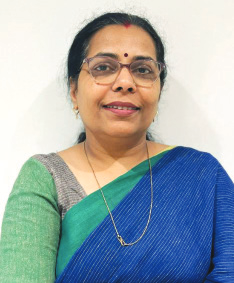
Sharma: teacher development focus
– Autar Nehru (Delhi)
Delhi-based Dr. Priyanka Sharma is CEO of the Australian Council for Educational Research India, the South Asia subsidiary of Melbourne-based Australian Council for Educational Research (ACER, estb.1930). ACER is a not-for-profit organisation globally recognised for leadership in education research and assessment to “improve learning across the lifespan”. It works with education systems in over 150 countries and is well-reputed for conducting large-scale assessment studies including the famous Programme for International Student Assessment (PISA) for OECD (industrial) countries.
Newspeg. In July, in tandem with City Montessori School, Lucknow and the Delhi Public School Society, ACER India conducted professional development workshops for 1,500 teachers. Aligned with the National Education Policy (NEP) 2020 and National Curriculum Framework for School Education (NCFSE) 2023, the workshops focused on competency-based teaching and assessment.
History. A molecular plant biology alumna of the Rajendra Prasad Central Agricultural University, Pusa Samastipur (Bihar) and the Indian Agricultural Research Institute, Delhi, Sharma began her career in 2005 as a science teacher at the DLF Public School, Ghaziabad, followed by a stint as Senior Research Advisor at the National Testing Agency (NTA). Since then she also discharged research leadership roles with the Pearson Assessment Centre, Khan Academy, CBSE-CAER and the Azim Premji Foundation.
In 2022, Sharma was appointed Director, Research and Assessment of ACER India. Three years later, she was promoted to the corner office as CEO to lead ACER India’s education assessments, monitoring, and research programmes in South Asia.
Direct talk. “In ACER India, our prime focus is to develop teacher competence. Through our Standardised Teacher Assessment and Reflection (STAR) programme, we are helping schools move beyond one-size-fits-all professional development by providing personalised learning pathways for teachers by assessing professional standards, diagnostic evidence, and continuous reflection. Another priority is enabling schools to become evidence-driven institutions by providing access to our proven school improvement programmes and education best practices,” explains Sharma.
Future plans. Sharma believes that over the next five years, significant education reforms will emerge as a consequence of robust student assessment, improved professional development, personalised learning and AI-enabled decision-making. “Assessment is not about grades or compliance; its purpose is student improvement and growth. Our goal is not simply to measure what exists today, but to help build education systems the country will need tomorrow to ensure that every learner succeeds,” says Sharma.
Wind in your sails!











Add comment