







Adopt single-window model, build higher education clusters in Tier-1 & 2 cities: Study
India should adopt a single-window clearance mechanism and develop dedicated higher education clusters around tier-1 and tier-2 cities to attract foreign universities, according to a joint study by Deloitte India and Knight Frank India titled Global Universities Eye India Opportunity: The Next Big Leap in Higher Education.
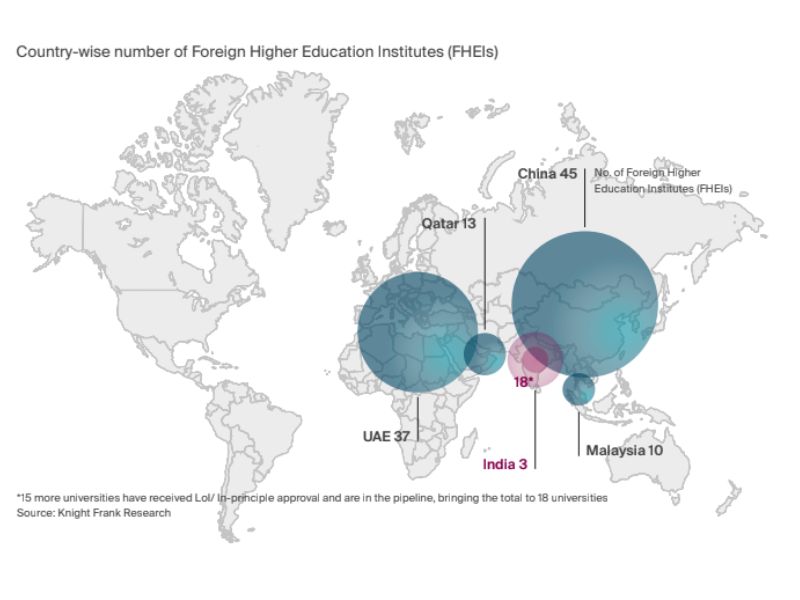
The study recommends emulating models followed in countries such as China, United Arab Emirates and Qatar, which host multiple international university campuses.
It suggests that India introduce a single-window system for programme accreditation, with the University Grants Commission acting as the nodal authority. The UGC would coordinate with regulators including the All India Council for Technical Education, state bodies and professional councils to streamline academic approvals and programme equivalence. The study adds that land acquisition, end-use permissions and other operational clearances could also be integrated into the same interface, potentially reducing campus setup timelines from months to weeks.
Another key recommendation is the creation of higher education hubs in and around major metros, where campuses, research labs, incubators, student housing and social infrastructure are co-located. Shared facilities such as broadband, laboratories, libraries, healthcare and transport, managed by a designated authority, could significantly lower capital and operating costs while fostering industry collaboration and research ecosystems.
Shishir Baijal, Chairman and Managing Director, Knight Frank India, said 18 international universities have already received approvals or commenced operations in India, signalling growing momentum. The report’s India Cities Playbook identifies Delhi NCR, Bengaluru and Mumbai as high-readiness hubs due to strong corporate ecosystems, while emerging tier-2 cities such as Chandigarh, Kochi and Jaipur are highlighted for governance and infrastructure strengths.
The study also notes shifting global mobility trends, pointing out that student visas issued by the United States Department of State fell 10% year-on-year in 2024, resulting in nearly 50,000 fewer international students. It identifies STEM, Artificial Intelligence, Data Science and Management as high-demand disciplines, adding that technical course enrolment in India has risen 39% over the past five years.
Also Read: India Emerges as Strategic Global Hub for Higher Education











Add comment