






Can India Rediscover its Fine Design & Aesthetics Heritage?
World University of Design-EW Viksit Bharat Study
The question is not whether India lost its craftsmanship and design leadership. It clearly has. The important question is why, and what must be done to reclaim it
Sanjay Gupta & Dilip Thakore

Sanjay Gupta
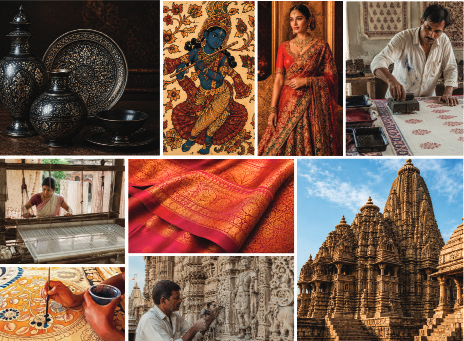
Once upon a time, the Indian sub-continent did not merely produce crafts; it designed life itself.
From the fine muslins of Bengal that were said to pass through a finger ring, to the resist-dyed textiles of Kutch that travelled across oceans, to temple architecture, tools, jewellery, and everyday utensils shaped with remarkable intelligence, India functioned as a vast, decentralised design system. Design knowledge was not concentrated in institutions but permeated communities. Each region developed its own vocabulary of materials, techniques, forms, and aesthetics, responding to climate, culture, and commerce with extraordinary sophistication.

Dilip Thakore
Fine design was not ‘craft’ in the modern, diminished sense of the term. It was embedded in production, in social systems, and everyday life. Artisans were not marginal labour; they were knowledge workers. Design was not a specialised profession/vocation; it was shared cultural capability.
Right until the end of the 19th century, India’s textiles powered global trade networks. Indian cottons were valued not merely for affordability but for their finesse, colour fastness, lightness, and adaptability to different markets. The Coromandel Coast supplied Southeast Asia, Bengal fed European demand, and Gujarat traded extensively with Africa and the Middle East. For centuries, India was the world’s workshop and not because of cheap labour, but because of design, craftsmanship and quality.
India’s fine designs: lost centrality and vitality
Yet during the past century, India’s design culture lost its centrality and vitality. Little remains in the ruins of a colossal wreck. Architecture is defined by concrete blocks of squat, ugly public buildings, unkempt public spaces and pedestrian design of utilitarian, commonplace manufactures. Capital and consumer goods appeal only to captive domestic consumers. In the past eight decades, India — government and private sector — has not established a single global consumer brand or logo recognised universally.
The question is not whether India lost its craftsmanship and design leadership. It clearly has. The important question is why, and what must be done to reclaim it.
THE FIRST RUPTURE: WHEN AN ECOSYSYTEM WAS DISMISSED
It is tempting to correlate the decline of once acclaimed Indian craftsmanship and design leadership with colonial exploitation. Although that explanation is not incorrect, it is incomplete. What colonialism did was not merely introduce competition. It altered the ecosystem of production and the cultural sensibility that sustained it.
The arrival of machine-made textiles from Britain is often advanced as the decisive moment, but it was only the most visible expression of a deeper shift. Beneath it lay a systematic restructuring of economic relationships. Local patronage systems that had supported artisans for generations began to erode. Traditional networks of credit and trust weakened. Raw materials were redirected into global supply chains controlled by imperial interests. Production systems that had evolved organically over centuries were forced to operate within new taxation regimes and market priorities they were never designed to accommodate.
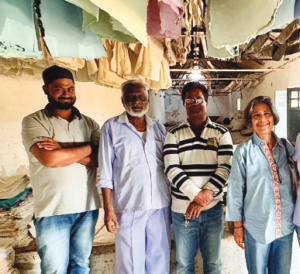
Agarwal (right): bric-a-brac status
The artisan, once embedded in a stable and interdependent social fabric, found himself exposed to volatile markets without institutional support. What had earlier been a resilient, adaptive system of distributed production became increasingly fragile. Crafts knowledge which had thrived on responsiveness to context, material, and user, was rendered vulnerable in a world that prioritised industrial scale, uniformity, and centralised control. However, the deeper rupture was not only economic. It was perceptual.
As industrial goods flooded the market, they did more than displace handmade products. They began to redefine aspiration. Machine-mades became synonymous with modernity, progress, and reliability. Handmades, however sophisticated, were gradually repositioned as backward, irregular, or inefficient. Over time, this shift seeped into everyday choices. The lay consumer who had once expected quality, proportion, and refinement in the objects of daily life, was compelled to prioritise affordability and availability.
“Right until the mid-19th century, India’s fine design traditions were visible in everyday textiles and hand-crafted consumer goods such as crockery, cutlery, household furniture and furnishings and children’s toys. But with the onset of the era of industrial mass production, traditional handcrafted goods and products were gradually reduced to the status of bric-a-brac. Issues of price and affordability became paramount. In architecture, in the post-independence socialist years, ill-designed functional buildings and PWD-style construction became normative with our fine design traditions ‘going down the drain’. Moreover, with profit-driven private sector housing springing up in our cities, considerations of design and culturally-aligned buildings have become extinct,” says Katyayani Agarwal, an arts history postgrad of SOAS, London with experience of museum design in Jakarta, Dubai and Paris who has established India’s first museum for traditional handmade paper in Aurangabad (Maharashtra).
However, post-independence India did not entirely ignore its design culture and traditions. Indeed, the Nehruvian government of the time diagnosed it with commendable clarity and responded to it within the constraints of that era. A landmark intellectual intervention of this period was commissioning the India Report, 1958, authored by California (US)-based architects Charles and Ray Eames. The report positioned design as a problem-solving discipline, deeply connected with everyday life, production, and national development. It acknowledged India’s legacy knowledge systems, particularly in crafts, and argued for building modern design education institutions to connect tradition with industry.
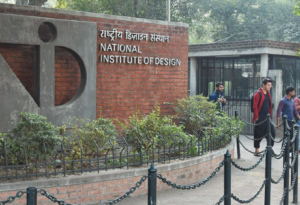
National Institute of Design, Ahmedabad: new generation designers
The report prompted establishment of the National Institute of Design (NID) in 1961 — the first of any developing nation. Over the years, NID has been articulating design as a discipline rooted in context, materials and users, engaged with craftspeople, collaborated with public institutions, and produced a new generation of designers.
NID’s imprint can still be seen. The identities of the State Bank of India, Doordarshan, Delhi Transport Corporation, and the Election Commission were shaped by NID faculty/graduates arousing national resonance. The State Bank of India logo, for instance, with its simple circular form and central keyhole cut, conveyed security and openness — values that were critical in building trust in a young financial system. These were not merely logos; they were designs through which the state communicated with millions of citizens. It’s pertinent to note that these design innovations were of public sector institutions. Private sector design innovations such as the Amul logo followed later.
Though these were clear and sincere attempts to integrate design into nation-building, spartan socialist ideology restricted the rise of mass consumer markets and culture of everyday design appreciation. Craft continued to be supported, but largely within the frameworks of preservation, welfare and export. Design remained concentrated within a small set of institutions and public-sector applications.
EXCELLENCE WITHOUT DIFFUSION
The decades that followed independence reveal a pattern that continues to define India’s design and craft landscape: the creation of islands of excellence without integration into everyday life.
Between the 1960s and the late 1980s, India built an institutional framework around crafts and design. Handloom boards, handicraft development corporations, state emporia, and design institutions were established. Crafts were supported through fairs, exhibitions, and national awards. The few designers NID produced were encouraged to work with artisan clusters. Organisations such as the Export Promotion Council for Handicrafts played a key role in connecting Indian crafts to global markets.
However, they did not fundamentally alter the position of craft within the mainstream economy or culture. Craft remained associated with rural livelihoods, heritage, and export markets, rather than becoming an integral part of everyday consumption within India itself.
Liberalisation of the isolationist socialist economy in 1991 transformed markets, aspirations, and the role of design. Consumer choice expanded. Retail began to grow. Branding, advertising, and visual communication acquired increasing prominence as the middle class expanded to an estimated 400 million over the past three decades.
The establishment of the National Institute of Fashion Technology (NIFT) in 1987 reflected growing recognition of fashion, textiles, and lifestyle products design. Coterminously, private enterprises began to reimagine the relationship between craft and contemporary markets. Companies such as Fabindia created new channels that connected rural artisans to urban consumers, translating traditional knowledge into products suited to modern lifestyles. As a result, retail spaces expanded, advertising became more sophisticated and branding entered everyday life. For the first time, design emerged as a significant factor within the consumer economy. And yet, even this transformation had its limits.
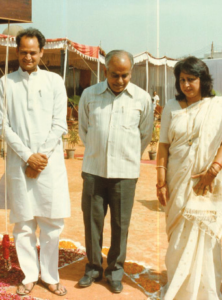
Rathi Jha (right): domestic market focus
While liberalisation created demand for well-designed products, it did not fully integrate craft into this expanding ecosystem. Much of the growth in design was aligned with industrial production, global aesthetics, and emerging consumer aspirations that were often detached from local material traditions. Craft, though present, remained niche, visible only in certain brands, certain markets, and certain moments, but not normalised as part of everyday consumption.
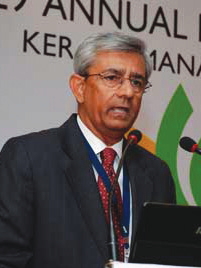
Bhattacharya: design disinterest
Rathi Vinay Jha, a history postgrad of Delhi University who joined the IAS in 1967 and drove the revival of the Tamil Nadu Handlooms Society and served as Founding-Director of NIFT (estb.1987), doesn’t quite agree that India has lost its fine design traditions that provoked a European stampede for sub-continental products in the 17th and 18th centuries.
“Although the initial years after independence were difficult as priority was given to stabilise the country and develop the long-exploited economy, design was not neglected. In the mid-fifties, the renowned French architect Le Corbusier designed the new city of Chandigarh and excellent architects such as Charles Correa, Balkrishna Doshi and Laurie Baker made valuable contributions to Indian architecture. Likewise in textiles and apparels, talented designers such as Tarun Tahiliani, Sabyasachi, Ritu Kumar, have achieved international reputations. If Indian designers have not made huge impact abroad, it’s perhaps because they have focused on the large domestic marketplace,” says Jha.
FRAGMENTATION OF POLICY
“Design has largely been treated as an educational and professional domain, rather than a national capability. While institutions like NID and other design schools have expanded the field, design has not been systematically integrated into sectors such as manufacturing, urban development, public services, and governance. The result is a fragmented ecosystem. Crafts are supported, but not scaled. Design is celebrated, but not democratised. The link between the two remains underdeveloped,” says Balbir Singh, a postgrad of NIFT and IBM certified Enterprise Design practitioner, visiting faculty at NIFT for over two decades, who has experience of project design in North America, Europe, Africa and Asia and is currently Dean, School of Design at the World University of Design, Sonipat.
Yet if 21st century India has acquired a reputation for shoddy, outdated merchandise over the past almost eight decades since independence, the licence-permit-quota system which created a sellers’ market is blameworthy. India Inc is also culpable because of its rock-bottom investment in research and innovation. Over the past several decades, national outlay for R&D (research and development) aggregates a mere 0.6 percent of GDP (cf. 3.45 percent in USA, and 2.9 percent in China) with most of it expended by government.
“Decades of industrial licensing and denial of consumer credit which restricted output, killed incentive for product development — typified by the Ambassador car, whose design remained unchanged for 40 years. A consequence of half a century of socialist licensing raj was that India’s industrialists were former buy-and -sell traders with minimal interest in engineering and manufacture. To this day, they are quite content with screw driver technology and reverse engineering of established Western and Asian products. Fine design products customised for the Indian and perhaps third world markets don’t seem to interest them. That’s why even today, the preference for foreign manufactures and consumer durables persists,” says V.N. Bhattacharya, an alum of IIT-Kanpur, IIM-Calcutta and currently visiting professor of business management at the top-ranked IIM-Bangalore and Ashoka University, Sonipat.
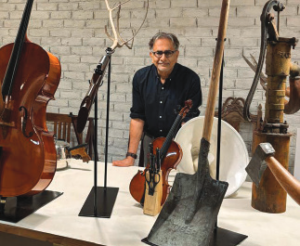
Bhatia: loud and obtrusive
Renowned Delhi-based architect Gautam Bhatia has a radically different take on India’s reportedly fine design traditions. According to him, the sub-continent has never had a native tradition of fine design and aesthetics except in forts and temples. “The plain unfortunate truth is that Indians have never had a conspicuous tradition of advanced design and aesthetics, especially in architecture and spatial design. The fine design of the Taj Mahal and monuments of the Mughal era were imported from Persia and Central Asia and later from Europe and Britain. Although there are individual craftsmen and localised designers of dhurries and carpets, they are not included in mainstream design. To this day, India’s cities and urban spaces are defined by clutter and disorder — shoddy bus stops, looming TV towers, visible water tanks and clustered buildings. The Ambani Arts Centre in Mumbai, the new Parliament buildings are very loud and obtrusive. Perhaps we should draw from the example of the recently inaugurated Grand Egyptian Museum, Cairo and Bibliotheca Alexandrina, which blend with their environment and make a real cultural statement about design of public buildings,” says Bhatia, an architecture postgrad of the University of Pennsylvania and author of Punjabi Baroque, Silent Spaces and Malaria Dreams, a triology focused on the cultural and social aspects of architecture.
EDUCATION: THE DEEPER FAILURE
Yet incontrovertibly, the root cause of the neglect of India’s ancient design and crafts traditions is insufficient attention and priority accorded to education — especially primary education — since independence. Way back in 1967, a high-powered Kothari Commission strongly recommended that annual national (Centre plus states) expenditure on human capital development, aka education be doubled to 6 percent of GDP. But successive governments at the Centre and in the states blithely ignored this sagacious advice. The consequences have been devastating.
Although over the past almost eight decades since independence, primary school enrolment has increased to over 98 percent, this statistic is deceptive. Learning outcomes in foundational primary education — especially in 1 million government schools countrywide — are abysmal. For over two decades, the Annual Status of Education Report (ASER) of the independent Pratham Education Foundation has been highlighting that half of routinely promoted children in class VII can’t read class V texts and solve simple division sums. Likewise for decades, the Union education ministry’s UDISE surveys have been reporting that thousands of government schools across the country are single-teacher institutions not provided basics such as toilets, safe drinking water and electricity. And over half lack digital equipment and/or internet connectivity. A recent NITI Aayog report confirms that 7 percent of government schools are single-teacher institutions, not providing basics such as toilets, safe drinking water and electricity. And over half lack internet and digital equipment (see editorial p.14)

Kingdon: unreasonable expectation
“Expecting children raised in environments of deprivation and rural and urban squalor to develop — or demand — fine design and aesthetics is expecting too much. All schools, especially public schools, should be adequately staffed and provided excellent infrastructure so that children learn to develop appreciation for discipline, order, neatness and aesthetic sensibilities. This requires investment of far greater resources in public education,”says Geeta Kingdon, CEO of the City Montessori School, Lucknow, the world’s largest single city cluster of K-12 schools (aggregate enrolment: 60,000 students mentored by 3,050 teachers); and also Visiting Professor, Institute of Education at University College, London.
In this connection, it is important to note that post-independence India inherited an education system that prioritised abstraction over making, theory over practice, and industrial modernity over vernacular knowledge. Over time, this created a deep division between hand and mind. Craft became associated with informality and low status. Design became associated with niche, urban, and often elite professions. The vast knowledge embedded in material practices, processes, and local innovations were excluded from mainstream curricula.
Moreover, engineering education focused on standardised industrial processes, disconnected from local materials and contexts, and business management education emphasised scale and efficiency, with limited engagement with decentralised production systems.
This separation has had long-term consequences. It has not only limited innovation but also shaped aspirations. For most young Indians, vocational education and training is a fallback, not choice. Craft knowledge, despite its complexity and sophistication, is undervalued.
The National Education Policy (NEP) 2020 attempts to address some of these issues by recommending multidisciplinary learning and vocational integration. However, the challenge lies in implementation. Integrating craft and design into the mainstream requires not just curricular changes, but major mindset transformation.
CRITICAL MOMENT FOR DESIGN REVIVAL
The limitations of earlier education policy prescriptions are becoming increasingly visible. Employment generation for a large and diverse population, remains a critical challenge. Large-scale industrialisation has not been able to absorb the workforce at the pace required. In this context, craft offers an alternative model — distributed, skill-based, and capable of generating livelihoods countrywide without large investment in infrastructure.
Simultaneously, environment sustainability has emerged as a central global imperative. Craft practices, by definition embody principles that contemporary industry is now attempting to rediscover — low energy consumption, local sourcing, material sensitivity, and circularity. Design and craft hitherto regarded as traditional is now being reframed as future-ready.
Around the world, cultural design and experience-driven industries are becoming major contributors to economic growth. India, with its vast and diverse cultural base, is uniquely positioned to participate in this shift — not as a follower, but as a potential leader.
Education must play a central role in this transformation. Institutions such as the World University of Design have begun experimenting with pedagogies that place learning-by-doing, materials engagement, and interdisciplinary collaboration at the core of learning. Students are encouraged to move fluidly between domains — working on products, spaces, digital systems, performances, and narratives — while engaging with industry and traditional knowledge systems.
This pedagogy transformation is necessary to address a long-standing lacuna in Indian education: separation of hand and mind. By reintroducing craftsmanship as a form of inquiry, and by situating design within broader cultural and economic contexts, there’s urgent need to rebuild informed consumers as much as skilled producers.
This also necessitates that artisans cannot continue to be treated as beneficiaries of government development schemes. They must be recognised as knowledge partners — co-creators whose expertise in materials, processes, and context is essential for innovation. This requires new forms of collaboration with designers and artisans working not in hierarchy, but in dialogue.
Encouragingly, the contours of such a mindset shift are already visible — in emerging institutions, evolving pedagogies, and growing awareness that design is not a luxury, but a foundational capability.
The task now is to scale this awareness into a national movement.
Yet incontrovertibly, the root cause of the neglect of India’s ancient design and crafts traditions is insufficient attention and priority accorded to education











Add comment