






CBSE: Declining reputation of India’s largest national school exams board
Although the proximate cause of the wave of dissatisfaction rising against CBSE is bungling of the inaugural On-Screen Marking (OSM) system, the root causes are authoritarianism and unaccountability of India’s premier school-leaving examinations board
Dilip Thakore
A wave of dissatisfaction of tidal proportions is rising against the Delhi-based Central Board of Secondary Education (CBSE) — India’s largest national school-leaving examinations (classes X and XII) board with 30,000 primary-secondary schools nationwide affiliated with it.
The proximate cause of discontent against this premier school exams board is its bungling of the On-Screen Marking (OSM) system introduced for the first time for the board’s class XII critically important school-leaving exam held nationwide between February and April, and written by 1.7 million students. The class XII exam — also offered by the pan-India CISCE (Council for the Indian School Certificate Examinations) and 30 state examination boards — is of crucial importance because high average scores obtained in these exams determine entrance into the best undergrad colleges countrywide. School-leaving students with less than high ‘cut-off’ scores prescribed by the top-ranked among 53,000 undergrad colleges, are shut out of best colleges and higher ed institutions. This usually dampens their chances of landing the best jobs and career trajectory. Therefore, any lapses, mishaps and whiff of corruption and marks manipulation — especially in the exams of the pan-India CBSE and CISCE boards — is certain to provoke a national outcry.
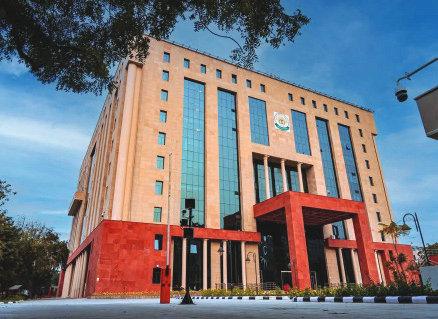
CBSE HQ, Delhi: nationwide dissatisfaction
In the interests of modernisation, transparency and prompt declaration of results, Union education minister Dharmendra Pradhan mandated — CBSE is an ‘autonomous’ subsidiary of his ministry — a switch to OSM of answer papers of the 1.7 million higher secondary students in India and abroad who wrote the exam this summer. The system permits every student dissatisfied with her score in any paper to pay a small fee and access a copy of her answer sheet after evaluation by examiners. After the CBSE class XII results were declared on May 13, over 1.6 lakh students who applied for their scanned answer sheets complained about blurred paragraphs, incomplete answers, missing pages, maps and graphs and mix-up of students’ answer sheets.
A news report in The Hindu (June 23) confirms that the scores/marks of “several” students who applied for re-evaluation of their answer sheets were “substantially increased”. The detailed report cites instances of a student whose physics paper marks were revised from 71 to 90; a student in West Bengal whose history paper marks were jacked up from 74 to 97, and one instance in which the state topper was toppled after re-evaluation. Quoting an anonymous CBSE evaluator, the report adds that evaluators had been given only two weeks lead time to introduce the new OSM system resulting in a “complete mess”.
Further investigation into the CBSE exam of academic year 2026-27, especially by Sarthak Sidhant, a Ranchi (Jharkhand)-based class XII student with IIT aspirations, revealed a deep flaw in the process through which Coempt Eduteck, an obscure Hyderabad-based ICT (information communication technologies) company was awarded the contract to introduce CBSE’s OSM evaluation system in preference to the globally renowned Tata Consultancy Services Ltd. Until recently, TCS was India’s most valuable company countrywide measured by market capitalisation (Rs.7.58 lakh crore). Sidhant’s investigation of the tender papers indicate that Coempt was awarded a higher score in terms of technical capability than TCS (91 percent cf. 89 percent) and its financial bid was substantially lower (Rs.384 crore cf. Rs.951 crore) enabling it to bag CBSE’s inaugural OSM contract. Invited by a Parliamentary Standing Committee to testify, Sidhant averred that across several bidding rounds, tender eligibility norms were customised to favour the relatively inexperienced Coempt Eduteck, which bagged the contract — and made a hash of it.
Worse, through accessing corporate records, writing on Substack (June 21) Dr. Prashant Narang, the Delhi-based Deputy Director of Research and Programs at TrustBridge Rule of Law Foundation makes a devastating revelation that Coempt Eduteck is the new avatar of Globarena Technologies Pvt. Ltd, a firm that managed the results processing software of the Telangana Internmediate examination in 2019. “Roughly 3.8 lakh candidates were initially declared unsuccessful amid serious complaints about the results. The controversy unfolded alongside reports that 23 students had died by suicide. Globarena was not formally blacklisted. Less than six months later, it changed its name,” writes Narang.
The CBSE contretemps followed hard on the heels of the National Eligibility cum Entrance Test — Undergraduate (NEET-UG) scandal of May this year, a single exam that determines admission into undergrad programmes of the country’s 823 medical and 330 dental colleges. Hours before the exam was scheduled to begin on May 12, question papers were auctioned on social media prompting cancellation and rescheduling of NEET-UG 2026 nationwide. After a national furore and several students who had slaved for the exam for years were driven to suicide, the exam written by 2.2 million school-leavers was re-staged on June 21. Earlier, NEET-UG 2024 was partially cancelled because 1,563 examinees were awarded compensatory aka ‘grace marks’ by the National Testing Agency (estb.2017) as compensation for loss of examination time caused by administrative lapses at a limited number of centres. Following a Supreme Court order, these grace marks were cancelled with the 1,563 students given the option to accept their original scores or rewrite the test.
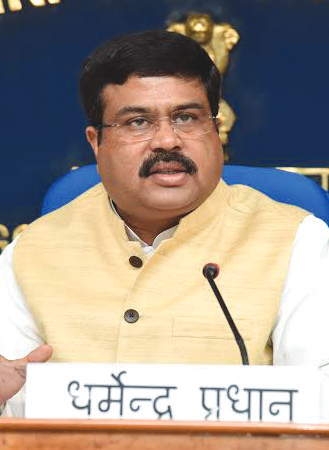
Pradhan: harsh spotlight
All these glitches and scandals following in quick succession have cast a harsh spotlight on Union education minister Dharmendra Pradhan, whose penchant for centralised entrance exams under the aegis of his ministry — which have sparked a revolt in some states as education is a concurrent list subject in the Constitution — is matched by total unaccountability for his initiatives.
Since he was appointed Union education minister in 2021, Pradhan has introduced CUET (Common University Entrance Test), a centralised entrance exam that determines admission into all 57 Central government-funded universities, and latterly NEET-UG for medical education. As a result, CUET controls admissions into the best Central universities; NEET-UG into all medical and dental colleges countrywide and IIT-JEE into top-ranked Central-government funded engineering colleges (IITs and NITs).
Moreover, although structural changes are being implemented in Indian education under his watch, including patchwork implementation of the National Education Policy (NEP) 2020, Pradhan is averse to explaining himself. True, carefully orchestrated perfunctory interviews have been granted to junior reporters of mainstream media. But all pleas by your editors who have domain knowledge and decades of experience of the education sector for a ‘conversation’ — interview is reportedly anathema to him — have gone unheeded. This despite EducationWorld (estb.1999) having established a pre-eminent reputation as the country’s premier education-focused news magazine.
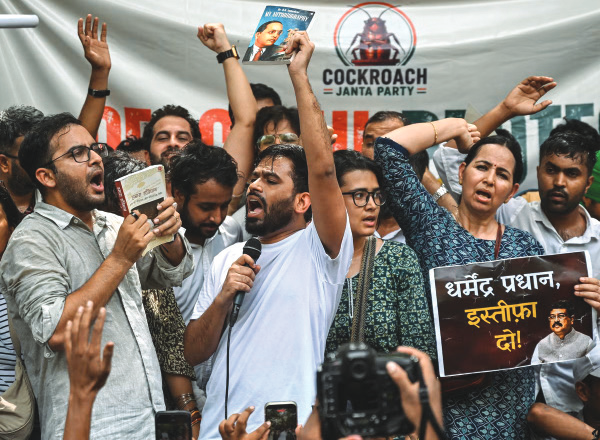
Cockroach Janata Party convenor Abhijeet Dipke (centre): strident resignation demand
In the circumstances, given Pradhan’s insolence of office and reluctance to be held accountable for the stagnation of public education, the chorus for his resignation is growing louder. The newly established Cockroach Janata Party promoted by Boston-based social activist Abhijeet Dipke which has taken social media by storm, notching up 22.6 million followers on Instagram in a few weeks, has made Pradhan’s resignation its topmost demand. Ditto Rahul Gandhi, leader of the Opposition in the Lok Sabha. Several political pundits in Delhi discern a parallel between the exam scams under Pradhan’s watch with the teacher recruitment scandals of West Bengal which proved the nemesis of the three-term Trinamool Congress party led by Chief Minister Mamata Banerjee.
Latterly shaken by the CBSE OSM scandal which has opened up a can of worms, Pradhan has accepted responsibility. “I take responsibility. It will be fixed; a solution will be found. We are all working on that task,” he said, addressing the media after a meeting with CBSE officials on May 27, adding that “I want to assure everyone that if any irregularities are found, no one will be spared,” according to an India Today online report (May 28). On June 2, the ministry set up a one-man inquiry committee to investigate the OSM Scam, which is yet to submit its report. However, on June 21, the cancelled NEET-UG 2026 was held countrywide amidst unprecedented security after the Indian Air Force, CRPF and police in all states were mobilised to ensure that the exam was conducted without a glitch.
Meanwhile against the backdrop of the snowballing OSM scandal, sudden introduction of the board’s peremptory mandate that children from class IX onward should start learning three languages from this academic year, and the CBSE’s lack of consulting culture with affiliated schools, managements of a growing number of top-ranked CBSE affiliated schools are contemplating switching affiliation to other recognised exam boards such as CISCE, IB and Cambridge International.
This is the outcome of belated awareness that the major infirmity of CBSE is that although much proclaimed as an ‘autonomous’ school education board, it is a compliant subsidiary of the Union education ministry. As such, it is less than autonomous, and has gradually transformed into a willing handmaiden of the imperious education minister and ministry officials.
The board began its innings in 1929 as the Board of High School and Intermediate Education, Rajputana with its headquarters at Ajmer and Agent of the Governor-General in Rajputana and Chief Commissioner, Ajmer-Merwara, Lt. Col. G.D. Ogilvie, as the Controlling Authority. And right down to this day, CBSE’s organogram (organisation chart) displayed on its website indicates that the Secretary (School Education and Literacy) is the “controlling authority” of CBSE ranked above the Chairman. Subsequently, this board was given its current nomenclature ‘Central Board of Secondary Education’ in 1952 with the primary objectives “of serving educational institutions more effectively, to be responsive to the educational needs of those students whose parents were employed in the Central Government and had frequently transferable jobs”.
As such, CBSE has always had the reputation of being a “government board,” all claims to being an autonomous entity notwithstanding. On the other hand, CISCE — the other major pan-India school-leaving examination board (and successor of the pre-independence Senior Cambridge Examinations) has had — and maintained — the reputation of a substantially less compliant institution. This explains why most of the country’s church and missionary promoted schools and several top-ranked non-missionary schools including The Doon School, Dehradun; Cathedral & John Connon, Mumbai; Bishop Cotton, Shimla and Bangalore; Inventure Academy, Bangalore, among others have opted for CISCE affiliation. And over time, CBSE has acquired a reputation for science and math focus whereas CISCE has a better reputation for English and the humanities — a perception vigorously contested by CISCE spokespersons.
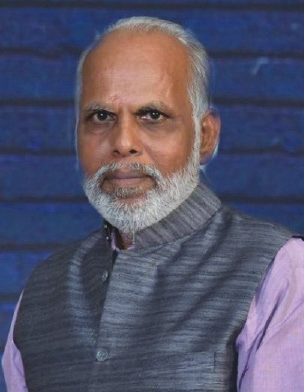
Srinivasan: authoritarian culture
Meanwhile dissatisfaction with CBSE’s OSM imbroglio and high-handed introduction of the three languages diktat, has catalysed pent-up criticism of the culture and modus operandi of India’s largest national school examinations board. In a podcast interview with EducationWorld’s Summiya Yasmeen (June 18), Dr. M. Srinivasan, the highly-respected promoter-chairman of the high-ranked CBSE-affiliated GEAR Innovative International School, Bengaluru (estb.1995) and President of the Managements of Independent CBSE Schools, Karnataka, minced few words in lashing out at the board’s authoritarian culture.
“During the past few years CBSE has developed a very controlling and bureaucratic culture. Amendments to the board’s by-laws are issued almost every month without any consultation with managements of affiliated schools. Curiously, although CBSE has 30,000 affiliated schools countrywide, there is no elected representative of affiliated schools, only handpicked selected yes-men. Moreover, of late, a tendency to introduce new initiatives without adequate planning and organisation — as evidenced by the switch to OSM and mandating class IX students to start learning three languages at short notice — seems to have afflicted CBSE. The world over, examination boards engage in deep research comparing their syllabuses with other countries, aligning them with industry needs and requirements. There is no evidence of the substantial funds that CBSE collects by way of affiliation, examination and other fees — sports fees have quadrupled in the past five years — being utilised for such research and ground studies,” says Srinivasan, an alum of Mysore and Connecticut (USA) universities, who established GEAR International three decades ago.
| Year | Issue | Comment |
|---|---|---|
| 2026 | On-Screen Marking (OSM) glitches and tender controversy | Administrative, technological and procurement controversy |
| 2018 | Mathematics and Economics paper leak | Examination security scandal |
| 2017 | Moderation/grace marks litigation | Policy controversy |
| 2021 | COVID assessment formula | Administrative controversy |
Moreover, CBSE which prescribes NCERT (National Council for Education Research & Training) — also an ‘autonomous’ subsidiary of the Union education ministry — textbooks is quick to accept and implement curriculum and textbook additions and deletions recommended by NCERT. Since 2022, NCERT has made 1,334 changes in 182 textbooks described as “rationalisation.” These include deletion of all information on the Delhi Sultanate and Mughal empire, patently at the diktat of the education ministry. It is arguable that as an autonomous school leaving examinations board, CBSE should have contested arbitrary and disruptive additions and deletions.
Sharma: lost focus
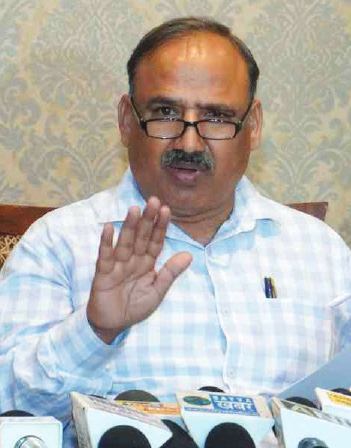
Kulbhushan Sharma, President of the National Independent Schools Alliance (NISA), a federation of state associations of low-fees, budget private schools in India, the second panelist on the EW podcast referred to above, was more critical of India’s largest national school-leaving examinations board.
“CBSE has lost its focus and purpose, which is to conduct examinations. It has transformed from an examination body into an inspector of schools, teacher training organisation and convener of conferences, neglecting its main job of conducting fair and trusted examinations. It’s become a money minting machine, focused on increasing the number of affiliated schools and associated services. In assuming this new ‘inspector’ role, the board has become preoccupied with issuing circulars and regulating schools and teachers than engaging with stakeholders to improve its testing and examination function, and has steadily been encroaching upon the autonomy of affiliated schools. Since it’s a Central government-controlled board with wide powers, school managements and principals are afraid of criticising it. If an independent board had been involved in an OSM-like scam, the government would have taken strict action against it by now. If CBSE has to become a truly autonomous body, it must change its structure and functioning by evolving into a democratically-run body with stakeholders — school principals and directors — from across the country — not just north India — serving on its governing body,” says Sharma.
The promoter of a Haryana-based budget private school and President of NISA which claims a membership of over 60,000 schools, including several CBSE schools, Sharma has long-standing experience of the transition of CBSE from a school-leaving examinations board into a “money-minting machine” with an annual income estimated at Rs.1,600-1,800 crore.
Long before its latest bloomers — OSM and peremptory introduction of the three language learning programme for class IX students with immediate effect — disillusionment with CBSE’s authoritarianism and bureaucracy had begun to manifest within promoters of affiliated and greenfield primary-secondary schools. This explains the rising number of schools preferring to affiliate with CISCE, its rival national board, and also with offshore exam boards such as International Baccalaureate and Cambridge International, which following liberalisation and deregulation of the Indian economy in 1991, have staged a comeback in Indian education.
Over the past two decades, the number of schools affiliated with CISCE has increased from 1,500 to 2,957; the number affiliated with IB to 280, and Cambridge International to 700 despite affiliation norms and fees levied by international boards being substantially higher. For instance, most upscale new millennium greenfield schools including Dhirubhai Ambani, Mumbai; Inventure Academy and Greenwood International, Bangalore among others, have opted to affiliate with CISCE plus IB or Cambridge International. Clearly, the headache of affiliating with the sarkari CBSE is a pain that intelligent new-age private school promoters prefer to avoid.
Mayo College’s Saurav Sinha: oppressive regulations
Although fear of the wrath of the Central government bearing down upon them, affiliation cost considerations and/or sheer inertia has prevented a mass exodus of private schools from the tight embrace of CBSE, some vintage schools are risking official displeasure and switching allegiance to CISCE. Perhaps the most striking instance is of the vintage Mayo College, Ajmer (estb.1875) ranked India’s #1 Ivy League boys’ boarding school in the EducationWorld India School Rankings 2025-26. From next February, this blue-chip boys’ boarding school affiliated with CBSE for the past 37 years will switch to CISCE.
The immediate provocation is CBSE’s three languages — of which two should be Indian languages — learning policy effective from this year. This order was issued without discussion or consultation with managements of affiliated schools.
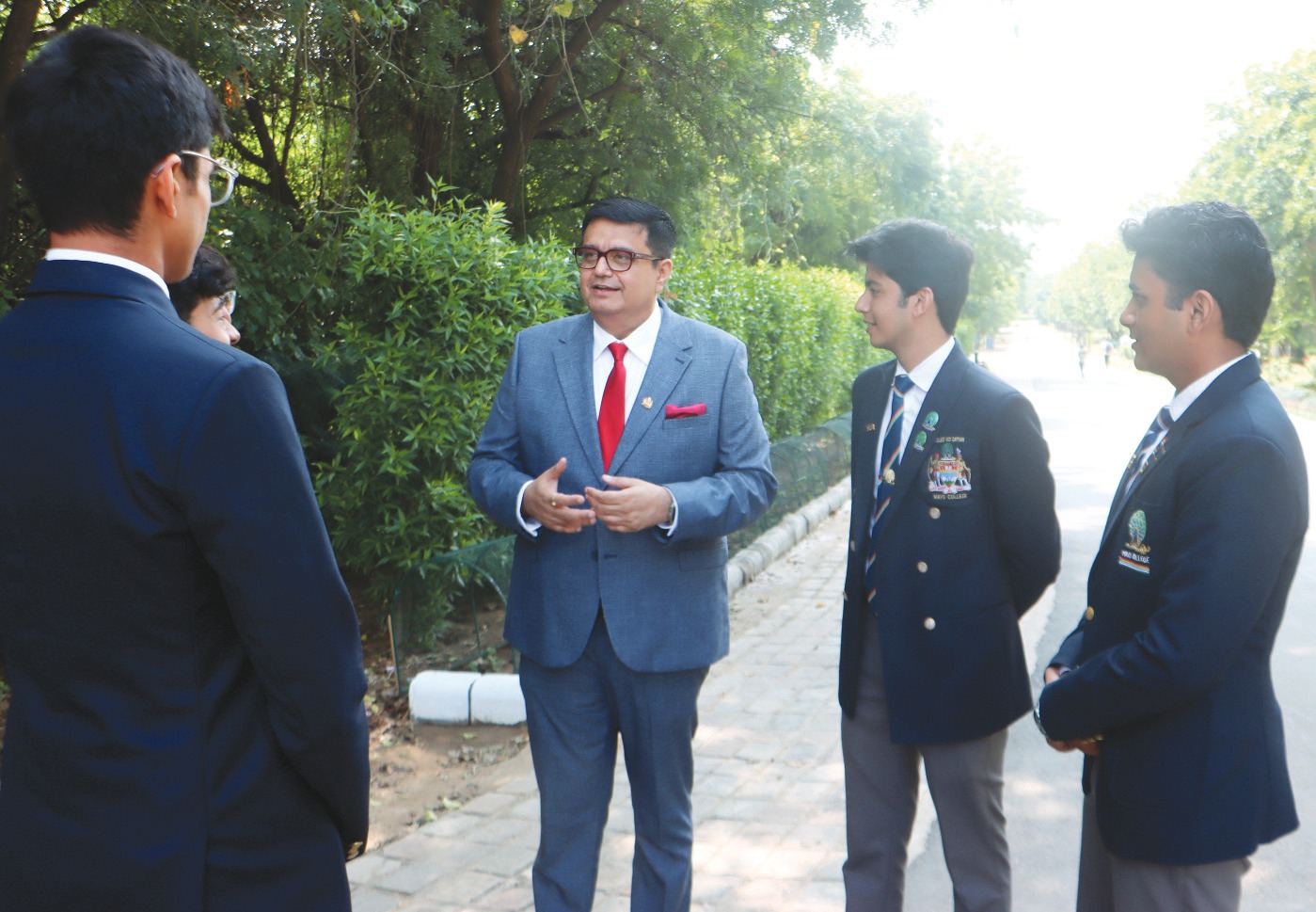
“In recent years, we have found it very difficult to get access or a hearing in CBSE. Perhaps with 30,000 affiliated schools, the board has become too large to allow room for bilateral discussions and consultation. Moreover, the paperwork mandated by the board has become excessive, requiring the equivalent of 400 man days per year. Simultaneously, regulations such as teacher training only by CBSE-approved master trainers, have become oppressive and directives such as switching to OSM and three languages learning have been issued at very short notice. Therefore, Mayo’s Board of Governors has opted to switch affiliation to CISCE where we believe we will get ease of access when necessary,” says Saurav Sinha, the highly qualified (Delhi University and London School of Business) principal of Mayo College, Ajmer.
Clearly, the root problem of India’s largest national school-leaving examinations board is that it is too closely tied to the apron strings of the Union education ministry. Under a series of ill-qualified authoritarian education ministers appointed by Prime Minister Modi — starting with former television star Smriti Irani, failed novelist Ramesh Pokhriyal and omniscient incumbent Dharmendra Pradhan — and a series of careerist IAS bureaucrats with little experience of education, CBSE officials have proved too amenable to ill-considered and whimsical diktats issued by ministers and ministry bureaucrats.
“The minister has merely to mumble some new policy initiative and career IAS babus, CBSE chairmen and compliant Governing Council officials fall over themselves to implement it. The choice of Coempt Eduteck over TCS, switch to OSM without adequately training evaluators, premature broadcast of the now revised three languages policy, are examples of sycophancy of the CBSE management. The board has to be led by experienced educators rather than generalist IAS bureaucrats reporting to an authoritarian minister impatient with debate and discussion,” says an incumbent principal of a high-ranked CBSE school.
Moreover, the incremental tendency of CBSE to launch new initiatives and policies without adequate consultation with affiliated schools — managements, principals and teachers — is prompting heartburn among educationists countrywide. The consensus of opinion is that the efficiency and effectiveness of CBSE directives will be greatly improved and successful if stakeholders are consulted and given sufficient time for implementation.
Lokhande Sitaram: incommunicado
The strength of an examination board is its ability to remain closely connected to the ground realities of affiliated schools, teachers, parents and students. Policies and reforms are effective when they are supported by adequate consultation, thoughtful planning, pilot implementation, and meaningful feedback from stakeholders across the country. CBSE has played a pivotal role in shaping the educational aspirations of millions of students. Therefore, preserving the confidence and trust of all stakeholders must remain a priority. Whether it relates to examinations, curriculum changes, assessment reforms, or new educational initiatives, clarity of communication and stakeholder participation is essential for successful implementation. In my view, the future of education requires a collaborative approach where policymakers, school leaders, teachers, parents, and students work together as partners,” says Bharat Malik, a founder-member of the National Independent Schools Alliance (NISA) and a Maharashtra-based educationist.
Confronted by a growing chorus for his resignation, the haughty Dharmendra Pradhan has somewhat climbed down from his high horse. In some interviews granted to mainstream media — though not to EducationWorld with 26 years of domain knowledge and expertise — the minister has blamed the “then CBSE leadership”, a reference to Rahul Singh, IAS chairman, and Himanshu Gupta, secretary of the board, who were relieved of their posts as soon as the OSM scandal broke.
“Prima facie, OSM was implemented in haste. The then CBSE leadership should have listened to whistleblowers with greater sensitivity. CBSE will have to think through how to proceed and consult parents, teachers and students,” said Pradhan, in an interview with Times of India (June 25).
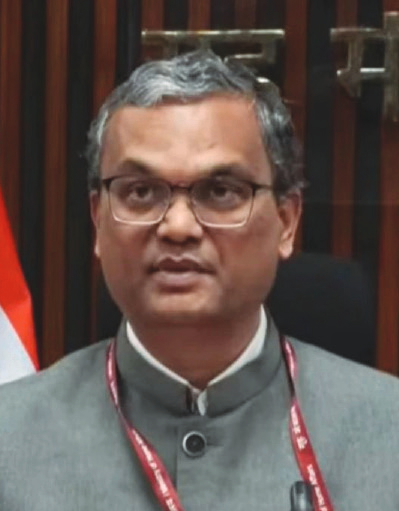
However, with Lokhande Prashant Sitaram, another IAS officer appointed chairman of CBSE, it’s unlikely that CBSE’s culture of subservience to the ministry will change. Repeated letters and phone calls to Lokhande by this writer to outline his board reform initiatives, if any, proved fruitless.
Against this murky backdrop of repeated centralised exams related scandals — NEET-UG 2024, 2026, CBSE OSM — and swelling tide of discontent with the arbitrary, ill-considered firmans being issued by his tightly controlled ministry, it has become clear that like his predecessors in Shastri Bhavan, Delhi who have disappeared unsung into the woodwork, Pradhan has failed to provide the sensitive leadership that this critically important ministry requires. Despite having held this critically important office for over a decade, learning outcomes in public primary-secondaries are stagnant; sputtering reforms in higher education have resulted in India hosting the world’s largest proportion of unemployed graduates (40 percent), and the minister has miserably failed in raising annual outlays for education, indicative of his lack of clout within the cabinet. At a time when AI and revolutionary digital technologies are upending education and workplaces worldwide, the Union education ministry can’t be led by an old-style autocrat with little awareness of the importance of shaping the development and future of 500 million children and youth — the world’s largest young population. Time for him to follow his failed predecessors into the woodwork.








Add comment