






Class 12 student develops CSIR-backed AI health app MediVaani
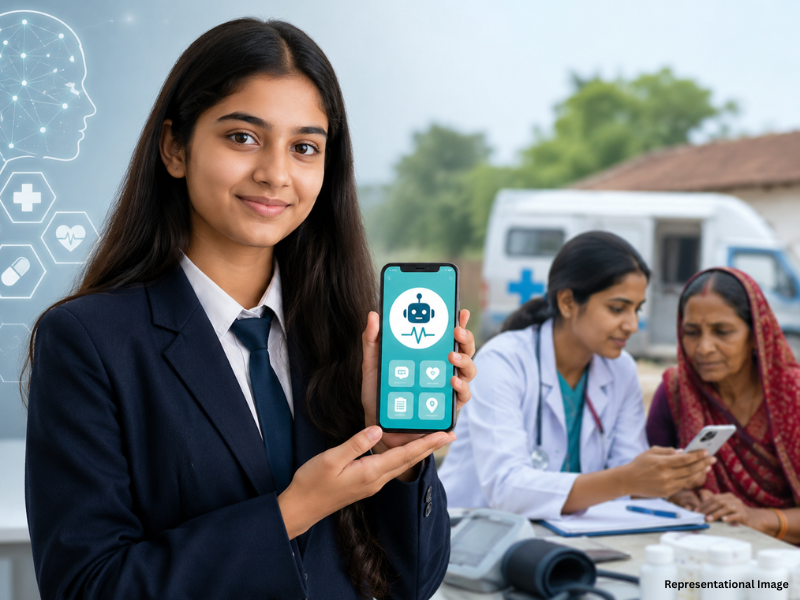
Shivanjali Sapra, a Class 12 student and Head Girl at Amity International School, Saket, New Delhi, has developed MediVaani, an AI-powered health triage application developed in partnership with the Council of Scientific and Industrial Research (CSIR).
The app is being piloted with mobile health units in Meghalaya and validated with hospitals and pharmacies across Haryana and Punjab. It supports 44 regional languages and has won the All India third prize at the CSIR National Hackathon. The app is also being deployed through Accredited Social Health Activist (ASHA) workers and Jan Aushadhi pharmacies to more than 500 rural students.
MediVaani is designed to provide language-accessible health guidance at the first point of contact, before a patient reaches a doctor. Users can describe symptoms by speaking in their own language, including tribal languages, or by selecting an area on a body map. The app then asks follow-up questions and either provides over-the-counter guidance and information on the nearest Jan Aushadhi Kendra or flags the case as urgent and directs the user to seek medical care.
“MediVaani’s aim is to make healthcare more accessible and affordable to the masses,” said Shivanjali Sapra. “It does not diagnose and does not prescribe.”
The application is built on Llama 2, a 70-billion-parameter large language model, and generates responses from structured medical data. It also uses GeoApify to locate hospitals within a five-kilometre radius and provides a direct link to India’s Emergency Response Support System (ERSS), 112. The app does not provide prescription-level advice, collects data only with user consent and is free to use.
The project began during a CSIR internship Shivanjali completed in Class 10, when she studied healthcare access gaps in underserved communities. Her initial proposal for physical health kiosks was later redesigned as a smartphone application because of challenges related to maintenance, electricity and security.
The project continued in Grade 11, and a patent filing now covers the app’s classification and escalation logic. MediVaani has been reviewed by CSIR researchers, including Dr Ramjee Pallela, Gladis Nair and Dr D Srinivasa Reddy, Director of CSIR-Indian Institute of Chemical Technology (CSIR-IICT).
Discussions are also underway with the Croasis Research Group, whose mobile healthcare units in Meghalaya reach an estimated 40,000-50,000 lower-income households.
MediVaani is among several projects developed by Shivanjali focusing on access-related challenges. Her other projects include RahSaarthi, a wearable navigation device for visually impaired users; GreenAid, a biodegradable band-aid; EquiWill, a campaign on equal inheritance rights for girls; Gulab-OH!, a breast cancer awareness campaign; and The TechnoMath Playground, an outdoor playset designed to teach mathematics.
With pilots underway in Haryana, Punjab and Meghalaya, MediVaani is being tested through pharmacists, ASHA workers and rural healthcare users as Shivanjali works towards expanding its use as a healthcare access tool.
Also Read: ETS hosts TOEFL Experience Day in Delhi







Add comment