






Delhi: Legal lèse-majesté furore
– Nivedita Sharma (Delhi)
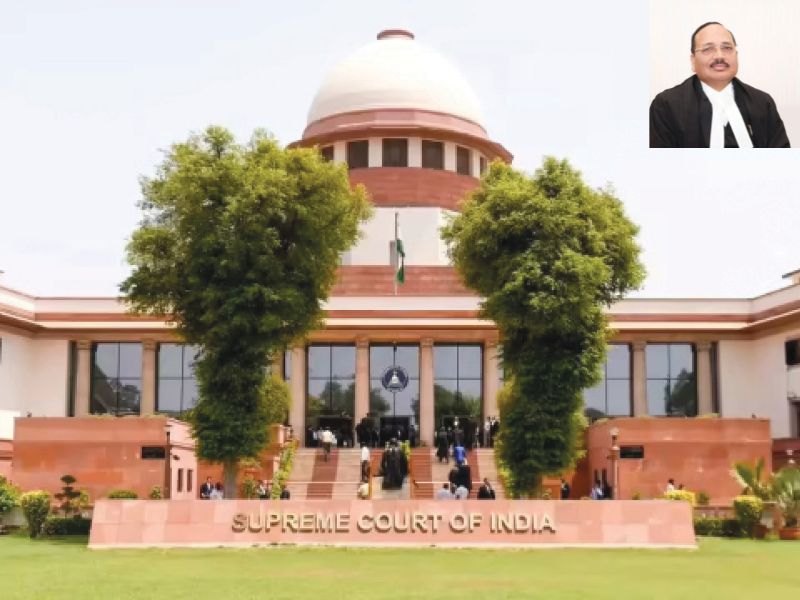
A reference in a class viii social science textbook to “corruption in the judiciary” has erupted into a national controversy after a Supreme Court bench headed by Chief Justice Surya Kant took suo motu cognisance of this lèse-majesté transgression. The three-judge bench termed the content a “calculated move to undermine and demean the dignity of judiciary” and ordered a blanket ban on further publication, reprinting or digital dissemination of the book titled Exploring Society: India and Beyond — Part 2. The irate justices of the apex court ordered the immediate seizure and sealing of any copies that had been distributed, as well as a takedown of all online versions.
Coterminously, it issued show-cause notices to the School Education Secretary in the Union ministry of education and Director of the National Council for Educational Research & Training (NCERT) as to why proceedings under the Contempt of Courts Act or any other law should not be initiated against them. “As head of judiciary, it is my duty to find out who is responsible. If there is more than one, heads must roll,” thundered CJI Surya Kant.
The apex court’s indignation has set the dovecotes of the BJP/NDA government at the Centre aflutter. Particularly since the textbook was commissioned and published by NCERT — India’s largest school textbooks publisher, and more pertinently, a subsidiary of the Union ministry of education.
Union education minister Dharmendra Pradhan said he was “deeply saddened” over the incident, reiterating the government’s “utmost respect for the judiciary.” “The moment our attention was drawn towards it, we issued the direction to take this book back and stop its distribution,” said Pradhan, adding that a formal inquiry would be held to affix responsibility and action will be taken against errant officials. Solicitor-General Tushar Mehta also offered an unconditional apology on behalf of the government during court proceedings, and told the bench that corrective steps would be taken.
Meanwhile the episode has unleashed a national debate as to what extent institutional critiques can be included in school curricula. Legal scholars say that the law’s delay, the mountainous backlog of the legal system, corruption in the judiciary are a matter of public discourse. It’s well-known that last year, a mountain of currency notes was unearthed in a garden garage of Justice Yashwant Varma, a judge currently serving at the Allahabad high court, after being repatriated from the Delhi high court in April 2025.
Thirty-five years ago, impeachment proceedings were initiated against Justice V. Ramaswamy of the Punjab & Haryana high court. Criminal proceedings against both these judges haven’t made any headway. Therefore, criticism of the country’s snail-paced judiciary is justified and protected as a fundamental right of free speech and expression, argue some legal pundits.
However other legal scholars and educationists draw a line between informed adult criticism of the judiciary for nonchalantly presiding over a low-performance justice system whose sloth, complex procedures and high costs deny justice to the majority of citizens, and inserting denigrating material into textbooks written for young impressionable children.
Informed educationists are inclined to agree. “Textbooks are written to assist students in understanding how the major estates of governance — legislature, executive and judiciary — operate in cohesion. Therefore, they must be written in age-appropriate language, balanced presentation, and careful contextualisation so that young learners develop informed perspectives of the Constitution and national governance. Children and early teens don’t need to be informed about the negative facets of institutions of governance,” says Dr. Silpi Sahoo, promoter-chairperson of the Bhubaneswar-based top-ranked SAI International Education Group.
Nevertheless, CJI Surya Kant and learned justices of the apex court would do well to attend to improved administration of the country’s 18,735 lower courts which are in terrible condition. “Every time I have had the misfortune to go into one of them, I have been horrified by the decay, dirt and disorder in them. In lesser courts in rural places, I have run into stray cattle, dogs and cats. Why is this? Why are fine old British buildings that house some of our higher courts being allowed to fall to pieces? Why are repairs so difficult?” queries Tavleen Singh, a long-tenured columnist of the Indian Express (March 1).
From his seat at the top of the country’s crumbling justice system CJI Surya Kant needs to become aware that if the judiciary demands respect, it must be seen to be respectable.









Add comment