






Delhi: Soft punches report
– Autar Nehru (Delhi)
SWI 2026: funding bindspot
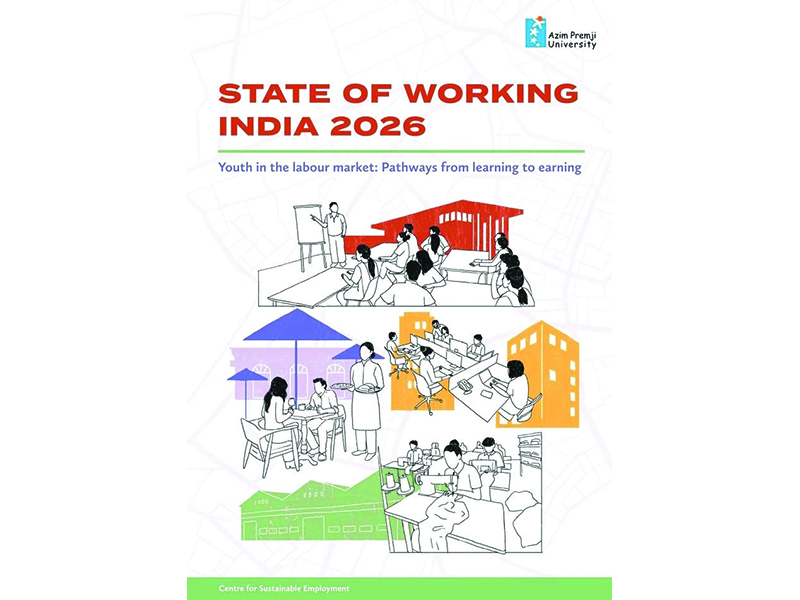
The fifth edition of State of Working India (SWI) 2026 report of Azim Premji University’s Centre for Sustainable Employment, titled ‘Youth in the Labour Market: Pathways from Learning to Earning’ released in March, paints an alarming picture of graduate unemployment. It reveals that 40 percent of youth who have graduated from India’s higher education institutions, including 53,000 colleges and 1,338 universities, are unemployed.
According to the report, the number of graduates (aged 20-29) unemployed for over 12 months, has risen from a mere 5 million in 1983 to 63 million in 2023, from 13 percent to 67 percent. Since then presumably after the country’s rate of economic growth picked up after the Covid-19 lockdown, the percentage of unemployed graduates has declined to 40 percent. Nevertheless this report is a harsh indictment of India’s higher education system. In the UK and US, the percentage of unemployed grads is less than 4 percent and in China an estimated 16 percent.
Warning that India is “nearing the peak of its demographic dividend”, with the share of working age population likely to start declining after 2030, SWI 2026 identifies several factors for this disturbing phenomenon. Among them: increase in number of faculty has not kept pace with increase in student numbers; although the number of Industrial Training Institutes has increased by nearly 300 percent since 2010, this expansion has been accompanied by decline in institutional quality “particularly among private providers”; though higher education has become increasingly democratised, financial barriers remain — between 2007-2017, the share of students from poorest households in tertiary education has inched up from 8 percent to 15 percent.
On the positive side of the ledger, SWI 2026 notes that graduate salaried earnings exceed non-graduates at the time of entry into employment and over their lifetime; young workers are exiting agriculture faster than older cohorts and increasingly entering manufacturing and services; caste and gender-based occupational segregation has weakened over time; migration has emerged as an important mechanism through which youth respond to uneven regional development and labour market opportunities. However, APU’s carefully worded report stops short of directly highlighting the deeper causes of the crisis in higher education which has transformed — and continues to transform — 21st century India into a distant also-ran in the global development race.
The causes of this phenomenon are mildly identified by SWI 2026 — lopsided teacher-pupil ratios, neglect of vocational and skills education, insufficient “democratisation”, i.e, lack of universal access, especially youth at the bottom of the pyramid. But self-evidently, the common factor behind these infirmities is insufficient funding.
Although it’s well-known that over the past almost eight decades since independence, national (Centre plus states) annual expenditure on education has averaged 3.5 percent of GDP instead of the minimum 6 percent recommended by the Kothari Commission in 1967 and every other commission since, SWI 2026 glosses over this important issue. Recruiting more faculty, establishing excellent, well-equipped STEM and digital labs and vocational training centres and also ‘democratising’ higher education, i.e, increasing the GER from the current 28 percent (cf. Korea’s 96 percent) requires substantially greater resource allocation. Yet if SWI 2026 states this, it does so tangentially.
Nor despite this report being authored by a private university, SWI 2026 doesn’t recommend multiplication of new genre, globally benchmarked private universities which top the annual EducationWorld India Higher Education Rankings (see cover story). They, horror of horrors, levy cost-plus, if not market-determined, tuition fees. Left-liberals who dominate India’s academy including APU, prefer over-subsidised HEIs (higher education institutions) whose seats are grabbed by middle class students always on the lookout for emigration opportunities.
“Our experience is that lack of domain knowledge and experiential learning is the biggest drawback of graduates from the great majority of India’s colleges and universities. Moreover they also tend to lack key horizontal skills — critical thinking, solution mindset, decision making etc, which are necessary to raise factory, farm and services productivity. Introduction of compulsory internships and hands-on-learning into college and university curriculums is urgently required for reducing graduate unemployment. In turn, this requires radical syllabus and curriculum overhaul and substantially greater academy-industry integration,” says Sumit Kumar, Chief Strategy Officer of TeamLease Services Ltd, India’s largest training, recruitment and placement company.
Although the 254-pages SWI 2026 is an information-intensive labour of love, it fails to see the wood for the trees.









Add comment