






Egypt: Land of Timeless Wonders
Egypt is one of the most visited countries in the world. It attracted 19 million tourists in 2025 drawn to its ancient wonders and monuments, rich cultural heritage, and extraordinary desert beauty
Anil Thakore
Egypt is not just another country with a rich history. It is an experience that enthrals, overwhelms, and awes. How did ancient Egyptians establish one of the world’s greatest civilisations on a sandy desert of 1 million sq. km, nourished with just the River Nile flowing through it from Aswan to Alexandria?
Earliest records of the great Egyptian civilisation are inscribed on the Rosetta Stone. With the invention of papyrus around 3000 BCE, millions of manuscripts have recorded the country’s history beginning with the reign of King Narmer (Menes, 3150 BCE), followed by a line of pharaohs that ruled for over 3000 years.
The last native Egyptian pharaoh to rule Egypt was Nectanebo II, defeated by the Persians in 343 BCE. Alexander the Great defeated the Persians in 310 BCE. One of his generals, Ptolemy established the Greco-Macedonian dynasty, which ruled as pharaohs for 300 years. With Roman emperor Augustus invading Egypt and the death of Queen Cleopatra VII, the pharaonic dynasty ended in 30 CE. Egypt became a Christian state. But the Roman period ended in 641 CE with the victory of the Caliphates from the Arabian peninsula.
This started the transition of Egypt from a Christian to an Arabic-Islamic society. For the next 800 years, Egypt was ruled by conquerors – the Mamluks from Türkiye, the French and British. In 1953, it became an independent democratic republic.
Egypt is one of the most visited countries of the world, attracting 19 million tourists in 2025 drawn to its ancient monuments, rich cultural heritage, and extraordinary natural beauty — from the boundless Sahara Desert to the life-giving Nile that has nourished civilisations for several millennia.
Cairo
 The starting point of our time-bound 11-day Egyptian adventure early this year, was Cairo, the country’s capital since the 12th century CE and the largest and oldest city of the Arab-speaking world and African continent. With a population of 22 million, Cairo is a buzzing metropolis where ancient minarets pierce a modern skyline and medieval bazaars adjunct contemporary shopping malls.
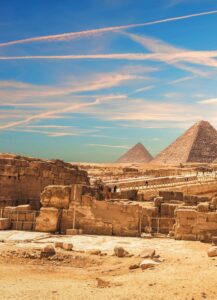
Day 1 began with a visit to the Pyramids of Giza, 13 km from Cairo, a Unesco World Heritage site and the last surviving wonder of the ancient world. These pyramids are royal tombs built for three pharaohs — Khufu, his son Khafre, and grandson Menkaure — between 2600 and 2500 BCE on a desert plateau on the west bank of the Nile. The engineering behind them is staggering. Each pyramid rises from a core of millions of rough-cut limestone blocks, originally encased in brilliant white limestone transported across the desert for vast distances. Deeper inside, the burial chambers were hewn from massive pink granite blocks — each one shipped from Aswan, nearly 900 km up the Nile. King Khufu’s pyramid is the largest and tallest at 146.6 metres (479 ft)
The Pyramids complex also includes nine smaller pyramids of the queens and the Sphinx. Carved from a single block of limestone, the Sphinx is a colossal statue with a lion’s body and a pharaoh’s head, believed to represent King Khafre. Standing guard near the pyramids for over 4,500 years, it is one of Egypt’s most iconic monuments.
While at the Pyramids don’t miss taking a camel ride through the sweeping sands of the Giza Plateau, with the pyramids rising majestically on the horizon.
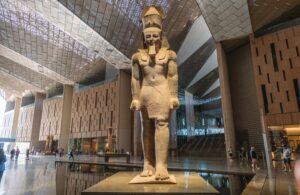
From the Pyramids, we headed to the Grand Egyptian Museum (GEM), a mere 2 km away. Inaugurated in 2023, GEM is a triumph of modern architecture — designed by an Irish firm and built over 20 years at a cost of $1.6 billion (Rs.15,222 crore), it is the largest archaeological museum worldwide. Its 100,000-strong collection spans every era of ancient Egyptian civilisation — from prehistoric artefacts and Old Kingdom masterpieces to the splendours of the New Kingdom — making it less a museum and more a journey through 7,000 years of human history. At every level of the six-storey atrium, colossal statues of kings and queens, towering sarcophagi, and extraordinary artefacts command attention. Presiding over the entrance is a 20-m granite statue of King Ramesses II — an arresting first encounter that sets the tone for all that follows.
A special highlight is the Tutankhamun collection — 5,000 of the boy king’s personal possessions displayed together for the first time, among them the legendary golden mask, golden throne, and his golden sarcophagi. Not to be missed is the adjacent Solar Boat Museum, housing the reconstructed 4,600-year-old cedar vessel used to transport the giant granite blocks that built the pyramids.
At night, as the museum’s multi-coloured lighting washed the Cairo skyline in vivid hues, we headed to our hotel The Hilton near Tahrir Square, for a quiet dinner and a belly dancing performance.
Day 2 began with a visit to Alabaster Mosque aka Muhammad Ali Mosque in Old Cairo. Built by Mamluk Muhammad Ali Pasha in 1848, it features a 52-metre central dome encased in glistening alabaster and two 84-m minarets. Access to this mosque is through the gates of the great Citadel, a massive fortress constructed by Saladin the Great in 1176 CE to defend Cairo against Christian crusaders.
Our next stop was the Coptic Hanging Church of Cairo, one of the oldest Christian churches of the world, dating back to the third century CE. Its name is no mere metaphor: the church is literally suspended above the gatehouse of an ancient Roman-Babylonian fortress, its nave hanging over ruins that predate it by centuries. Inside, the air is thick with history and quiet reverence. A carved wooden ceiling, shaped like the inverted hull of Noah’s Ark, arches overhead, while walls adorned with exquisite icons — some among the oldest in Christendom — tell stories that have outlasted empires.
This was followed by a stroll through Khan-El-Khalili, the largest and oldest market in the Middle East. In its narrow cobbled-stoned lanes are quaint shops vending finest Egyptian cotton textiles, jewellery, brass and ceramic artefacts. Also, within are cafes and restaurants. We selected the iconic Naguib Mahfouz Café — named after the legendary Egyptian author who won the Nobel Prize in Literature in 1988 — for lunch. Traditional khosari, kebabs, baba ghanoush, hummus and Ta’ameya and sweet Basbousa were served by traditionally dressed waiters.
The evening was reserved for a stroll through Tahrir Square and a quiet dinner at The Intercontinental Hotel.
Day 3 in Cairo was spent exploring the Egyptian Museum in Tahrir Square, the oldest archaeological museum of the Middle East. Inaugurated in 1902, it houses the world’s largest collection of over 120,000 pharaonic antiquities. Artefacts from Tutankhamun’s tomb, preserved mummies of kings, noblemen and crocodiles (the God Sobek), statues spanning the pre-dynastic period to the Greco-Roman era, Royal Jewellery of Tanis, and simple household possessions are beautifully exhibited on its two floors. A must-visit for history buffs.
Accommodation: Ramses Hilton (Rs.12,000-20,000 per night)
Aswan
 Day 4. An hour’s flight from Cairo takes visitors to Aswan (pop.380,000), sited in southern Egypt on the banks of River Nile, just north of the Sudan border. We landed mid-morning and drove straight to the Aswan High Dam — a striking meeting of contrasts, with golden desert on one side and the vast sweep of Lake Nasser — the world’s largest man-made lake, on the other. Built between 1960 and 1970 with support from the Soviet Union, this monumental feat of engineering tamed the Nile’s once-devastating floods and transformed Egypt’s agricultural landscape, reclaiming thousands of acres for cultivation.
However, the dam project came at a profound human and cultural cost: it displaced over 100,000 people and threatened to submerge priceless monuments, including the great temples of Abu Simbel, Philae Temple, Kalabsha, Amada, Derr, and Wadi es-Sebua. In what remains one of the most remarkable international engineering feats of the modern era, a Unesco-led campaign successfully relocated 22 giant complexes to higher ground.
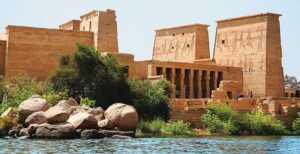
Our next stop was Temple of Philae, a Unesco World Heritage site, which was relocated to the island of Agilkya. The ‘Pearl of the temples of Egypt’, it is accessible only by boat and was built by King Ptolemy II in 690 BCE. The temple is a graceful blend of Egyptian and Greco-Roman architectural styles, its walls adorned with intricate carvings of Goddess Isis, Osiris (husband), and Horus (son).
Aswan is also a popular starting point for Nile cruises. At midday, we boarded our cruiser, M/S Sun Times for a three-night Nile cruise. After a quick lunch, we wandered through the bustling streets of Aswan, browsing lively souks filled with the heady aromas of spices and perfumes, and stalls glittering with handcrafted jewellery and curios. At sunset, we made our way to the legendary Sofitel Legend Old Cataract Hotel, a Victorian-era hostelry overlooking the Nile, where British novelist Agatha Christie drew inspiration for some of her most famous mysteries, including Death on the Nile.
A Victorian-style high tea on its grand terrace, as the sun dipped over the river in a blaze of gold, offered a lingering glimpse into the elegance and quiet indulgence of a bygone colonial age.
Day 5. After a well-deserved rest in our neat and well-equipped cruise cabin, early next morning (4.30 a.m), we boarded our luxury coach for a four-hour (283 km) drive to Abu Simbel. The astounding temples of Abu Simbel — one dedicated to Ramesses II and the other to his favourite queen, Nefertari — were carved into a sandstone mountain in the 13th century BCE during his reign (1279-1230 BCE). They lay buried under desert sands for over two thousand years until Swiss explorer Johann Ludwig Burckhardt rediscovered them in 1813. At the entrance of the Great Temple, four colossal 20-m statues of Ramesses II stand in commanding symmetry. Inside, towering columns and walls are etched with intricate carvings and hieroglyphs celebrating his military triumphs. The Temple of Nefertari, often considered the more graceful of the two — with statues of the queen, strikingly equal in size to those of the pharaoh, reflect the rare honour and deep regard Ramesses held for her.
We returned mid-afternoon and set sail for Kom Ombo, a serene riverside town on the Nile famed for its eponymous twin temple. Nearing sunset, we disembarked to visit the Temple of Kom Ombo dedicated to Sobek, the crocodile god, and Horus, the falcon god. Constructed by Ptolemy VI and Cleopatra II, his sister-wife (180-145 BCE), it is the only perfectly symmetrical temple of the Egyptian era.
Day 6. Through the night, the cruiser sailed to Edfu, another Nile-side town renowned for its remarkably well-preserved Temple of Edfu. Dedicated to the falcon-headed god Horus, its massive pylon gateway is guarded by imposing granite falcon statues. Hieroglyphs depicting battles, temple rituals, festivals, and mythological deities line its narrow corridors. Getting to the temple in a horse-drawn carriage along cobbled streets and returning in a Indian Bajaj tuk-tuk was a delightful trip down memory lane.
After a delightful three nights on M/S Sun Times, we disembarked at Luxor. The Nile River Cruise is highly recommended for a riverside view of Egypt. Relaxing on the top deck, watching palm trees swaying in the breeze, hawkers selling wares from feluccas, and villages drifting by like scenes from an ancient painting is an enchanting experience.
Luxor
One of the oldest continuously inhabited cities in the world, Luxor (pop.300,000) is a unique blend of the modern and traditional. On the east bank of the Nile is a busy commercial hub with contemporary infrastructure — the “city of the living” — while the west bank, dotted with tombs carved into sandstone hills, is known as the “city of the dead.” Recognised as a global capital of culture and history, and the “world’s greatest open-air museum”, Luxor seamlessly combines antiquity with accessibility. With a modern airport, river access, and tourist-friendly infrastructure, it welcomes over 6 million visitors annually. Here are the must-visit sights of Luxor (Day 7-8):
Karnak Temple Complex. A Unesco World Heritage Site and the largest religious complex ever built, the Karnak Temple Complex evolved over nearly 2,000 years under successive pharaohs, each adding to its monumental grandeur. This vast open-air museum features the awe-inspiring Great Hypostyle Hall with 134 towering columns, a sacred lake, colossal obelisks, including the 30-metre monolith of Hatshepsut and the 3-km-long avenue of lion-headed sphinxes linking it to the Luxor Temple.
Temple of Luxor. Located in the heart of Luxor, this Unesco World Heritage Site is a striking example of ancient Egyptian grandeur and continuity. Built primarily by Amenhotep III and later expanded by Ramesses II, it features monumental pylons, colossal statues, and an elegant colonnade. Uniquely, the active Abu el-Hagag Mosque stands within its complex, reflecting the temple’s continuous use across the Egyptian, Greek, Roman, and Islamic eras.
Valley of Kings. A Unesco World Heritage Site, the Valley of the Kings houses over 60 rock-cut tombs of pharaohs and nobles, their walls richly adorned with vivid paintings and hieroglyphs that narrate beliefs about the afterlife. Unlike Old Kingdom rulers such as Khufu, who built pyramids that were widely plundered, New Kingdom kings including Ramesses II and Tutankhamun chose hidden underground tombs in this valley and the nearby Valley of the Queens. Though many were looted, Tutankhamun’s tomb remained largely intact until its discovery in 1922, and its treasures are now preserved in the Grand Egyptian Museum.
Mortuary temple of Pharoah Hatshepsut. A masterpiece of ancient architecture, this striking terraced temple rises dramatically against the cliffs near the Valley of Kings. It was built for Hatshepsut of the 18th Dynasty (1479–1458 BCE), one of Egypt’s most successful female pharaohs, who assumed the full regalia of a king including the ceremonial false beard.
Accommodation. Sonesta St George (Rs.8,000-15,000 per night)
Alexandria
 Day 9-10. A one-hour flight from Luxor took us back to Cairo, from where we drove (a three-to-four-hour journey) on a smooth, twelve-lane expressway to the coastal city of Alexandria (pop 6 million). Our beachfront stay at Hilton Alexandria Corniche offered sweeping panoramic views of the Mediterranean Sea.
Founded by Alexander the Great in 331 BCE on the site of the ancient settlement of Rhakotis, Alexandria sits at the meeting point of the Nile and the Mediterranean Sea. Today, it is Egypt’s second-largest city and its principal seaport. Once home to one of the Seven Wonders of the Ancient World — the legendary Lighthouse of Alexandria — the city was also a beacon of knowledge. It hosted the famed Mouseion (seat of the great Library), established under Ptolemy II Philadelphus (285–246 BCE), which was destroyed over a series of fires and conflicts.
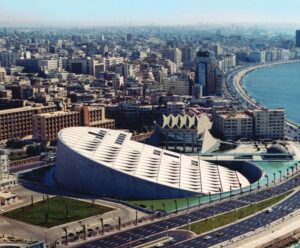
After a much-needed rest, first on our sightseeing agenda the next day was the Bibliotheca Alexandrina, inaugurated in 2002, in memory of the ancient Mouseion. One of the largest libraries of the world, its nine floors offer shelf space for up to eight million books and features a vast 20,000 sq. m reading hall. Housed within a striking, sun-disc-inspired structure designed by Norwegian architects, the library — built at a cost of $220 million — contains an extraordinary collection of books and manuscripts contributed from around the world. Beyond its library, the complex includes museums, art galleries, and an active manuscripts restoration centre.
Our next stop was the Citadel of Qaitbay — built using remnants of the ancient Lighthouse of Alexandria — followed by the Roman-era necropolis, the Catacombs of Kom el Shoqafa; Pompey’s Pillar, a towering Roman column, and the nearby Roman Amphitheatre of Alexandria, a well-preserved relic of the city’s Greco-Roman past.
Accommodation. Hilton Alexandria Corniche (Rs. 9,000-15,000 per night)
Day 11. We drove to Cairo (three-four hour drive) to board our flight to India.
Travel tips
Getting there. Direct and connecting flights to Cairo are available from major Indian cities (Delhi, Mumbai, Bengaluru).
Best time to visit. October-April is ideal, with pleasant weather for sightseeing. Summers (May-September) are extremely hot, especially in Upper Egypt (Luxor, Aswan).
Guides. Hiring a certified Egyptologist guide enhances the experience — monuments come alive with context. Carry small cash for tips (a common and expected practice).
What to wear. Light, breathable cotton clothes; comfortable walking shoes are essential. Sunglasses, hats, and sunscreen are must-haves. December-January are surprisingly cold requiring padded jackets, warm clothes and scarves.











Add comment