






Focus shifts from degrees to skills in entry-level hiring: Gi Group report
India’s entry-level hiring market is undergoing a fundamental reset, with employers increasingly shifting from academic credentials towards demonstrated capability, practical exposure, workplace readiness and learning agility, according to Gi Group Holding’s latest report, ‘From Degrees to Capability: Redefining India’s Entry-Level Talent Landscape’. Based on responses from 1,329 participants — including 750 employers and 579 candidates and early-career professionals — across 12 sectors and eight major Indian cities, the study examines how employers are redefining entry-level talent requirements and how young professionals are navigating an increasingly skills-led labour market.
The shift is visible at the very first stage of recruitment. Employers are finding it increasingly difficult to identify candidates who can clear the initial bar, while candidates themselves report significant gaps in readiness:
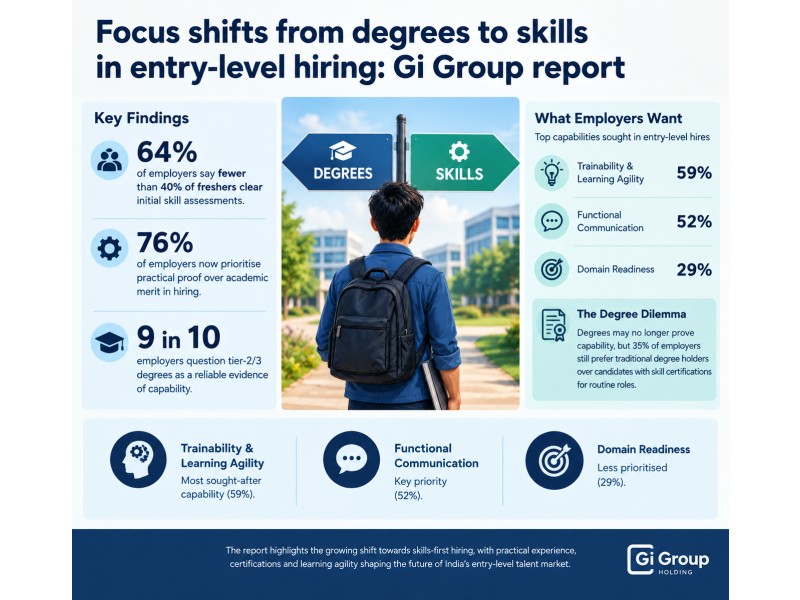
64 percent of employers say fewer than 40 percent of entry-level candidates clear their initial domain and skill assessments. The challenge is even sharper among organisations hiring at scale, rising to 70 percent among Large Enterprises and 74 percent among employers hiring more than 2,000 freshers annually.
On the candidate side, 49 percent of Tier-2/3 graduates say they feel completely unprepared when entering their first job, while only 19 percent feel fully prepared. The contrast with the Tier-1 comparison group is significant, where 67 percent report feeling fully ready and only 6 percent feel unprepared.
Together, these findings point to a widening disconnect between education, employability and workplace expectations. The issue is no longer simply whether young people possess qualifications, but whether those qualifications translate into the ability to perform, communicate, adapt and learn in a real work environment.
The strongest evidence of this shift comes from what employers now use to make shortlisting decisions. 76 percent of employers say their primary shortlisting decisions for Tier-2/3 graduates are driven by practical proof or workplace exposure, including certifications, software fluency, internships and workplace experience. Pure academic merit, by contrast, accounts for only 6 percent of primary shortlisting decisions.
This is also reshaping the employability equation itself. Employers are increasingly looking for candidates who can learn quickly, communicate effectively and apply knowledge in changing workplace situations, rather than expecting freshers to arrive with complete domain expertise. Trainability and Learning Agility is the most sought-after capability, with 59 percent of employers identifying it as a priority, followed by Functional Communication at 52 percent. Domain Readiness is considerably less prioritised, cited by 29 percent of employers.
The report identifies one of the most consequential contradictions in India’s early-career hiring market: the degree is losing its power to prove capability, but continues to retain power as a hiring gatekeeper. Nine in ten employers no longer treat a degree from a Tier-2/3 institution as proof of capability. Yet degrees have not disappeared from hiring decisions: 35 percent of employers still prefer traditional degree holders over candidates with independent skill certifications for routine entry-level roles. Among certified non-degree candidates who clear assessments, 46 percent are evaluated equally to degree holders and 12 percent are valued higher, but 31 percent are still treated as fallback candidates and 11 percent are automatically rejected.
This creates a credential paradox: a degree may no longer provide convincing evidence that a candidate can do the job, but can still influence whether that candidate receives the opportunity to demonstrate what they can do.
Sonal Arora, Country Manager, GI Group Holding, said, “This report explores how India’s entry-level hiring landscape is evolving and what these changes mean for employers, educational institutions, policymakers and young professionals. Our findings reveal a clear shift towards skills-first hiring, with practical experience, internships, certifications, apprenticeships and demonstrable competencies increasingly influencing hiring decisions. Equally important is the growing emphasis on learning agility, the ability to continuously acquire new skills as jobs and industries evolve. For policymakers and the broader skilling ecosystem, they highlight the importance of strengthening industry-academia collaboration and ensuring that skilling initiatives remain closely aligned with the evolving needs of the economy.”
The transition is also evident in the interview experience. Candidates report that company assessments and practical experience are increasingly more important than the degree itself when they are evaluated for entry-level roles. For candidates with no prior work experience, company assessments become the dominant filter, while practical experience becomes increasingly important as candidates gain one to two years of experience.
Employers and candidates also broadly agree on what is going wrong when candidates fail to make the transition from education to employment: the inability to apply practical skills is the leading reason interviews fail, identified by 42 percent of employers and 38 percent of candidates. The more revealing disconnect is around academic knowledge. Employers identify academic knowledge as a problem only 4 percent of the time, compared with 16 percent among candidates — suggesting that candidates may still place greater weight on what they have learned academically than employers place on that knowledge when assessing workplace readiness.
The implication is not that academic learning has become irrelevant. Rather, its value increasingly depends on whether candidates can convert that learning into demonstrable workplace capability. This distinction becomes particularly important across different educational backgrounds: within the Tier-2/3 cohort, readiness varies considerably between Engineering, Polytechnic/Vocational and Arts/General Science graduates, pointing to an employability challenge that cannot be addressed through a single, uniform model of education.
The findings point towards the need for a stronger “Employability Bridge” between education and employment — one that moves beyond the traditional assumption that completing a degree is the end point of preparation for work. Education institutions need to strengthen workplace exposure and practical application; employers can play a more active role through assessments, internships and apprenticeships; policymakers and the skilling ecosystem can focus more closely on employment outcomes and sustained market value; and candidates themselves need to take greater ownership of continuous learning.
Gi Group Holding, India, is among the world’s leading companies contributing to the evolution of the labour market by offering services in various domains of talent acquisition and management.
Also read: UnMathX launches Math Museum for schools across India










Add comment