






GEMS Education: When Empathy Leaves the Room, Peace Leaves With It
– GEMS Education India
In an age of instant judgement, everyday aggression and diminishing patience, GEMS Education India is helping students experience empathy before asking them to advocate for peace.
Road rage over a few seconds. A disagreement online turning into abuse. A person being judged, labelled or “cancelled” before anyone pauses to understand their story.
We seem to be living in a culture of instant reaction. Anger travels faster than context. Opinions arrive before questions. Listening is often mistaken for agreement, while empathy is dismissed as weakness.
Somewhere along the way, empathy appears to have left the building.
And when empathy disappears, peace becomes little more than a slogan.
Peace is not simply the absence of war. It is the ability to live with difference without turning difference into hostility. It requires people to listen before reacting, recognise the humanity behind an opposing position, and remain in conversation even when agreement seems impossible.
These capacities do not suddenly appear in adulthood. They need to be experienced and practised while children are still forming their ways of seeing the world.
At GEMS Education India, the annual theme, Loops and Ripples, began with a simple idea: the behaviours we repeat become loops, and every loop creates ripples around us. A moment of patience can travel. So can ridicule. A thoughtful response can de-escalate conflict. An impulsive one can amplify it.
Ripples of Peace was created to help the school community examine the ripples it wanted to send into the world.
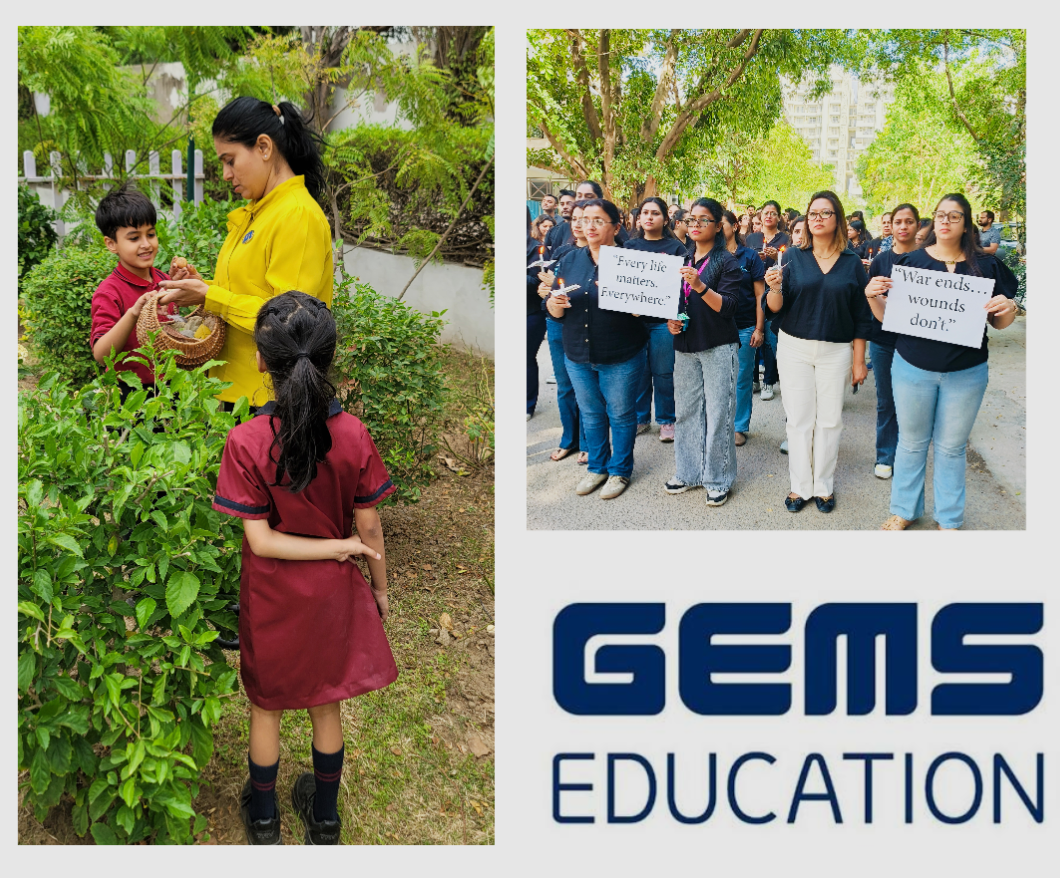
The initiative began with teachers gathering in a circle around a flame for reflection, prayer and a collective pledge to lead with empathy. It then moved beyond the school gates through a silent peace march in the neighbourhood. Teachers sang Heal the World, and students came together on the basketball court to form a large peace symbol.
These were powerful collective expressions. But the deeper work happened quietly, inside classrooms.
Students from Grades 5 to 12 participated in a structured engagement plan consisting of a brief period of stillness, an age-appropriate reflective experience, and voluntary sharing. The purpose was not to conduct another school activity or explain peace through a lecture. It was to create small moments in which children could pause, notice and respond.
Younger students imagined what peace might look like within themselves and expressed it through art. Middle-school students wrote one sentence they wished the world could hear. Students in Grades 9 and 10 enacted everyday peer conflicts twice: once through immediate reaction and again after a deliberate pause. Senior students reflected on the question, “Where does conflict begin?”
Across the grades, the learning moved from feeling peace to expressing it, practising it and, finally, taking responsibility for it. A drawing, a sentence, a pause before reacting, and an honest moment of self-reflection became different ways of developing the same human capacity: empathy.
The next ripple is now unfolding at GEMS School of Excellence, Lucknow, through Concordia 2.0, its Model United Nations conference themed Ripples of Peace: Negotiating a World Beyond Conflict.
Here, students move from reflecting on empathy to applying it within complex global situations. They represent competing national interests, encounter opposing perspectives, negotiate difficult questions, and attempt to build resolutions through dialogue. The conference positions diplomacy, meaningful conversation and collaborative problem-solving as alternatives to hostility and force.
This is where the journey becomes significant. A child who first learns to pause during a disagreement may later become a student who can hear an opposing delegate without dismissing them. Empathy does not require the abandonment of conviction. It enables conviction without dehumanisation.
“Education must prepare children not only to succeed in the world, but also to humanise it. Empathy gives young people the courage to listen, the wisdom to negotiate and the responsibility to act,” says Francis Joseph, India CEO, GEMS Education.
Perhaps peace does not begin with grand declarations.
Perhaps it begins in the few seconds between provocation and response, when a child learns to pause long enough to see another human being.
Also Read: GEMS Education to expand India footprint with USD 30 million investment









Add comment