





In this Part-II edition of EWISR 2026-27, the co-ed day schools national league table (restricted to Top 100 schools, for the full national league table see www.educationworld.in), state and city league tables aggregating over 150 printed pages are featured
It’s difficult to find silver linings to the toxic grey cloud that has poisoned post-independence India’s education system and blighted the future of two generations of the world’s largest, high-potential population of children and youth. Repeated independent audits of the Annual Status of Education Report (ASER) have indicated that over 50 percent of class VII children of rural primaries are unable to read class III textbooks and solve simple division and multiplication sums. In secondary schools rote memorisation and regurgitation of information provided by obsolete, suspect textbooks is the rule rather than exception.
In tertiary education not one of India’s 1,500 universities — some of them of over 150 years vintage — is ranked among the Top 200 in the World University Rankings published annually by the highly-respected London-based higher education rating and ranking agencies — QS, THE and The Financial Times. And as repeatedly lamented on the neglected pages of EducationWorld, neither Indian academia nor industry, despite much getting and spending, has produced one global game-changer product or service on a par with the internet, computer, smartphone, advanced automobile or jet plane engine.
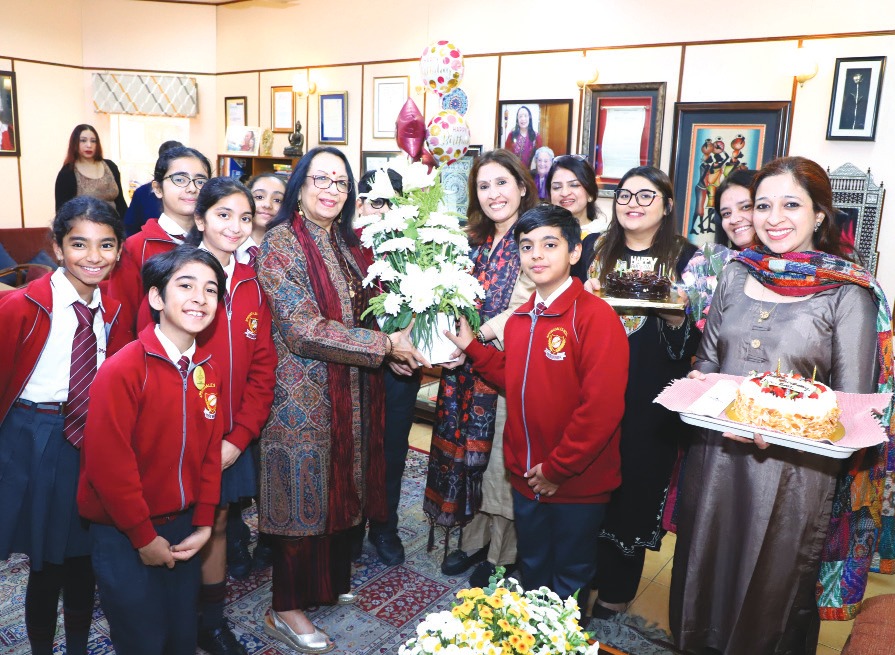
Springdales, DK’s Dr. Jyoti Bose (centre left): beyond academics education
Yet one positive feature of India’s education system is that despite women citizens not being permitted to exercise their constitutional rights across large swathes of the country, ab initio the great majority of the country’s 1.10 government primary-secondary schools are mixed gender, aka co-ed, institutions. Although single gender boys and girls schools continue to provide K-12 education to children from conservative and religious households, almost all government schools and the majority of private schools host mixed gender classrooms.
This is a progressive, nation-building development because when children start learning together from young age, male children in particular, develop the virtues of empathy, respect and gender egalitarianism from their early years. Moreover when girl children learn in co-ed classrooms, they are better equipped and more likely to participate in the labour force and engage in nation-building work outside their homes.
Therefore, it is unsurprising that the national league table of Day co-ed schools has always been the lengthiest in the annual EducationWorld India School Rankings (EWISR) since they were introduced in 2007. This is an indicator that at least on one metric K-12 education is advancing in the right direction. In EWISR 2026-27 which ranks the country’s most well-reputed schools in three umbrella categories — Day, Boarding, International — and in 29 sub-categories (e.g, Day co-ed, boys and girls) to provide a level playing field for ranked schools by eliminating apples and oranges type comparisons, over 3,000 Co-ed Day schools are ranked nationally, in the states and cities.
In this Part-II edition of EducationWorld, the co-ed day schools national (restricted to Top 100 schools, for the full national league table see www.educationworld.in), state and city league tables aggregating over 150 printed pages are featured. However, it’s important for parents searching for the most suitable schools for their children to bear in mind that for day schools, national rank is of limited value, and city/town rankings are of greater import because of ease of access. National rankings are important, but mainly for boarding, day-cum-boarding and residential education institutions, and for providing the important stimulus of continuous improvement and countrywide benchmarking. For day scholars, town and city rankings are of prime importance (see p.52).
From last year the national league table of over 3,000 of India’s most reputed co-ed day schools has become more broad based for two main reasons. First, because our more professional research agency, the Bangalore-based AZ Research Partners has introduced a broader respondents’ database. Until 2023, sample respondents were drawn from SEC (socio-economic category) ‘A’ — upper middle and elite classes in terms of income and social status. However for the past two years the sample respondents database is more broad-based, a mix of SEC ‘A’ and SEC ‘B’ respondents.
Secondly, because last year some repeatedly top-ranked schools were elevated to a new Ivy League category. This initiative was ideated by the need to spare readers the tedium and deja vu of witnessing the same institutions topping the Co-ed day (and other) league tables year after year. Also to provide opportunity to marginally bested schools to advance higher in EW league tables. Therefore, this year as well there’s considerable rearrangement of the pecking order in the national, states and city league tables of co-ed day schools.
In the 2026-27 national league table of India’s most admired Co-ed Day schools, there has been a substantial rejig of the seating order at top table.
Nirmal Bhartia School’s Joyeeta Dasgupta: distinctive philosophy
This year’s 18,000 sample respondents have dramatically promoted the CBSE-affiliated Springdales School, Dhaula, Kuan, Delhi (SDK) ranked # 7 in 2025-26 to #1 this year, displacing the highly-reputed The Shri Ram School, Vasant Vihar/Moulsari, Delhi (TSRS). TSRS is jointly ranked #2 with Nirmal Bhartia School, Delhi which has also been awarded a big promotion (ranked #5 in 2025-26) this year. Smt. Sulochanadevi Singhania School, Thane (2) and Suncity School, Gurugram (4) are jointly ranked #3 this year followed by the Shiv Nadar School, Gurugram #4 (3) and The School, KFI, Adyar, Chennai #5 (6) completing top table.
“I am delighted with SDK’s big promotion to the very top of this highly competitive category. By intent and design our school isn’t very upscale to ensure that fees are affordable. But evidently our top score for infrastructure provision indicates that it is sufficient. We also prefer to accord greater importance to teachers welfare and remuneration,” says Dr. Jyoti Bose, the highly qualified (Miranda House, Delhi School of Economics and London School of Economics) Founding-Director of SDK (estb.1983) which has 2,400 students mentored by 95 teachers on its muster rolls.
Although SDK has been awarded high scores under all parameters of school education excellence, Bose is most pleased about the school’s top scores under the parameters of co-curricular education and community service. “In SDK we believe that beyond academics children should receive balanced, holistic education. Therefore I am very satisfied with our top score under the parameters of co-curricular activities and high score for sports education and also for community service. This combination is essential for the mental and emotional wellbeing of students for which we perhaps deserved a higher score,” says Bose.
Joyeeta Dasgupta, a highly articulate economics postgraduate of Kolkata’s premier Jadavpur University, former journalist and corporate trainer switched tracks and began a new career as a teacher in Carmel Convent Kolkata in 2004. Thereafter she acquired valuable teaching and admin experience in Ashok Hall Girls, Kolkata, Director of Indirapuram Group, Delhi NCR and Techno India Group Kolkata, before she was appointed Principal of the Nirmal Bhartia School, Delhi (NBS, estb.2005). Dasgupta is “incredibly pleased” this consistently high ranked school has been moved higher up on top table.
“There is spreading awareness of the distinctive education philosophy, systems, and processes students experience in NBS, and discerning parents with whom our philosophy resonates are increasingly enrolling their children with us. In NBS we have taken a conscious decision not to merely prepare students for examinations success, but to ensure their all-round development and discover their unique potential. For this the role of teachers is of critical importance and I am glad to learn about the high score awarded to us under the parameters of teacher welfare and development, teacher competence and individual attention to students. We are not only a child-centric, but also a teacher-centric school inasmuch as we invest heavily in teacher training to ensure they implement our unique curriculum. Therefore, I am also content with the high score awarded to us under the parameter of curriculum and pedagogy which includes a good connect with industry and out-of-school shopfloor experience for senior students. As for the high score for leadership, a major share of the credit must accrue to our Chairperson Pooja Jhaver who is truly an education philosopher and has ideated our structure and unique curriculum,” says Dasgupta.
Beyond top table, the status quo has been largely maintained, except the Krishnamurti Foundation managed The Valley School, Bangalore has been given a huge promotion to #7 from #17 in 2025-26 and the Sri Venkateshwar International School, Dwarka, Delhi to #10 (12).
Further down the Top 20 table, the Mallya Aditi School, Bangalore #12 (14); Children’s Academy, Kandivali, Mumbai #13 (15); Blue Bells Model School, Gurugram #13 (17) have risen in the public esteem. But not as much as Elpro International, Chinchwad, Pune #19 (28) awarded a huge promotion by this year’s sample respondents.
Dr. Amrita Vohra, the highly qualified (Punjab, Himachal and Jabalpur universities) principal of Elpro International, Pune (EIP, estb. 2011), is “overjoyed” that this year’s 18,000 sample respondents have vaulted this CBSE, Cambridge International and IB affiliated school into the national Top 20 and ranked it #1 in the fast-track city of Pune (pop. 7.6 million) with above-rank scores under the parameters of teacher welfare, sports education, curriculum & pedagogy, infrastructure, mental and emotional wellbeing services and value for money.

Elpro’s Dr. Amrita Vohra: balanced education outcome
“In EIP we accord highest priority to teacher welfare and development because if teachers are happy and given ample professional development opportunities, high quality education is inevitable. Our affiliation with three of the best examination boards enriches the teaching-learning environment of the school and encourages our teachers to teach well beyond the curriculum of each board. I am also pleased with our good scores under the parameters of sports education and mental and emotional wellbeing of our students which is proof of a balanced, holistic environment in which students learn happily,” says Vohra who modestly ascribes EIP’s good score under the leadership parameter to a “great team of like-minded” teachers and support staff.
Beyond the Top 20 in the lengthiest league table of EWISR 2026-27 which rates 3,090 schools countrywide across 14 parameters of primary-secondary school excellence and ranks them inter se (in this print edition the national league table is restricted to the Top 100; for the full league table in extenso visit www.educationworld.in), there is considerable churn as well. For instance Amity International, Sector 46, Gurugram #22 (43); Glendale Academy, Hyderabad #23 (33); Mt. Abu Public School, Delhi #24 (38); CNM School, Vile Parle, Mumbai #25 (51), and Lotus Valley International, Noida #28 (62).
Parents with children in Co-ed Day schools are advised to study City league tables which also provide state and national rankings which will facilitate access to parameter scores. Meanwhile please note that all schools ranked in the 3,090-strong EW league table 2026-27 are the best of the country’s estimated 1.20 million Co-ed Day schools, especially those included in the Top 50 and Top 100.
Moreover, it’s self-evident that for day schools city rankings set out in extenso in this issue are of prime importance, and that schools modestly ranked nationally could well top city league tables. For instance SVVM World School, ranked #19 nationally is #1 in Coimbatore (pop. 1.4 million) and Tamil Nadu (77 million); Maharaja Sawai Man Singh Vidyalaya India #19 is #1 in Jaipur (4.5 million) and Rajasthan; Seth M.R. Jaipuria School, Lucknow ranked India’s #34 Co-ed Day school is #1 in Lucknow (4.2 million) and Uttar Pradesh (241 million). Therefore, parents and students should note that for day schools in particular, national rankings are of limited value and at best confer bragging rights.










Add comment