






India’s best government multi-disciplinary universities 2026-27
Although new genre globally benchmarked private universities endowed with glitz and glamour have captured the public imagination in the new millennium, of the country’s 1,399 universities, 741 are government — 257 Central and 484 state and 552 are privately promoted.
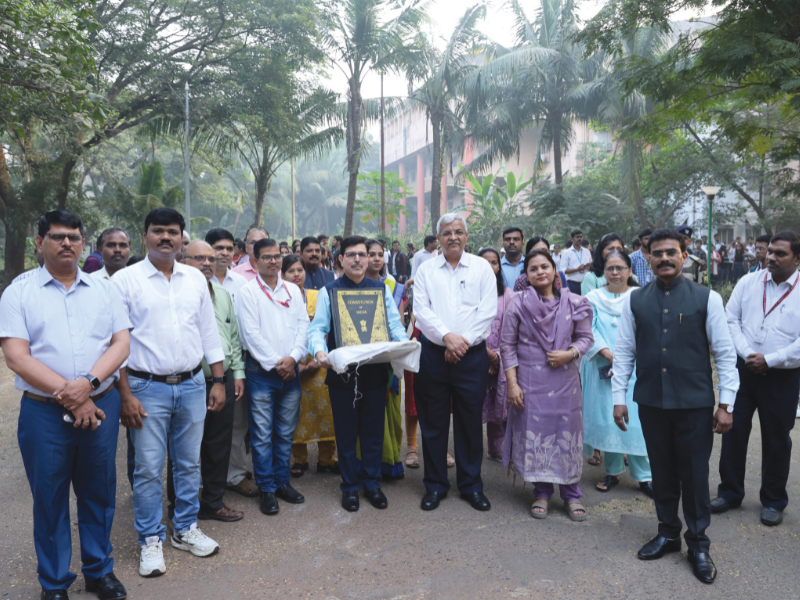
UoM VC Prof. Ravindra Kulkarni (centre left): deepened academy-industry engagement
Government universities enroll a disproportionately large share of the country’s tertiary student population. India’s 741 government varsities teach 74 percent of the 43.3 million youth enrolled in the country’s higher education system (cf. 26.3 percent of youth enrolled in private universities). However within the public higher ed system, a mere 57 Central and 42 deemed universities well-funded by the Centre, offer acceptable high-quality education. The remaining 484 state universities are overstretched, underfunded, plagued with faculty shortages and burdened with administering an average 500 affiliated colleges.
Driven by awareness of the vital nation-building importance of tertiary education, in 2020, the annual EducationWorld India Higher Education Rankings, which hitherto ranked only privately promoted higher education institutions, were expanded to include best government universities. Subsequently in 2022, under the categories of private and government universities, institutions were further sub-divided according to subject specialisation, to provide level playing field comparisons.
To compile the EW Best Government University Rankings 2026-27, the Bengaluru-based market research company AZ Research Partners Pvt. Ltd (estb.2002) interviewed 2,175 sample respondents comprising higher education faculty, students and industry representatives in 22 states countrywide. These respondents were persuaded to award government universities of whom they have sufficient knowledge, perceptual scores of 1-300 under ten parameters of higher education excellence.
Within the broad category of government universities, the league table of multidisciplinary degree awarding universities is the largest and most competitive. This year’s sample respondents have again voted Delhi University (DU, estb.1922) and University of Mumbai (UoM, estb.1857) joint #1 in the government multi-disciplinary universities league table. While DU has been awarded the highest scores under the parameters of faculty competence, research and innovation, infrastructure and range/diversity of programmes, UoM is top-ranked for curriculum and pedagogy, faculty welfare and development, industry interface, internationalism, leadership and placements.
Prof. Ravindra Kulkarni, an alum of the Institute of Chemical Technology, Mumbai (ICT) and RMT University, Nagpur, appointed vice chancellor of UoM in 2023, is delighted that this vintage varsity is ranked India’s #1 public multi-disciplinary university for the second consecutive year, with top scores under six of the ten parameters of higher education excellence.
“We regard this not merely as an award, but as a direct outcome of the operational discipline and academic rigour of our faculty, administration, and students. A prime cause of our consistent top rank is aggressive implementation of the National Education Policy 2020. It has fundamentally restructured our pedagogy models to meet modern global standards. I am especially pleased with our high scores under the parameters of curriculum and pedagogy, industry interface and placements — they reflect an institutional shift toward outcome-based education. We have deepened academy-industry integration to align our curriculum with industry needs, directly driving higher placement metrics. Our future roadmap prioritises complete digital transformation of the university’s administrative framework and introduction of micro-credential programs to facilitate rapid upskilling of students to prepare them for the fast-evolving workplace,” says Kulkarni. Currently, UoM has 962 affiliated colleges with an aggregate 784,179 students.
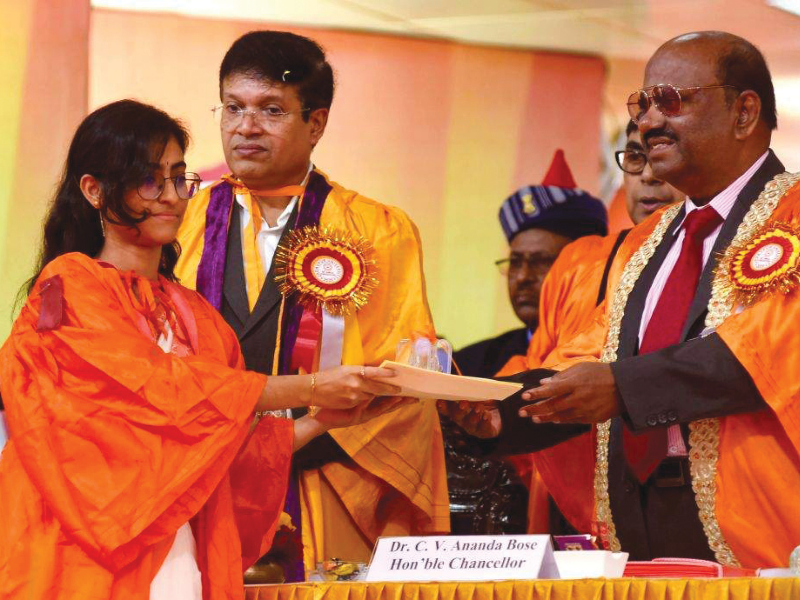
Jadavpur University VC Prof. Chiranjib Bhattacharjee (centre left): rare academic mix
Beyond the joint Top 2, there is a minor rearrangement of seats at top table. Banaras Hindu University (estb.1916) has retained its #2 rank of 2025-26 and Jadavpur University, Kolkata has been promoted to #3 (#4) and University of Hyderabad to #4 (6). The elevation of these two universities has pushed Jawaharlal Nehru University (JNU), Delhi to #5 (3).
Prof. Chiranjib Bhattacharjee, the newly appointed Vice Chancellor of Jadavpur University (estb.1955), is “delighted” with JU’s entry into the national Top 3 and high scores under the parameters of competence of faculty, placements, infrastructure and range/diversity of programmes.
“This promotion will improve our academic reputation, reinforce stakeholder confidence, and amplify the value of our degrees in both national and international contexts. I attribute the elevated ranking of Jadavpur University to a rare mix of academic excellence, highly competitive admissions, affordability, high-quality faculty, excellent placement outcomes, robust research ecosystem and a deeply entrenched culture of intellectual rigour. Our high scores under the parameters of faculty competence, placement, infrastructure, and diversity of programmes reflect these strengths,” says Bhattacharjee, an alum of JU and IIT-Kanpur who came aboard JU in 1991, serving in various roles, including professor and dean of the engineering faculty prior to his appointment as Vice Chancellor in February.
The Top 10 table is completed by Savitribai Phule Pune University at #6 (5) followed by Aligarh Muslim University at #7 (7), Panjab University, Chandigarh #8, Alagappa University, Karaikudi at #9 (9) and Dr. Manmohan Singh Bengaluru City University at #10 — all of whom have retained their last year’s ranking.
Beyond the Top 10, several universities have risen in public esteem. Among them: University of Calcutta, ranked #11 (13), University of Madras #13 (15), Bharathiar University, Coimbatore #15 (18), University of Mysore #17 (19) and Kurukshetra University #19 (24).
“I am happy to learn that the University of Madras (UoM) has improved its national rank. UoM is one of the country’s three oldest — Bombay and Calcutta being the other two — modern universities established way back in 1857. Over the past 169 years, UoM has built a national reputation for academic quality — awarded NAAC rating of A++. The university’s five campuses host 86 departments, offering over 95 study programmes and affiliate 148 colleges with 250,000 students. Our faculty is highly qualified with many professors with impressive foreign qualifications. And our research output is qualitative, because we are constrained by limited funding. Despite this, our basic sciences campus at Guindy and medical sciences campus at Taramani are highly reputed for their quality of academics and research with our Lab of Medical Sciences recognised as excellent by the Indian Council of Medical Research. Therefore, I am pleased to learn of our high scores under the parameters of faculty competence, research and innovation and range and diversity of academic programmes,” says Dr. Rita John, a physics alum of UoM, Anna University, a Fulbright-Nehru Fellow and Registrar of UoM.

UoM’s Dr. Rita John (centre seated): improved rank satisfaction
Likewise, Prof. Som Nath Sachdeva, Vice Chancellor of Kurukshetra University (estb.1956), is delighted that this Haryana state government-promoted university has debuted in the National Top 20 at #19 (24) with high scores under the parameters of faculty welfare and development, infrastructure and range/diversity of programmes. “Our improved ranking is the outcome of sustained focus on excellence in academics and research. This progress is also mirrored in other rankings frameworks, such as the NIRF 2025 where the university has climbed to #35 in the State Public University category, and top recognition by way of A++ NAAC accreditation. Moreover, implementation of NEP 2020 has changed the university’s academic landscape following the introduction of specialised industry-linked academic programmes. For professional development, we actively conduct NEP orientation and development programmes for our 668 faculty and offer a diverse academic portfolio with our 50 academic departments providing over 175 programmes, including high-demand tech diplomas in AI, cyber security, and cloud computing. I am also pleased with our high score for infrastructure — our 473-acre wi-fi-enabled campus hosts modern smart classrooms, 25 hostels, a 24-hour library facility, and world-class sports and cultural activity centers. Going forward, one of our top priorities is to encourage quality research in emerging areas,” says Sachdeva, an alumnus of Regional Engineering College, Kurukshetra with over 37 years of experience of teaching, research, consultancy & administration and appointed VC in 2020.
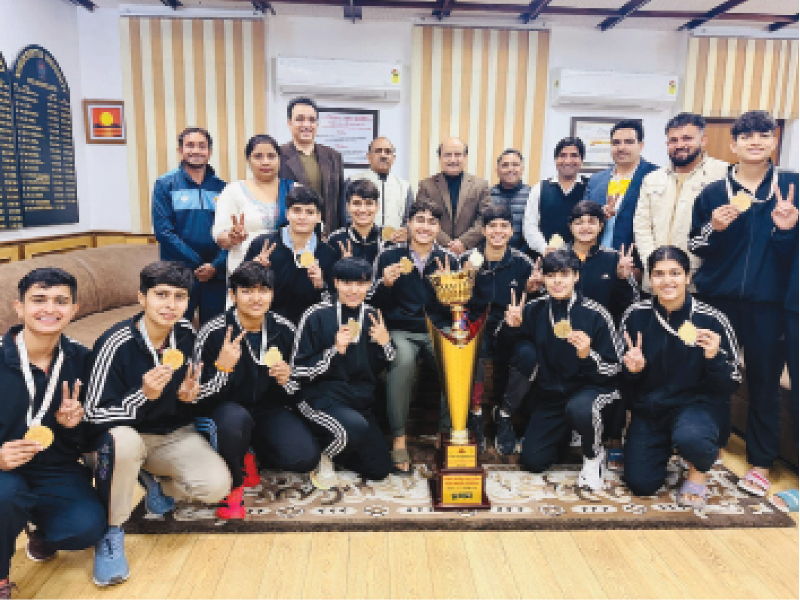
Kurukshetra University VC Prof. Sachevda (centre): research priority
The 98-strong league table of India’s best government multi-disciplinary universities features a mix of Central and state governments with several institutions improving their previous year’s ranking. Moreover, several universities ranked modestly in the national table are top-ranked in their host states. For instance Andhra University, Visakhapatnam, nationally ranked #27 is the #1 government university of Andhra Pradesh (pop.53 million); Indira Gandhi National Tribal University, Amarkantak, India #51 is #1 in Madhya Pradesh (pop.89 million); and Central University of South Bihar, Gaya, ranked #65 nationally is the #1 government university of Bihar state (134 million).
With aggregate enrolment in Central and state universities estimated at 32 million — far exceeding that of India’s 552 private universities — their transformation and upgradation of teaching, learning, and research standards is imperative for attaining the nation’s Viksit Bharat and $30 trillion GDP goals by 2047 when the nation will celebrate its centenary of independence from British rule.











Add comment