






India’s top gov. agriculture varsities 2026-27
While government response has largely centred on price support and subsidies for agriculture, a deeper and more enduring driver of agrarian stagnation hasn’t been sufficiently addressed — poor quality agriculture education and research
With the US and India having signed a historic trade deal in February under which India is obliged to lower tariffs on a “vast array” of American industrial and agricultural products, including fruits and vegetables, the country’s 195 million farmers — long cushioned by policy protections — are confronted with the prospect of being tested for efficiency, productivity, and international competitiveness as never before. This moment of reckoning comes against the backdrop of a failing, structurally weak agriculture sector struggling to keep pace with the demands of an increasingly competitive global agricultural marketplace.
The contribution of agriculture to national GDP has steadily shrunk from 35 percent in 1990-91 to 15 percent in 2022-23, even as it continues to sustain a disproportionately large segment of the population (45 percent). According to NCRB (National Crime Records Bureau) data, between 1995 -2023, 394,206 farmers and agricultural labour died by suicide due to agrarian distress.
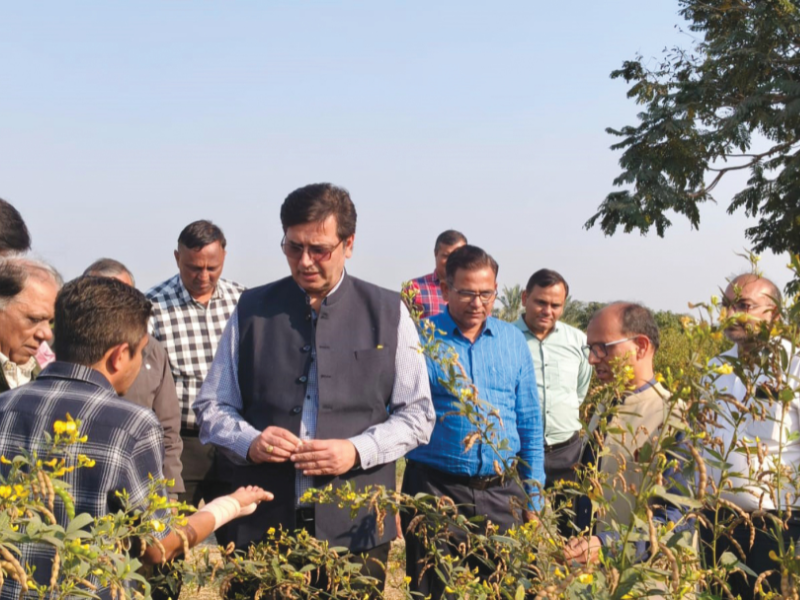
NAU’s Dr. Timur Ahlawat (centre): 28 research stations in 18 locations
India’s farm productivity lags far behind global benchmarks, with average per-hectare foodgrain yields significantly lower than of several Western countries and China. Persistently low yields, fragmented landholdings, inadequate irrigation, and limited access to institutional credit have kept farm incomes stagnant and vulnerabilities high. Unsurprisingly, the country’s rural majority is on the perpetual warpath demanding fair rural-urban terms of trade and in particular, legally guaranteed minimum support prices for agricultural produce.
Yet, while government response has largely centred on price support and subsidies for agriculture, a deeper and more enduring driver of agrarian stagnation hasn’t been sufficiently addressed — poor quality agriculture education and research. India’s farm sector is supported by agricultural practices and technologies that are outdated, theory-heavy, and disconnected from field realities. Curricula in many agricultural universities are rooted in the Green Revolution era.
Although in 2021 the Delhi-based Indian Council for Agricultural Research (ICAR) — the country’s apex body for coordinating agricultural education and research — announced a comprehensive overhaul of agricultural curriculums to incorporate emerging knowledge such as climate-resilient agriculture, biotechnology, agribusiness management, and artificial intelligence, implementation is lamentable. Most of the country’s 113 ICAR institutes and 74 state government agricultural universities are ivory tower institutions with pathetic farm extension capabilities.
In 2020, EducationWorld took the lead to rate and rank the country’s best government agricultural universities annually. Unsurprisingly since 2022, ICAR’s flagship institute — ICAR Indian Agricultural Research Institute, Delhi (ICAR-IARI) — has been topping the league table of India’s best agri education institutions.
In 2026-27, the 2,175 sample respondents polled by the well-known Bengaluru-based market research firm AZ Research Partners Pvt. Ltd, have once again overwhelmingly ranked the generously funded ICAR-IARI India’s #1 government agriculture varsity with top scores under the parameters of faculty competence, faculty welfare and development, curriculum and pedagogy and research and innovation. But it’s an indicator of the ICAR-IARI top brass’ public accountability that they failed to respond to several emails and phone calls for interview.
Following ICAR-IARI is Punjab Agricultural University, Ludhiana jointly ranked #2 with the Navsari Agricultural University (#3 in 2025). ICAR — National Dairy Research Institute, Karnal has lost ground and is ranked #3 (5) followed by Govind Ballabh Pant University of Agriculture & Technology, Pantnagar (Uttarakhand), which has retained its #4 rank and Junagadh Agricultural University (JAU), promoted to #5 (7).
Dr. Timur Ahlawat, the newly appointed (December 2025) Vice Chancellor of Navsari Agricultural University (NAU), is “overjoyed” that NAU is promoted to second rank nationally. “This is recognition of our unwavering commitment to provide quality agricultural education, farmer-oriented research and impactful extension activities. At NAU, we take great pride that we are among the few agricultural universities in India that actively research and develop cutting-edge technologies to serve the large farming community and tech-savvy agripreneurs. I thank our farmers, faculty, students and stakeholders, who remain our greatest inspiration and most valuable evaluators,” says Dr. Ahlawat.
Ahlawat is especially pleased with NAU’s highest score for range/diversity of programmes, and high scores under the parameters of research and innovation, industry interface and placement. “These high parameter scores validate NAU’s strengths — an experienced and dedicated faculty and robust research and industry interface ecosystem. Our 28 research stations in 18 locations focus on need-based fundamental, applied and verification research on crops such as paddy, sugarcane, cotton, sorghum, small millets, mango, banana, sapota and vegetables. We have introduced high-value crops such as rubber, avocado and charoli and are the first institution in Gujarat to initiate research on Biochar. Over the past five years, our commitment to research and innovation has led to the award of 27 patents. We have also established state-of-the-art research facilities, including Speed Breeding Facilities, Rainout Shelter, Omics Laboratory, Agrotextile Center, Central Tissue Culture Lab, Germplasm Conservation Park, Bamboo Gallery, among others. We are proud of our strong industry connections and career support. Our annual campus placement fair attracts over 100 reputed companies routinely ensuring campus recruitment of 65 percent of our graduates,” says Ahlawat.











Add comment