






India’s Top-Ranked Private Multi-Disciplinary Universities 2026-27
Promoted by go-getting education entrepreneurs, a new genre of multi-disciplinary private universities which benchmark themselves against the best worldwide, offers the prospect of delivering excellent teaching, research and knowledge creation opportunities
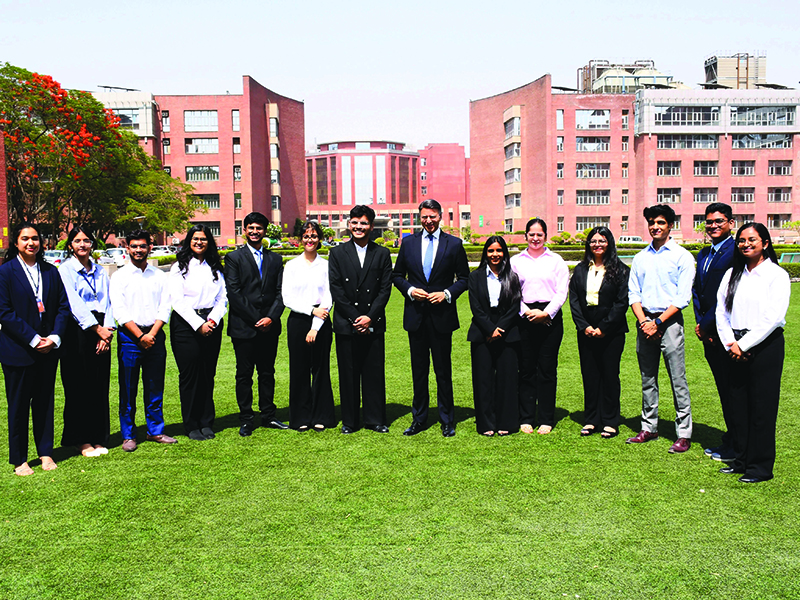
Amity’s Dr. Atul Chauhan (centre right): path-breaking innovations & technologies
Post-independence India’s higher education sector comprising 53,000 undergrad colleges and 1,338 universities with an aggregate enrolment of 44.6 million youth, has proved a huge disappointment. How come not a single global game-changer product/ service on the impact scale of the internet, personal computer, smartphone, robot, jet engine or advanced, fuel-efficient automobile, has emerged from the shady bowers of Indian academia where millions of presumably the country’s most learned scholars, professors and researchers are engaged in daily cerebration and knowledge creation?
An answer that readily comes to mind is that for over half a century after independence, higher education remained a government monopoly. And under the inorganic socialist ideology that was imprinted upon the nation, it became a levelling down prescription for mediocrity. Even the best public universities — Indian Institute of Science, the vintage universities of Bombay, Calcutta and Madras — were subject to heavy regulation by government through agencies such as the University Grants Commission (UGC) and All India Council for Technical Education (AICTE) whose mandate was to standardize — interpreted as levelling down — higher education countrywide.
Moreover with academy-industry collaboration officially discouraged, India’s higher education institutions (HEIs) transformed into teaching institutions with scant attention paid to research and creation of new knowledge. Consequently, no solutions for resolving any of the socio-economic problems that were inherited by independent India — mass poverty, illiteracy, runaway population growth, poor industrial and agriculture productivity, toxic air and water quality — have emerged from the shady bowers of Indian academia.
Nor from the Soviet-inspired Council of Scientific & Industrial Research (CSIR, estb.1942) which has established 84 research and innovation centres countrywide. Furthermore in socialist India, academia alignment with profit-driven private business enterprises which in Western democracies results in corporates commissioning research for commercialization, was officially discouraged. This explains Indian accademia’s zero significant inventions and innovations record.
Against this backdrop of decades of getting and spending without any accountability in India’s public universities, the rapid rise and multiplication of private universities — mostly enabled by state government legislation — in the new millennium generated considerable excitement within the country’s fast-expanding middle class.
Promoted by go-getting education entrepreneurs, a new genre of multi-disciplinary private universities which benchmark themselves against the best worldwide, offer the prospect of delivering excellent teaching, research and knowledge creation opportunities. However until EducationWorld was launched in 1999, private universities scarcely received attention in the media dominated by jholawallahs and Left intellectuals. This despite the on-ground reality that well before liberalisation and deregulation of the Indian economy, 70 percent of all higher education institutions were privately promoted.
Therefore ab initio EW not only began giving private varsities (Manipal, Amity, NIIT, Ashoka, Krea and O.P. Jindal etc) in-depth coverage, in 2013, following the runaway success of the EW India School Rankings introduced in 2007, we initiated the annual EducationWorld India Higher Education Rankings and started ranking privately promoted universities (and undergrad colleges) separately. The rationale was that private institutions that levy tuition and other fees which are significantly higher than of over-subsidised Central and state government HEIs, need to be evaluated carefully in the public interest. Moreover, the annual EWIHER evaluate and rank private multidisciplinary and engineering/technology universities in separate categories.
In the increasingly important category of private multidisciplinary universities — the National Education Policy 2020 strongly recommends that all universities should progress towards transformation into large multidisciplinary higher education institutions — for the past quinquennium, the brilliantly marketed and advertised Amity University, Noida has been voted India’s #1 private multidisciplinary university. Promoted by Dr. Ashok K. Chauhan, who in 1960-90 established himself as the most successful Indian origin businessman in continental Europe after which he packed and returned to India following liberalization of the Indian economy in 1991, the Amity Group comprising 26 K-12 schools and 12 universities with an aggregate enrolment of 200,000 students and 6,000 faculty, has emerged as arguably India’s most diverse and largest education conglomerate.
Therefore, although establishment academics in ivory towers sneer that it is “too commercial” reflecting the mindset of a bygone era, contemporary, clued-up faculty, students and industry leaders are more appreciative of Amity, Noida’s industry-aligned study programmes, research and placements record. This explains why for the fifth year consecutively, they have ranked Amity, Noida India’s #1 private multidisciplinary university with top scores under the parameters of research and innovation, career readiness, and range and diversity of study programmes, and second highest under leadership.
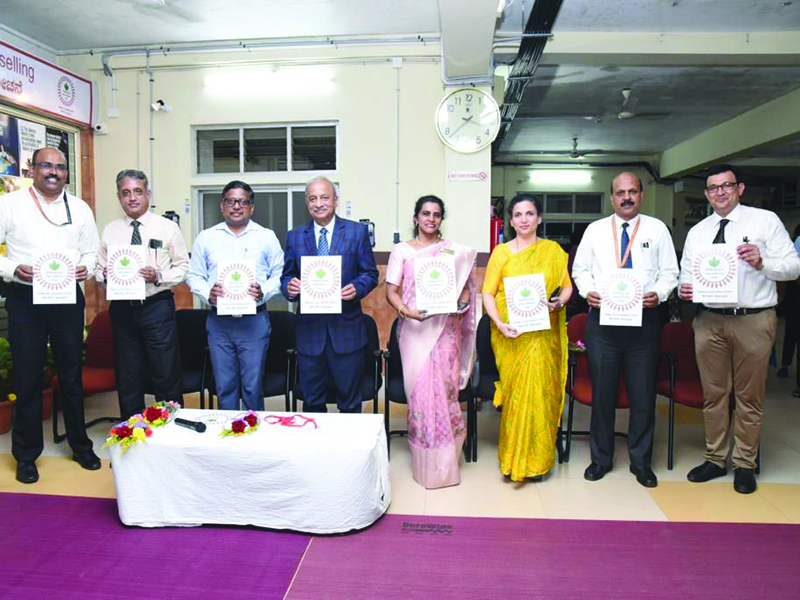
MAHE’s Gen. Venkatesh (centre): 360 degree transformation programme
In the EW 2026-27 league table of private multidisciplinary universities, there’s a minor change in the seating at top table. Amity, Noida is followed by the vintage low-profile Manipal Academy of Higher Education (MAHE) which since it was established in 1953, has acquired a formidable reputation for providing in-depth higher education, especially in engineering and medicine. Although MAHE is second in terms of overall score, it has been awarded top scores under the parameters of competence of faculty, teacher welfare & development and infrastructure.
The sole change in the top table seating order of private multidisciplinary universities is that from last year, the Noida (Gautam Buddha Nagar)-based Shiv Nadar University is promoted to #3 (from #4 in 2025-26) trading ranks with Ashoka University, ranked #4 this year. Top table is completed by the Mumbai-based Narsee Monjee Institute of Management Studies (NMIMS) which retains its #5 ranking of 2025-26.
“I am delighted that differing batches of your sample respondents have repeatedly ranked Amity, Noida India’s #1 private multidisciplinary university. This is very motivational and reaffirms that we are on the right path to build a globally benchmarked, values-driven academic ecosystem that not only nurtures knowledge but also the character, innovation, and leadership capabilities of our students. I am especially pleased with our top score under the parameter of Research and Innovation which is a strong focus area at Amity U. Our scientists, researchers and students are relentlessly working on developing path-breaking innovations and technologies which are enhancing India’s research and innovation ecosystem. It is our Founder President Dr. Ashok Chauhan’s firm belief that a country can progress only through research, science and technology, and he is constantly exhorting and supporting us to develop breakthroughs that will make India a global superpower and realise the Prime Minister’s Viksit Bharat and $30 trillion economy goals by 2047,” says Dr. Atul Chauhan, the highly qualified (London School of Economics and University College London) Chancellor of Amity University, Noida and CEO of the Amity Group which since it was promoted in 2003, has established 12 universities in India and 13 campuses abroad with an aggregate enrolment of 200,000 students.
Confident of riding the AI wave that’s upturning Indian academia and industry — “a powerful enabler of personalized and future-ready education” — Chauhan accords highest importance to students learning joyfully in all Amity schools and HEIs. “Above all, we place a premium on the success and well-being of our students. We believe that happy, confident, and empowered students are the foundation of future leadership,” says Chauhan.
Although MAHE is second placed for the fifth year, Lt. Gen. M.D. Venkatesh, Vice Chancellor of this “admittedly low-profile” university with an international footprint (campuses in Malaysia, Dubai and West Indies), is unfazed. “While the EW league table of best universities is valuable inasmuch as it prompts institutional self-evaluation, it is based on the perceptions of admittedly knowledgeable individuals. On the other hand, we are satisfied on the basis of evaluation of hard data and highly respected academics aware of our cohesive team, institutional development strategies, and deep research culture, that we are moving constantly upward. This is reflected in our highest scores under the critical parameters of faculty competence and faculty welfare and development as also infrastructure. Over the past few years in collaboration with global management and consultancy leaders including PwC, Deloitte, Salesforce, and GloboSoft, we have engineered a 360 degree transformation programme to digitize all processes and procedures from admission to graduation, and also customer and alumni management and research initiatives. As a result, we have won the trust and deepened our engagement with Indian industry, and MAHE is well-prepared for the new digital and AI-driven era,” says Gen. Venkatesh who is all set to retire after a “highly constructive” six-year innings at MAHE.
Beyond the Top 5, there is a rearrangement of the seating order. Chitkara University (CU), Chandigarh continues its steady march up the league table and is ranked #6 (cf.#7 in 2025-26) – and #1 in Punjab; Amrita Vishwa Vidyapeetham, Coimbatore is #7 (8) jointly ranked #7 (6) with ICFAI, Hyderabad; Symbiosis International University, Pune is ranked #8 (9); St. Joseph’s University, Bengaluru has made a great leap forward to # 9 (12) with the Top 10 table completed by Shoolini University, Bajhol (Himachal Pradesh) at #10 (11).
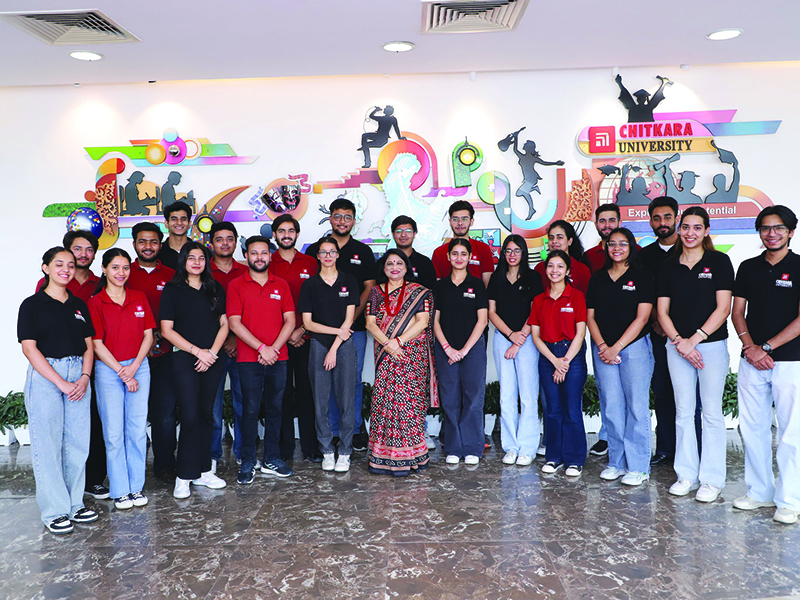
Dr. Madhu Chitkara (centre): China example emulation
Dr. Madhu Chitkara, Chancellor of the eponymous Chandigarh-based university (estb. 2010) is elated with CU’s steady progress up the EW annual private multidisciplinary varsities league table and its #1 rank in Punjab (pop. 40 million). She is especially satisfied with this new-age varsity’s above-rank scores under the parameters of faculty welfare and development, industry interface, career readiness, internationalism and infrastructure.
“Over the past 16 years, we have invested liberally in developing our infrastructure. This and our institutional emphasis on ensuring our graduates are industry-ready is reflected in our high score under the industry interface parameter. As a result, we have established well-equipped Centres of Excellence for experiential education and research in collaboration with several highly respected companies including Apple, Infosys, Cap Gemini and Reliance Jio. Moreover we have signed collaboration and dual degree agreements with over 200 universities around the world. The success of China as an economic powerhouse nation is mainly because of the close connect between its best universities — which I have visited several times — and Chinese industry. This is an example we are attempting to emulate in CU,” says Chitkara.
Beyond the Top 10, there’s considerable churn in the EW private multidisciplinary universities 2026-27 league table. The low-profile Christ Deemed University has been promoted to #11 (13) jointly ranked with the Sri City (Andhra)-based Krea University (14); Somaiya Vidyavihar University, Mumbai is ranked #12 (13) jointly with Sathyabama, Chennai (10); Amity University, Jaipur to #13 (15) co-ranked with Presidency University, Bengaluru (15); Siksha ‘O’ Anusandhan (Deemed University), Bhubaneswar is #14 (16) — and #1 in Odisha (pop.48 million). Moreover the Bengaluru-based universities REVA #17 (36) and CMR #18 (42), Sharda University, Noida #19 (31); Navrachana, Vadodara #19 (39), Jagran Lakecity University, Bhopal #20 (23) and Woxen University, Hyderabad #20 (40) have risen high in the knowledgeable public esteem this year.
In view of alarming reports of rising unemployment of college/university graduates, private HEIs are multiplying and stepping forward to assume the responsibility of getting the world’s largest youth population career-ready in right earnest. Further down the 160-strong league table of India’s best private multidisciplinary universities, several HEIs are getting their act together and have impressed the EW sample respondents. Among them: IIMT University, Meerut ranked #21 (38); GD Goenka, Gurugram #23 (58); SAGE University, Indore #25 (70); Adamas University, Kolkata #48 (52) and Martin Luther Christian University, Shillong #50 (54).
Parents and students searching for the most suitable private multidisciplinary university should also bear in mind that institutions modestly ranked nationally could well be highly-respected heavyweight teaching-learning HEIs in their host states, most of them more populous than European nations. Thus Krea University ranked #11 nationally, is the #1 private multidisciplinary university in Andhra Pradesh (pop.53 million); Amity University, Jaipur #13 India is #1 in Rajasthan (pop.85 million); Sharda University India #19 is #1 in Uttar Pradesh (pop.246 million); Woxen University #20 nationally is #1 in Telengana (38.5 million) and Martin Luther Christian University #50 India is #1 in Meghalaya and the seven sister states of North-east India.
Therefore, school-leavers and undergrads who prefer to receive their higher education closer to home and in culturally comfortable environments would be well-advised to check state (and city) rankings carefully.
Parents and students should bear in mind that institutions modestly ranked nationally could well be highly-respected heavyweight teaching-learning HEIs in their host states










Add comment