






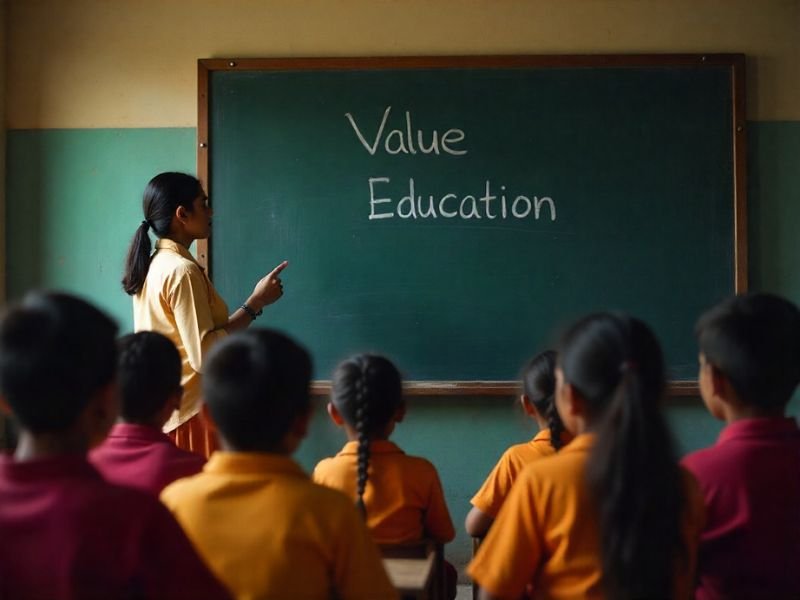
Karnataka just rewrote value education and it could change Indian classrooms
– Mansoor Ali Khan, General Secretary of the Management of the Independent CBSE Schools Association in Karnataka and a board member of Delhi Public Schools, Bengaluru and Mysuru
For far too long, value education in India has lived on the margins of our schooling system — a quiet period after lunch, a chapter at the end of a textbook no one finishes, or a token moral story read out once a week. Everyone agreed that values were important, but the system never treated them with the seriousness reserved for mathematics, science, or languages.
Karnataka’s newly introduced Value Education textbook for classes 1st – 10th children changes that. In doing so, it signals the beginning of a much-needed shift in how we understand education itself.
At first glance, it is easy to underestimate what a single textbook can achieve. But after browsing through the digital version, it becomes clear that this is not a supplementary reader or a collection of moral tales. It is a curriculum grounded in today’s realities – the lived experiences, pressures, joys, and anxieties of modern childhood.
And that makes it one of the most significant curriculum reforms in recent years.
What immediately stands out is its tone. This is not the moral-science book of the past, overloaded with prescriptive advice or “good behaviour” checklists. Instead, it treats children as intelligent, perceptive human beings capable of reflection. It invites them into conversations rather than dictating conclusions.
What I love most is that it does not preach, It invites, It starts conversations and encourages children to think, question, express, and understand themselves and others.
That marks a radical departure from past pedagogies and education practice. For decades, we taught values as commandments. This textbook, instead, treats them as lived experiences — to be explored, understood, and applied, not simply memorised.
Importantly, the content reflects what children actually struggle with today. Bullying, body-shaming, exclusion, insecurity, stereotypes, identity, and self-worth are not abstract themes. They are part of daily school life. Every educator encounters them. Every parent worries about them. And most children grapple with them silently, without structured opportunities to discuss or understand these feelings.
By acknowledging these realities and placing them at the centre of value education, Karnataka has validated the emotional world of children — something our education system has long overlooked.
The textbook also integrates themes like gender sensitivity, equity, emotional safety, consent, digital behaviour, respect for diversity, and empathy for people who do not fit stereotypes — including transgender identities. These are not easy topics. But they are necessary, and the book handles them with nuance and age-appropriate framing. This alone places Karnataka ahead of many global education systems that still hesitate to engage with such issues openly.
Equally transformative is the role envisioned for teachers. The textbook recognises that the success of value education lies not in the content alone but in the space created around it. Teachers are not simply expected to “teach a chapter”; they are encouraged to facilitate discussions, hold sensitive conversations, listen without judgement, and build safe, trusting environments.
This kind of pedagogy requires confidence and training. Teachers must feel equipped to handle emotional disclosures, disagreements, and questions that may not have straightforward answers. For many educators, this is new terrain. Therefore, the state’s investment must go beyond the textbook – it must include sustained teacher training, reflective practice, and continuous support.
If implemented well, these classrooms can become spaces where children learn not just to score marks, but to understand themselves better. They can become spaces where disagreements are resolved with empathy, friendships are built on respect, and young people learn to see the world from multiple perspectives.
The broader question here is: what do we expect from education?
For years, the answer has been academic excellence. But the world children are entering demands much more. They will need resilience, adaptability, collaboration, ethical judgement, empathy, and the ability to navigate complex social situations. These skills do not emerge automatically with age. They need to be nurtured intentionally.
Karnataka’s textbook reflects a recognition of this truth: education is not just about preparing children for exams; it is about preparing them for life.
Of course, challenges remain. Value education often risks being treated as an “extra” — a period that gets cancelled on busy days or rushed through when exams approach. If that happens, the transformative potential of this textbook will be lost.
Schools will need to integrate these conversations into their culture — in how teachers speak, how conflicts are handled, how student leadership is encouraged, how diversity is celebrated, and how emotional well-being is prioritised. Value education cannot exist only on paper; it must live in everyday interactions.
Parents, too, must see this as a partnership. Children practise empathy best when they see it modelled at home. No textbook can undo mixed messages children receive outside school unless families participate in the process.
Still, despite these challenges, this initiative is a milestone. It shows that a state can place emotional learning, inclusivity, and dignity at the heart of formal education. It shows that policymakers recognise childhood for what it truly is – a formative period where emotional and social experiences shape long-term well-being.
Karnataka has raised the bar and, in doing so, offered a blueprint for the rest of the country.
If India wants to raise a generation that is kinder, more resilient, more inclusive, and better prepared for the complexities of the future, then reforms like this must become the norm, not the exception.
This textbook is not just a curriculum change. It is a reminder that education must evolve — just as our children do.
Also Read: Reforming Indian Education: Cultivating Minds, Not Just Marks











Add comment